Synthetic Amethyst Identification
Natural vs. Hydrothermal Amethyst: The “Breadcrumb” Inclusions You Can’t See Naked-Eye
Synthetic Amethyst Identification usually starts with a narrow point: breadcrumb inclusions are not a naked-eye test. When they do appear, they are most often a magnified clue for hydrothermal synthetic quartz, especially if the stone also shows a seed-plate trace, very even color, or growth features that do not fit natural amethyst.
By eye alone, natural and hydrothermal material can look very close. In some clean stones, the answer stays uncertain until microscopy, polarized light, or lab work.
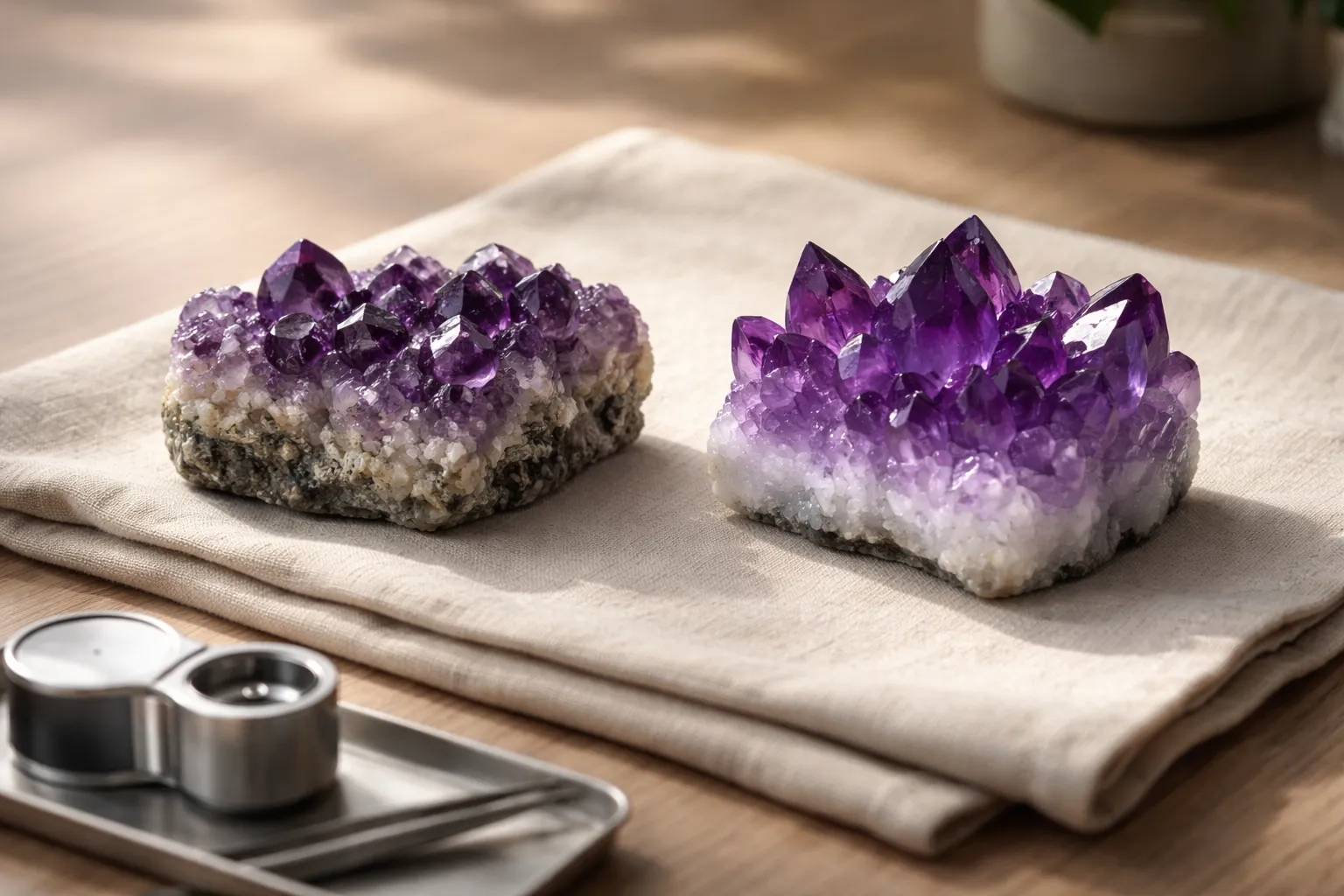
What “breadcrumb inclusions” usually mean
In gemological writing, breadcrumb inclusions are tiny granular particles that can look like crumbs suspended in quartz. They are commonly linked to hydrothermal synthetic amethyst and related synthetic quartz grown on a seed crystal. They may appear as scattered grains or as a line tied to the seed plate.
That is why the clue matters. When the pattern is there, it points more toward growth history than toward a natural geologic origin. But it is not the same as simple cloudiness or a random fracture. The shape and placement matter.
Just as important, the clue is usually too small to read without magnification. In a faceted stone, the eye may only see purple quartz. The breadcrumb pattern may be hidden until a loupe or microscope brings it into view.
Why the eye alone is usually not enough
Natural and hydrothermal synthetic amethyst are both quartz. They can share the same basic chemistry and a similar purple appearance. That is the heart of the confusion.
A stone can look clean, attractive, and ordinary while still being synthetic. The reverse is also true: a natural stone can have features that make it look unusual without being synthetic.
Under magnification or polarized light, the literature often points to a few recurring clues:
- breadcrumb inclusions in synthetic quartz
- seed-plate traces or a colorless growth core
- nail-head spicules
- more even color in many synthetic stones
- flame-like or streaky zoning in some synthetic material
- Brazil-law twinning in many natural amethysts
None of these should be treated as absolute on its own. Clean quartz can be difficult to classify, and a cut stone may hide the most useful evidence. A stone that looks “too perfect” can raise suspicion, but that is still only a clue.
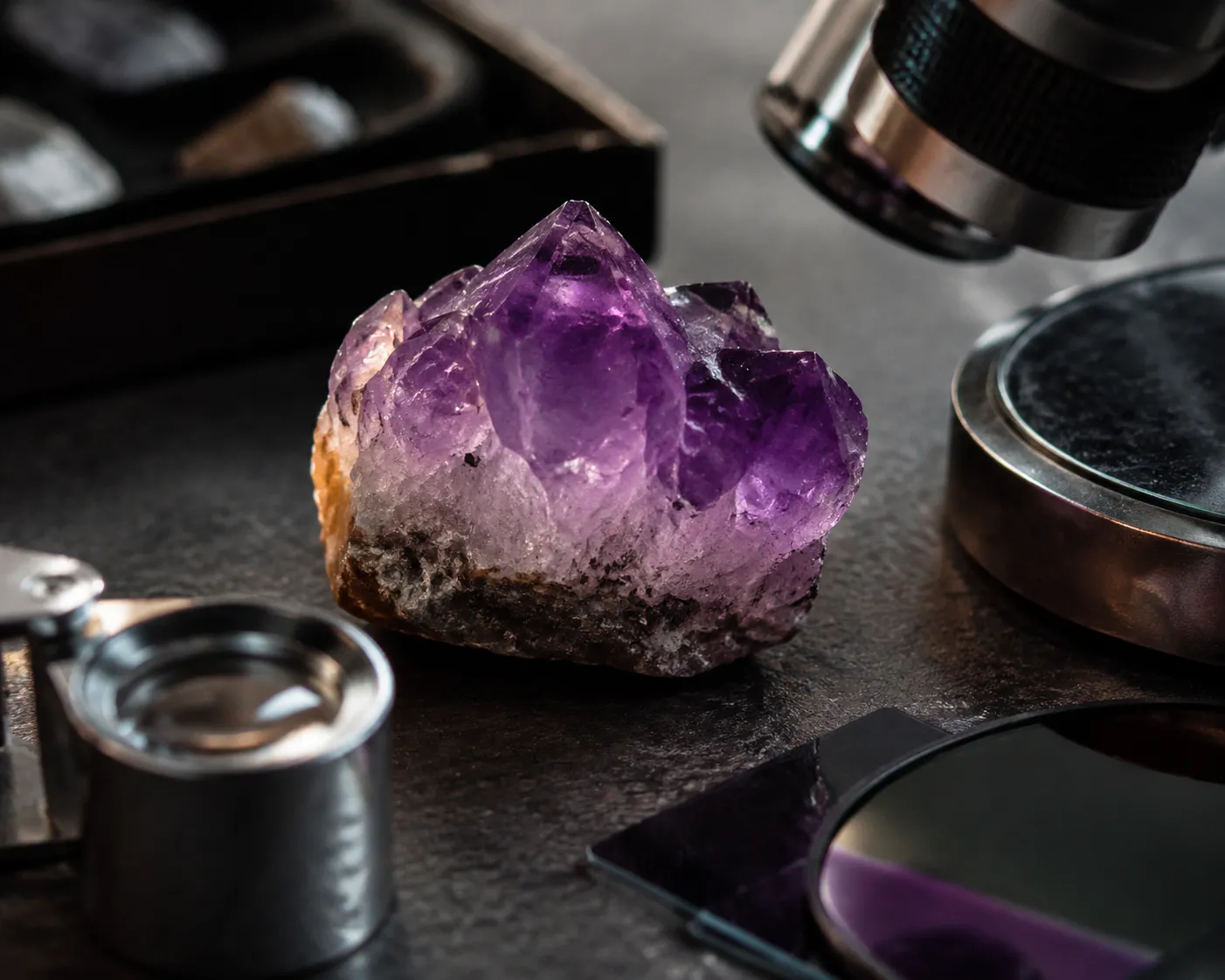
What changes the answer
The identification changes depending on which internal features are actually visible.
Inclusion pattern
Natural amethyst more often shows mineral or fluid inclusions that fit geologic growth. Synthetic quartz is more often described with breadcrumb inclusions, seed-plate remnants, and nail-head spicules.
Still, one feature by itself does not settle every case. Some similar-looking structures can appear in more than one context, and cut stones can distort what you see. Shape, placement, and the surrounding pattern matter.
Color zoning
Natural amethyst is often described as having angular or straight zoning that follows crystallographic directions. Synthetic stones more often show a more even body color, or zoning tied to the seed crystal and growth sectors.
Some synthetic stones can also show flame-like zoning or streaky bands. That pattern is a useful clue, not a final verdict.
Twinning under polarized light
Brazil-law twinning is one of the classic natural clues. Under crossed polarizers, many natural amethysts show patterned interruptions or alternating bands linked to twinning. Many synthetic stones are untwinned, which can support a synthetic reading.
Even here, caution matters. Some synthetic material is grown on twinned seed material, and some natural stones do not show an easy view. Twinning helps, but it does not solve every case by itself.
Where the limit sits
For collectors, the hardest part is that a clean faceted stone may remain uncertain. Even a gem lab may need multiple methods if the visible clues are sparse.
Common lab tools include:
- microscopy and polariscopy
- infrared spectroscopy
- LA-ICP-MS trace-element analysis
These are useful because they can separate some natural and synthetic quartz more confidently than a loupe can. They are not home checks, though. And they are not always decisive in every stone.
A few common shortcuts do not help much here. Scratch tests, temperature feel, and bubble checks are mainly aimed at glass or plastic imitations. They do not reliably separate natural amethyst from hydrothermal synthetic amethyst.
Any symbolic reading of amethyst may matter to a person, but it does not tell you whether the stone is natural or synthetic. For origin questions, the material features come first.
FAQ
Can breadcrumb inclusions be seen without magnification?
Usually not. They are generally a microscopic clue, not a naked-eye one.
Do breadcrumb inclusions prove synthetic amethyst?
They strongly point toward hydrothermal synthetic quartz in the right context, but one feature alone is not always enough.
If a stone has no breadcrumb inclusions, is it natural?
Not necessarily. Clean stones can be hard to separate, and some require polarized light or lab testing.
Is Brazil-law twinning enough on its own?
It is a useful natural clue, but not a complete answer by itself.
In short, breadcrumb inclusions are one of the better clues for hydrothermal synthetic amethyst, but they are usually visible only with magnification. By eye alone, the question often stays open. The most reliable reading comes from the full pattern: inclusions, zoning, twinning, and, when needed, laboratory analysis.