Collector decision note
Investment Grade Amethyst in 2026: Size, Provenance, and the “Unheated” Rule
A large amethyst with deep purple color, clean cutting or strong crystal habit, documented origin, and clear treatment disclosure may be a serious collectible. It is not, by that alone, a dependable investment category in 2026.
If you want to Invest in Amethyst, treat “investment grade amethyst” as a seller claim to examine, not as proof of future resale value. Size helps only after beauty and condition are already strong. Provenance helps only when it is specific and traceable. “Unheated” helps only when the disclosure is tied to the exact stone and can be reviewed independently. Without reliable market records, lab-style documentation, and comparable resale evidence, amethyst belongs in a cautious collectible-buying frame rather than a predictable asset-class frame.
broader context
Begin with the main amethyst page
This narrower page lands better after the broader amethyst context page.
What “Investment Grade” Can Mean for Amethyst
“Investment grade” sounds precise, but for amethyst it is usually a marketing phrase rather than a shared grading standard. At best, it may point toward a better-than-average specimen: larger size, attractive color, pleasing cut or crystal habit, limited distracting features, and a story that can be supported with documents.
That still does not make it a financial instrument. The safer translation is: “The seller wants me to believe this piece is exceptional enough to preserve desirability.” That is worth checking. It is not proof of gemstone appreciation, liquidity, or future demand.
Amethyst also carries two kinds of appeal. One is material: quartz, color zoning, clarity, cut, condition, origin paperwork, and treatment disclosure. The other is cultural or symbolic: purple quartz chosen for rooms, collections, meditation spaces, or personal ritual. Symbolic meaning may matter deeply to the owner, but it does not verify rarity, authenticity, or resale value.
In 2026, the better question is not “Is this investment grade?” It is: what evidence turns this amethyst from attractive purple quartz into a collectible worth paying a premium for?
Size Helps Only After Quality Is Clear
Large carat gems are persuasive because size is easy to see. A large amethyst can command attention in a ring, pendant, cabinet, or display setting; it also gives a seller one simple number to emphasize. But scale is not a quality grade.
A big stone with uneven color, weak saturation, awkward cutting, surface damage, or distracting internal features may be less desirable than a smaller stone with better balance. In collector terms, size is a multiplier only after the main quality factors are already present. It can amplify beauty; it cannot create it.
For cut stones, ask how the size works with the cut. Does the stone carry color evenly, or does it show pale windows and dark patches? Is the cutting symmetrical enough for the intended use? Is the piece practical to set, insure, store, or resell?
For crystal specimens and geodes, judge size alongside habit, color zoning, stability, and display condition. A large cluster may still have broken points, repaired areas, dull surfaces, or an unsteady base. It may be wonderful for home atmosphere; that is a different decision from treating it as a dependable asset.
The narrow rule: size strengthens the case only when the amethyst is already strong without the size number.
Provenance Needs Specifics, Not Atmosphere
Provenance is easy to overstate. A country name, mine story, or poetic origin phrase can make a stone feel more important, but useful provenance is specific, consistent, and connected to documents a buyer can review.
For amethyst size and provenance, ask what the seller can show. Does the paperwork identify the exact stone or specimen? Do invoices, prior collection records, appraisals, dated photographs, or reports match the object in front of you? Are measurements, weight, photos, and descriptions consistent across the documents?
A provenance premium should not be assumed. The available material for this page does not support a broad claim that certain origins automatically command stable premiums for amethyst in 2026. A named source may matter to a particular collector, especially when the specimen is visually strong and well documented, but that is not the same as a predictable market rule.
Seller language can make origin sound like destiny; evidence makes origin usable. If provenance cannot be separated from the sales story, it should not carry much weight in the price decision.
The “Unheated” Rule Is About Disclosure
“Unheated stones” often sound more natural, rarer, and more desirable in gemstone listings. For amethyst, the safer question is not whether the word appears; it is how treatment disclosure is handled.
A credible unheated amethyst claim should be clear, attached to the specific stone, and open to independent review. If a seller says “natural,” ask what that means: natural quartz, natural color, no dye, no heat treatment, no irradiation, or simply not synthetic. These terms are not interchangeable for a buyer.
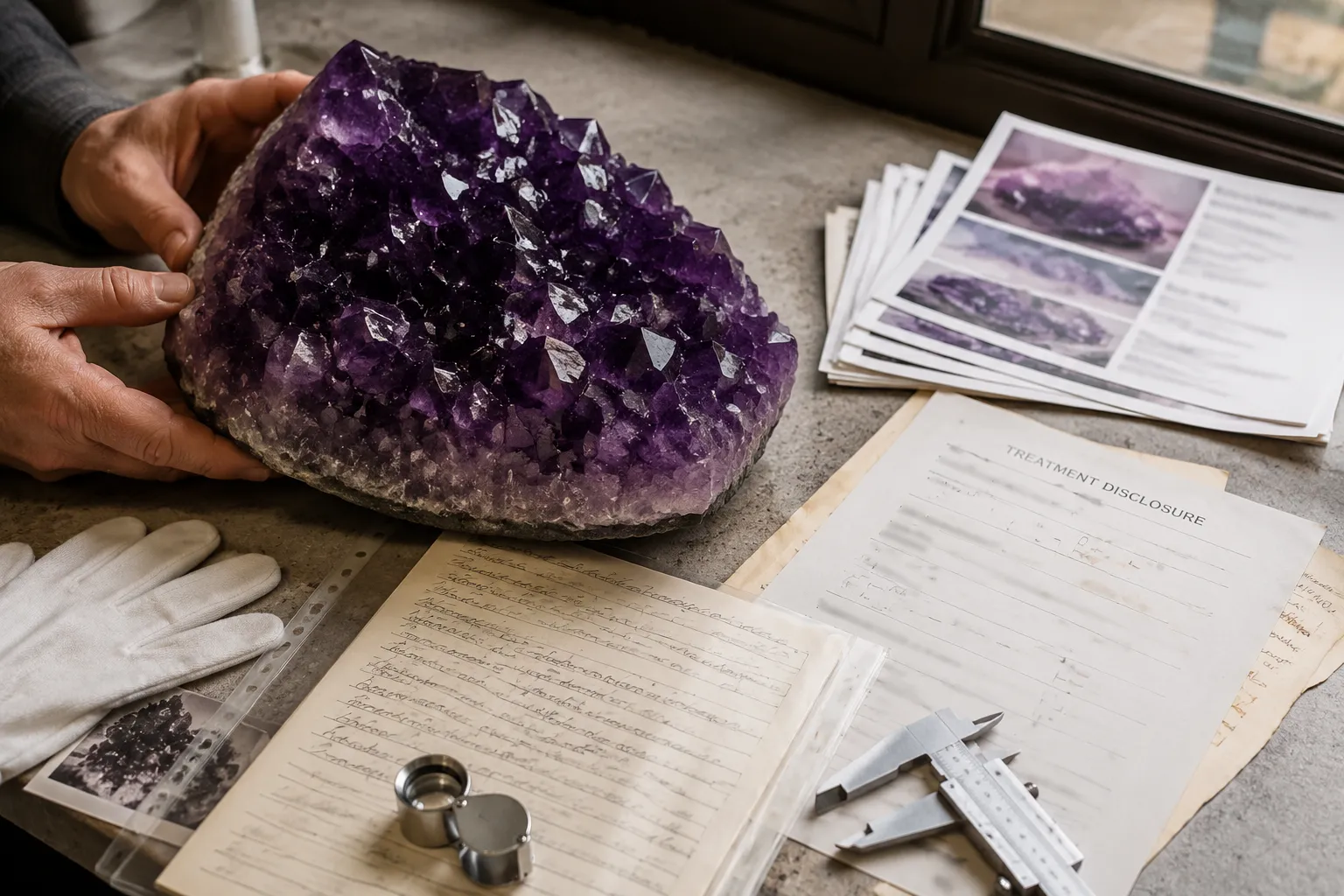
An unheated amethyst disclosure is most useful when it appears with supporting documentation from a relevant independent source, not only in sales copy. Read the document closely. Does it identify the item by weight, measurements, photos, or other matching details? Does it actually address treatment, or only identify the material as amethyst? Does it belong to this stone, or to a parcel, type, or older listing?
The word “unheated” should not be treated as a price engine by itself. The current source base does not establish that unheated amethyst carries a documented investment premium across the market. It may matter because it supports authenticity preferences and collector taste. That is a valid collecting reason; it is not evidence of future performance.
The Evidence to Request Before Paying a Premium
Before accepting the label “investment grade amethyst,” build a small evidence stack. It should be clear enough that another informed buyer could understand what is being offered.
Start with identity. The stone or specimen should be described in a way that distinguishes it from general decorative quartz: weight or dimensions, photos, cutting style or crystal habit, visible condition, and identifying features. If the purchase price is significant for you, consider independent gemological or appraisal review before buying.
Then ask for treatment disclosure. “Natural,” “rare,” “museum quality,” and “collector quality” do not answer enough. The useful statement is direct: what treatments are claimed, what remains unknown, and what source supports that position.
Then ask for provenance. Documents should connect the stone to its claimed origin or prior ownership. If the seller cannot provide them, the purchase may still be enjoyable, but provenance should not be priced as though it has been established.
Finally, compare resale reality. Ask what comparable resale evidence supports the price. A listed price shows what someone hopes to receive; it does not show what buyers have recently paid for similar amethyst. Because the current source set does not provide reliable auction or market-history material, this page cannot claim a 2026 price direction for large fine amethyst. That absence matters.
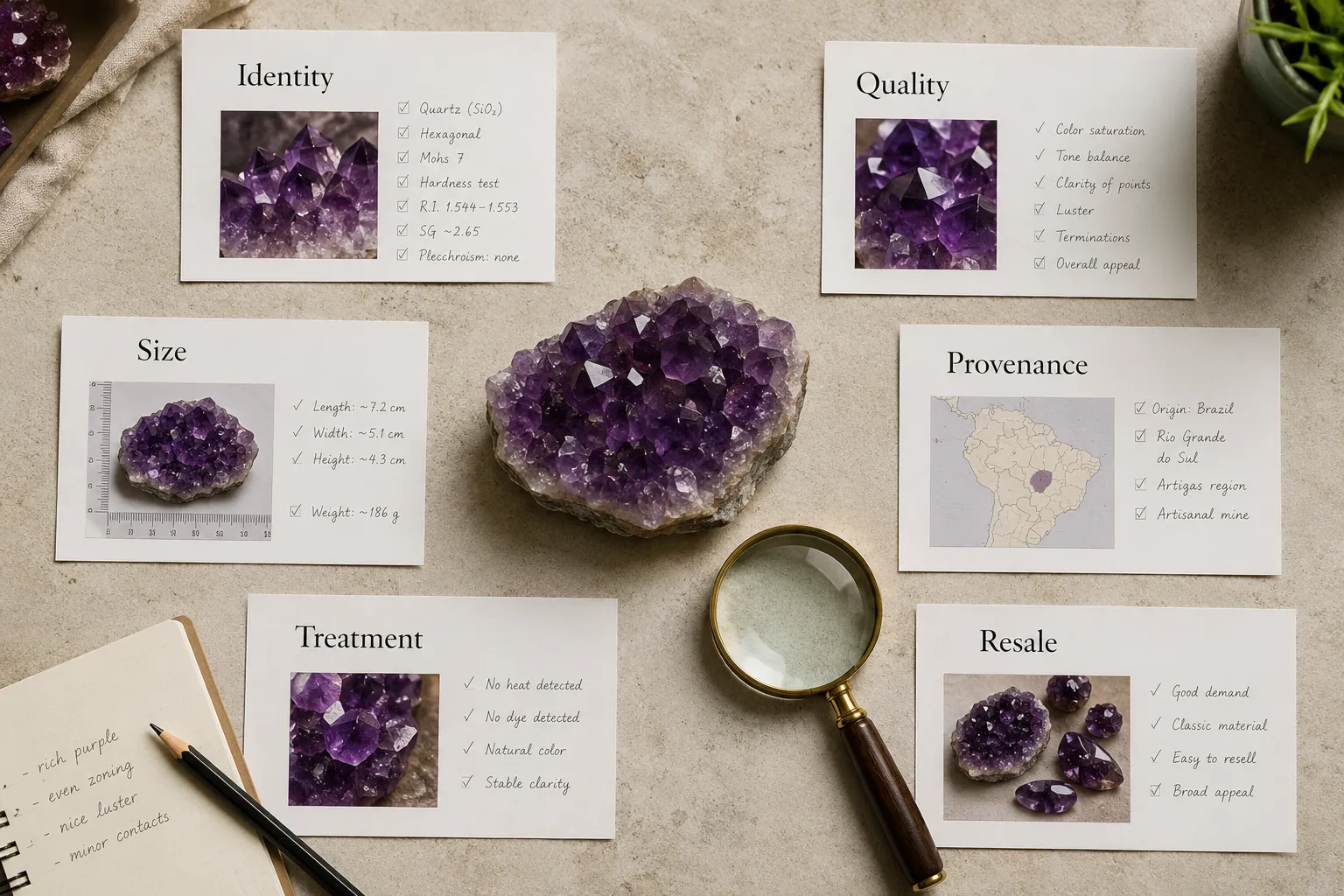
A concise amethyst decision framework
- Identity: Can the object be matched clearly to its description and documents?
- Quality: Do color, cut or habit, condition, and visual presence justify attention without the investment language?
- Size: Does the scale improve desirability, or only inflate the headline?
- Provenance: Is the origin or ownership history traceable beyond seller wording?
- Treatment: Is the unheated or untreated claim explicit and independently reviewable?
- Resale: Is there comparable sale evidence, or only optimism?
If one of these points is missing, the answer may still be “buy it because you love it.” It should not be “buy it because the label settles the investment question.”
Common Misunderstandings
Gemstone does not mean asset class
One confusion is treating amethyst as a dependable asset because other gemstones sometimes appear in investment discussions. That comparison is too broad. “Gemstone” is not one market, and “asset class” requires stronger evidence than a beautiful object and a confident listing.
Bigger does not always mean better
Another confusion is assuming that bigger always means better. Large amethyst can be dramatic, but decorative scale and collector quality are not identical. A room-filling geode, a large faceted stone, and a fine mineral specimen appeal to different buyers and may have different resale paths.
Symbolism is not market evidence
A third confusion is reading spiritual symbolism as market evidence. Amethyst is often associated with calm, contemplation, and atmosphere. Those associations may shape how someone chooses a crystal for a shelf, bedside table, or meditation corner. They do not prove authenticity, rarity, treatment status, or resale value.
“Unheated” is not enough alone
The last confusion is expecting “unheated” to do too much. Treatment disclosure can be important, especially when a buyer prefers less-altered material. But disclosure is part of the evidence stack, not a substitute for beauty, condition, provenance, and market comparables.
When to Pause or Walk Away
Pause when the price depends heavily on unsupported words: “investment grade,” “rare origin,” “unheated,” “collection worthy,” or “future appreciation.” These phrases may describe a seller’s opinion, but they do not replace verification.
Slow down when the seller resists basic questions about identity, treatment, provenance, condition, return terms, or document matching. A serious collectible purchase should tolerate careful scrutiny. Pressure and vagueness are poor companions for an expensive amethyst decision.
Reframe the purchase when the stone is beautiful but the evidence is thin. There is nothing wrong with buying amethyst for visual pleasure, room atmosphere, spiritual symbolism, or personal attachment. The problem begins when a pleasurable purchase is dressed as financial certainty.
For many buyers, the most honest category is not “investment grade.” It is “collectible if the evidence holds, decorative if it does not, personally meaningful if the owner chooses it for that reason.”
Should You Treat Amethyst as Investment Grade in 2026?
Treat it as potentially collectible, not automatically investment grade. A large, documented, untreated amethyst may deserve closer attention when size, beauty, provenance, condition, and treatment disclosure all line up. But the current evidence base for this page does not support claims that amethyst in 2026 offers predictable appreciation, easy resale, established provenance premiums, or dependable asset behavior.
The strongest buyer position is disciplined: ask for identification, treatment disclosure, provenance documents, condition details, and comparable resale evidence before paying a premium. If those pieces are missing, enjoy the crystal as amethyst first; a purple quartz specimen can still be lovely on a table, meaningful in a quiet room, and worth owning for aesthetic reasons without being asked to behave like a financial plan.