2026 Portfolio Discipline
Amethyst in Your 2026 Portfolio: The “Liquidity Layer” Strategy
Amethyst can belong in a 2026 Gemstone Investment Portfolio only in a narrow, collectible, liquidity-aware role. The “liquidity layer” strategy should not mean treating amethyst like cash, a public security, or a reliable inflation hedge. It means something more practical: if you choose to own amethyst, favor pieces that are easier to identify, document, store, insure, explain, and potentially resell.
That answer is conditional. Amethyst may suit a collector who already values the material, accepts resale uncertainty, and keeps the position modest. It is a weak fit for anyone looking for predictable returns, fast exits, or evidence-backed protection against inflation.
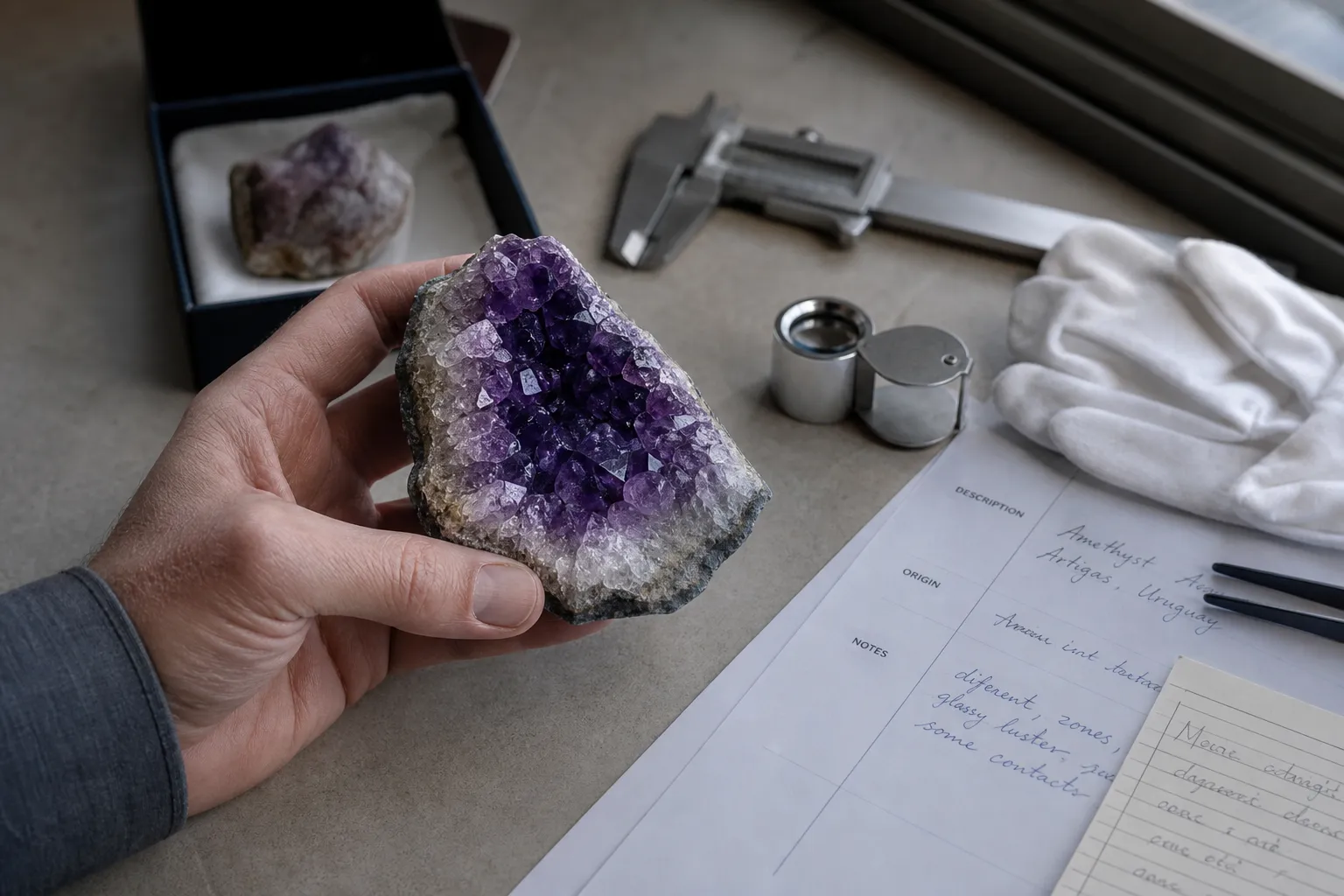
broader context
Begin with the main amethyst page
This narrower page lands better after the broader amethyst context page.
What “Liquidity Layer” Means for Amethyst
In ordinary financial language, liquidity means an asset can be converted into cash quickly and with limited discount. Amethyst needs a softer definition. A crystal, specimen, carving, or faceted stone does not trade like a regulated financial asset. There is no simple daily price, no universal buyer base, and no standard exit route.
For this article, a liquidity layer means reducing avoidable resale friction.
That may include:
- Clear identification instead of vague seller language.
- Documentation that helps a later buyer understand the piece.
- A form, size, and quality level that can be described without relying only on decoration or mood.
- Storage and condition care that preserve appearance.
- Realistic expectations about selling costs, delays, and discounts.
This is not a verified investment method. The available source pool does not support claims that amethyst is reliably liquid, undervalued, or positioned for a 2026 price move. The framework is useful only as a buying discipline: if you are going to own amethyst anyway, buy as someone who may someday need to explain and exit the object.
Where Amethyst Fits in Asset Allocation
The safest way to discuss amethyst asset allocation is not through percentages. There is no evidence base here that supports a recommended allocation range for gemstones, amethyst, or collectible minerals. A fixed number would create false precision.
A better approach is to define the role before the amount.
If included at all, amethyst belongs on the collectible hard-asset side of a personal collection. That does not make it equivalent to bullion, real estate, cash, bonds, or listed funds. It means it is a tangible object whose value depends on a future buyer recognizing desirability, authenticity, condition, and price reasonableness.
For a collector-minded owner, the amethyst portfolio role may be:
- A small tangible holding connected to mineral appreciation and aesthetics.
- A learning object that builds gem and specimen literacy.
- A collectible with possible resale routes if documentation and condition are strong.
- A non-core position that does not carry essential financial goals.
That last point matters. If a future sale would need to fund an urgent obligation, amethyst is probably the wrong tool. Gemstone resale liquidity can be uneven, slow, and dependent on buyer confidence. A liquidity-aware owner plans around that friction instead of pretending it disappears.
Verification Comes Before the Resale Story
The first resale question is not “What is it worth?” It is “Can a future buyer understand what this is?”
Amethyst resale verification matters because a buyer may need confidence in identity, treatment disclosure where relevant, condition, dimensions, origin claims, and the difference between natural crystal forms, cut stones, decorative objects, and altered or assembled pieces. Without clear documentation, the owner may face a narrower buyer pool or stronger price resistance.
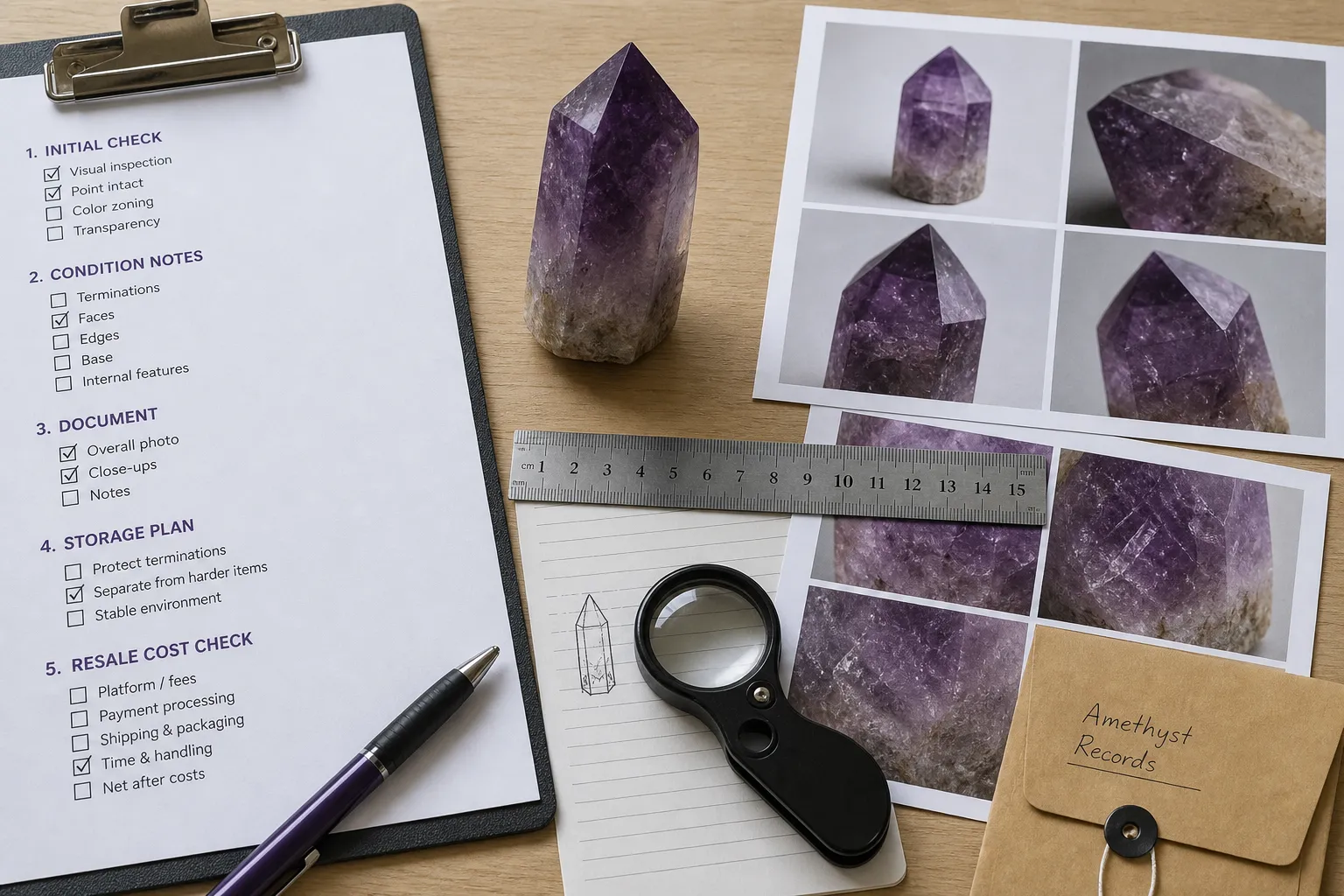
For higher-stakes purchases, a pretty listing description is not enough. Written identification, photographs, measurements, invoices, condition notes, and, where proportionate, independent gemological review can make the object easier to evaluate later.
Question 1
Do you personally want to own it?
Question 2
Could someone else later evaluate it without relying entirely on your opinion?
The second question is what separates a sentimental object from a more resale-conscious collectible. It does not make a profitable sale likely. It simply makes the piece easier to discuss, compare, and present.
The Costs That Quietly Reduce Liquidity
A common mistake is to compare a retail purchase price with an imagined future sale price and call the difference profit or loss. For collectibles, that is too simple.
Gemstone transaction costs can appear in several places: appraisal, photography, platform fees, shipping, insurance, packaging, payment risk, dealer margin, and the time required to find a buyer. Even when some costs are small, they still affect the real exit price. A piece that looks attractive at a display price may look different after resale costs and negotiation.
There is also a gap between asking prices and completed sales. Marketplace asking prices can show how sellers talk about amethyst, but they do not prove what buyers actually pay. Luxury retail pricing can show presentation and positioning, but it should not be treated as a neutral resale benchmark. Individual auction results may be interesting, but one sale does not establish a general market rule.
Careful language matters:
- “Resale possible” is not the same as “easy to sell.”
- “Collectible” is not the same as “investment grade.”
- “Rare-looking” is not the same as independently supported rarity.
The Ruby Comparison Can Mislead
Ruby vs amethyst comparisons often appear because ruby is widely associated with higher-value gem conversations, while amethyst is more accessible to many collectors. The contrast can be useful, but only if it does not become a performance claim.
This article has no evidence showing that amethyst is superior or inferior to ruby as an investment for 2026. It also has no evidence supporting claims about relative liquidity, appreciation, buyer depth, or market resilience. Any confident ranking would go beyond the material available.
The better use of the comparison is structural. Ruby and amethyst remind readers that gemstone categories differ in price expectations, buyer behavior, verification needs, and resale routes. But a category comparison does not replace documentation for the specific object in front of you.
For amethyst, the useful question is not “Can it behave like a more expensive gemstone?” It is “Can this particular amethyst be owned with clear eyes about verification, costs, and exit limits?”
Inflation Hedge Language Needs Restraint
Hard assets are often discussed as inflation hedges. That language can be tempting when prices feel unstable and tangible objects seem reassuring. With amethyst, it needs restraint.
The available material does not support a claim that amethyst has reliable inflation-hedge behavior. It does not show that amethyst prices move in a protective pattern during inflationary periods. It also does not support a forecast that 2026 will make amethyst more attractive as a defensive asset.
A more accurate framing is this: amethyst is tangible, but tangibility alone does not create financial protection. A physical object can still be hard to sell, expensive to authenticate, vulnerable to condition issues, or dependent on taste-driven demand. Ownership may feel reassuring because the object is visible and durable. That feeling should not be confused with measured portfolio protection.
If inflation protection is a serious financial goal, amethyst should not be treated as the main answer. At most, it can be considered a collectible holding whose financial behavior is uncertain.
A Practical 2026 Screening Checklist
If you are considering amethyst as a limited liquidity layer, screen the piece before excitement makes the decision for you.
Ask before buying:
- Can the piece be clearly identified and described?
- Is the seller’s language specific enough to evaluate later?
- Are dimensions, weight, photographs, condition notes, and purchase records available?
- Would independent appraisal or gemological review be proportionate to the price?
- Is the object easy to store without damage, fading concerns, or display wear?
- Are you comfortable if resale takes time or requires a discount?
- Would you still value the piece if it never becomes financially profitable?
The last question is the most revealing. Amethyst is strongest when the owner appreciates it as amethyst: a mineral object, a decorative presence, a collector’s study piece, or a symbolic material. It becomes risky when the owner needs it to behave like a liquid financial instrument.
A liquidity layer strategy should begin with restraint. Buy less than enthusiasm allows. Favor clarity over sales drama. Keep records. Avoid unsupported market narratives. Do not let 2026 language turn a collectible decision into a forecast.
When Amethyst Does Not Belong in the Portfolio
Amethyst is a poor fit when the buyer needs:
- Predictable return behavior.
- Quick conversion to cash.
- Evidence-backed inflation protection.
- A standardized market price.
- A professionally supported allocation rule.
- A simple comparison proving it is better than another gemstone.
It is also a poor fit if the purchase depends on vague claims: “investment grade” without explanation, “rare” without support, “museum quality” without context, or “easy resale” without a realistic route. Those phrases may be common in market language, but they should not carry the decision.
The amethyst investment limitations are not a reason to dismiss the stone. They are a reason to own it honestly. A collector can still choose a beautiful, well-documented amethyst piece while refusing to exaggerate its financial role.
The Bottom Line
The 2026 liquidity layer strategy is best understood as a cautious ownership filter, not an investment promise. Amethyst can sit at the edge of a gemstone portfolio when the buyer values the object, keeps the position limited, documents it carefully, and accepts that resale may be slower, costlier, and less predictable than the word “liquidity” suggests.
The strongest version of the strategy is not “amethyst will protect my portfolio.” It is: if I include amethyst, I will choose pieces that are easier to verify, easier to explain, and less dependent on hype.
That is a narrow role, but a useful one. For amethyst-focused readers, it keeps the stone in its proper place: meaningful, collectible, and potentially resalable under the right conditions, but not established as a liquid asset, inflation hedge, or assured investment vehicle.