Prasiolite clarity note
The Science of Prasiolite: Is Green Amethyst a Real Stone or a Lab Creation?
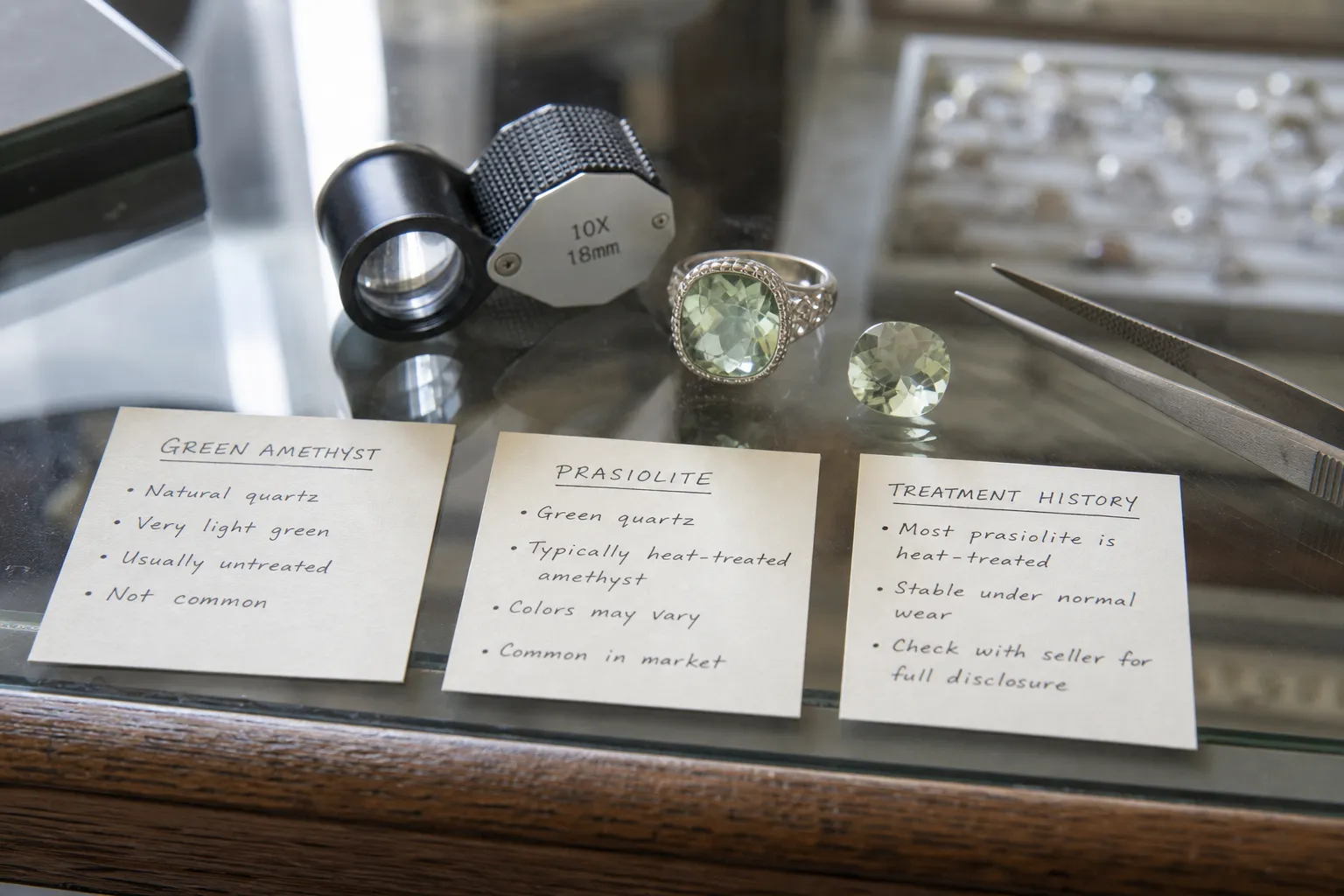
“Green amethyst” can be authentic in the everyday sense if the stone is genuine green quartz, usually discussed under the more precise name prasiolite. But the label is not complete evidence. It does not prove that the color is natural, untreated, rare, or lab-grown.
For the search question “Green amethyst authentic,” the best short answer is this: the stone may be real quartz, but the name, color origin, and treatment history are separate questions.
That matters because “real” can mean more than one thing. A stone can be real quartz and still have a color changed by treatment. A jewelry label can be familiar to shoppers and still be imprecise as mineral wording. A seller may use “green amethyst” because the phrase is recognizable, while a gem-focused description may use prasiolite or green quartz.
broader context
Amethyst context note
This narrower page lands better after the broader amethyst context page.
The Short Answer
If a ring, pendant, bead strand, or loose stone is labeled “green amethyst,” treat the label as a starting point, not a full identification.
A careful reading looks like this:
- The material may be genuine green quartz.
- The more specific name to look for is prasiolite.
- The color may be natural, treatment-related, or not documented.
- “Green amethyst” does not prove untreated origin.
- “Lab-created” is a separate claim and should be stated clearly if it applies.
So the authenticity question has two layers. First, is the material actually quartz rather than glass, imitation, or another green stone? Second, if it is green quartz, how did it become green, and has that history been disclosed?
In plain terms: green amethyst is not automatically fake, but it is not automatically a naturally green amethyst crystal either.
Prasiolite, Green Quartz, and the Naming Problem
Prasiolite is the key term behind most serious discussions of green amethyst. In simple buyer language, prasiolite refers to green quartz. Quartz is the broad mineral family that includes amethyst, citrine, smoky quartz, and rock crystal. Those names usually point to color and appearance within the same mineral family, not to completely unrelated base materials.
The naming issue is that amethyst is traditionally purple quartz. “Green amethyst” borrows the familiarity of amethyst while pointing to a green material that is usually better described as prasiolite or green quartz.
That does not make every use of the phrase dishonest. Jewelry language often keeps names that shoppers recognize. Still, the phrase should not be treated as a precise mineral description on its own. A listing that also says “prasiolite,” “green quartz,” or gives a treatment note is more informative than “green amethyst” alone.
Green amethyst
May suggest a market-facing name for a green quartz-like gem.
Does not prove natural color, untreated origin, or strict mineral wording.
Prasiolite
May suggest a more specific name associated with green quartz.
Does not prove that this specific stone is untreated.
Heat-treated green quartz
May suggest a treatment route has been disclosed.
Does not prove that the material is fake or without value.
Lab-grown green quartz
May suggest synthetic origin is being claimed.
Does not prove that it is natural prasiolite.
The label begins the identification. It does not finish it.
Natural Versus Treated Prasiolite
The most common misunderstanding is that “natural” and “real” mean the same thing. They do not.
A stone may be natural in material origin but treated after mining. It may be real quartz but have a color changed or stabilized through a process. It may also be synthetic, imitation, or misidentified, depending on the actual item. Without a credible report, clear disclosure, or detailed seller documentation, the full history cannot be inferred from color alone.
Heat treatment often appears in this discussion because quartz color can be affected by internal color centers. In plain language, color centers are tiny structural or electronic features in a crystal that influence how light is absorbed and what color the eye sees. Some quartz color discussions also refer to metastable color centers, meaning color-related states that may exist under certain conditions but are not necessarily permanent in every environment.
That science explains why color history matters, but it is not a home identification method. A buyer cannot look at a pale green stone under room light and reliably know its geological and treatment history. Color, clarity, cut, and setting are not enough.
The better question is: what does the documentation say? If a listing says “heat treated,” that is a treatment disclosure, not a confession that the stone is fake. If it says only “natural green amethyst” with no explanation, the claim is less useful. If it avoids the words prasiolite, green quartz, treatment, synthetic, or origin entirely, important information is missing.
What Makes the Label More Trustworthy?
For a specific stone, the goal is not to become a gem laboratory. It is to separate useful identification from attractive wording.
A stronger description usually answers questions like these:
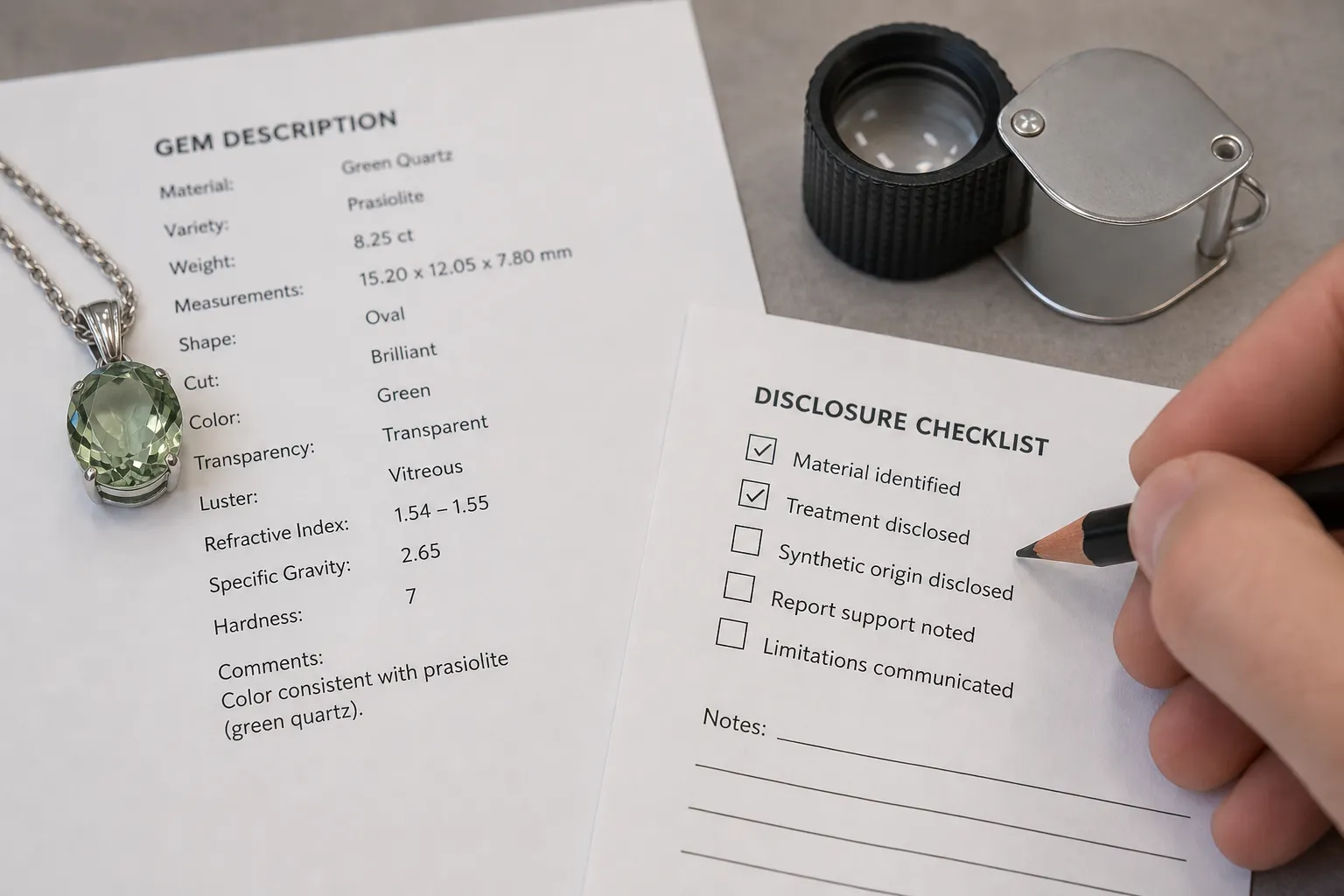
- What is the material identified as: quartz, prasiolite, green quartz, or something else?
- Is the stone natural, treated, synthetic, assembled, or unspecified?
- If treatment is known, is heat treatment or another color-related process disclosed?
- Is there a gemological report for higher-value material?
- Does the seller distinguish the trade name from the mineral name?
- Are rarity, origin, and color claims specific rather than dramatic?
A weaker description leans on mood and color without identification. Phrases such as “rare green amethyst,” “natural green crystal,” or symbolic language around the stone may describe how the piece is being presented, but they do not settle the material question.
This distinction also leaves room for personal taste. Someone may simply like the soft green color, the look of quartz jewelry, or the symbolism attached to a stone. Those preferences can be real preferences without becoming evidence of untreated origin or geological rarity.
What “Lab Creation” Can and Cannot Mean
The title question asks whether green amethyst is a real stone or a lab creation. That framing is understandable, but the answer is not a clean either-or.
“Lab-created” usually points to a synthetic material grown in controlled conditions. “Treated” means a material has been altered after extraction. “Imitation” means a material resembles the named gem but is not that gem. These are different categories.
A heat-treated quartz, if that is what the item is, is not the same as glass pretending to be quartz. A lab-grown quartz, if that is what the item is, is not the same as a natural stone with a treatment history. A vague “green amethyst” label does not tell you which category applies.
So the most useful answer avoids a dramatic verdict. Green amethyst is not automatically fake. Prasiolite is the relevant green quartz term. But the market name alone cannot prove whether the color is naturally occurring, treatment-related, or synthetic. If the price or appeal depends on rarity or origin, the documentation has to carry that claim.
What a Buyer Can and Cannot Infer
A few limits are worth keeping clear.
Color is not proof. Pale leek-green, mint-green, olive-green, or yellow-green appearances can be attractive, but appearance alone does not provide a reliable origin story.
The word “amethyst” does not prove purple-amethyst ancestry in a way a buyer can verify from a label. It may be used because “green amethyst” is a familiar marketplace phrase, not because the listing is giving a full mineralogical explanation.
Treatment is not automatically a problem. Many gem materials are sold with disclosed treatments. The issue is not that treatment may exist; the issue is when treatment history is hidden behind a natural-sounding name.
This page also is not an appraisal method. It can help you ask sharper questions, but it cannot identify an individual stone from a photo, receipt, or color description. If value matters, look for a qualified gemological report or a seller who provides clear, specific documentation.
A Simple Way to Read the Label
When you see “green amethyst,” translate it into a better set of questions:
- Do they mean prasiolite or green quartz?
- Is the stone natural, treated, synthetic, or not specified?
- Is treatment disclosure included?
- Is the wording scientific, commercial, symbolic, or mixed?
- Does the price depend on a claim that is actually documented?
That keeps the answer balanced. Green amethyst can be authentic in the sense that the item may be genuine green quartz. The better name to understand is prasiolite. But “green amethyst” is a market-facing phrase that can blur important distinctions.
The calmest conclusion is the most useful one: prasiolite is the serious term to investigate, “green amethyst” is not enough by itself, and authenticity depends on what the specific stone is and what has been disclosed about it.