Quantum materials context
Beyond Jewelry: How Amethyst Color Centers Are Shaping the Future of Quantum Internet
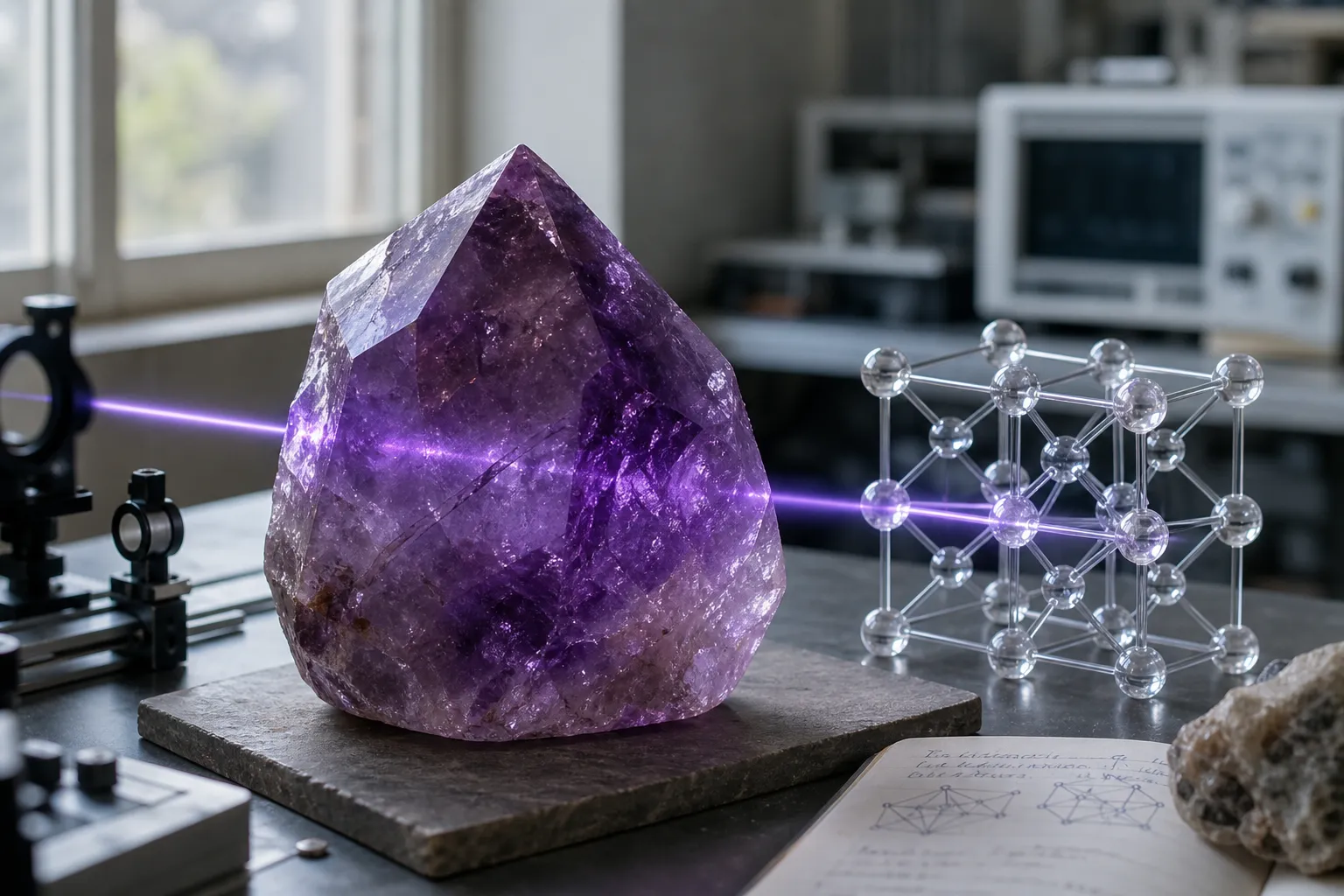
Amethyst is a useful doorway into Quantum color center qubits, but not because a jewelry-grade crystal is ready for quantum internet hardware. The useful connection is simpler: amethyst makes it easy to picture how color, crystal structure, and internal defects can be related. In quantum materials research, some carefully studied defects in solid materials are interesting because they can interact with light and quantum states in measurable ways.
That is the boundary for this page. Amethyst can help explain the idea. It does not, by itself, show that a quartz point, pendant, or collector specimen can act as a qubit or a network component.
broader context
Amethyst context note
This narrower page lands better after the broader amethyst context page.
What Amethyst Helps Explain
Amethyst gives readers a concrete image for an otherwise abstract topic. Its purple color invites a natural question: what inside the mineral makes it look that way?
That question is close to the basic idea behind a color center. In broad terms, a color center is tied to an imperfection or altered state in a crystal that affects how the material interacts with light. This does not mean every colored crystal has quantum-network value. It means the visible color of a mineral can introduce the larger idea that crystal defects matter.
That is where the amethyst comparison is helpful. It moves the conversation from “a crystal looks beautiful” to “a crystal’s internal structure can change its optical behavior.” For an amethyst-focused reader, that is a good first step.
The careful next step
A qubit is not just a colored spot, a natural inclusion, or a visually interesting defect. A possible qubit system has to be prepared, measured, and controlled under specific conditions. Its value comes from demonstrated quantum behavior, not from appearance, rarity, locality, or gemstone quality.
Where the Quantum Research Actually Begins
The serious research question is not whether amethyst jewelry becomes part of the internet. It is whether certain defects in solid materials can be engineered and controlled well enough to support quantum information tasks.
That question belongs to the broader field of solid-state qubits. In these systems, researchers study quantum behavior inside a material rather than only in isolated atoms or purely optical setups. Some color-center systems are interesting because a defect in a crystal may have optical or spin-related behavior that can be addressed with instruments.
For quantum internet concepts, the challenge is not only making a qubit. A network would need ways to create, preserve, transmit, or link quantum states across distance. That is why technical discussions may mention spin coherence, optical transitions, photon interaction, telecom compatibility, and device integration.
Those terms are not decorative. They point to practical questions: Can the state last long enough to be useful? Can it be read or controlled reliably? Can it interact with light in a way that fits a communication system? Can the material be made consistently?
This is where quartz and amethyst framing can become misleading if it moves too fast. Quartz is a real mineral family, and amethyst is a purple variety of quartz. But a research-grade material platform is not interchangeable with a natural specimen. A controlled defect system is not the same thing as an attractive crystal on a shelf.
What Would Need to Be Shown
A credible claim about quartz or amethyst in quantum internet materials would need more than the phrase “color center.” It would need specific evidence about a specific defect system.
Definition
The source would need to identify the material, the defect structure, the preparation method, and the measured behavior. “Amethyst color centers” is too broad if it does not say what center is being discussed.
Controlled quantum behavior
If a claim mentions spin coherence, it should make clear what remains coherent, for how long, under what conditions, and how it was measured. General language about energy, vibration, or crystal frequency does not answer that question.
Repeatable defect engineering
High-energy ion beams and related methods can change materials, but the key issue is whether the resulting defect can be reproduced, identified, and used as a qubit candidate. Altering a crystal is not the same as creating a useful quantum system.
A communication link
If a claim moves from “qubit” to “quantum internet,” it should explain how the system connects to light, readout, wavelength needs, stability, or integration with network components. Without that bridge, “quantum internet” may be more of a futuristic label than a supported conclusion.
A path beyond a single sample
A defect can be scientifically interesting without being close to practical deployment. Scaling would raise questions about fabrication, consistency, temperature conditions, optical coupling, and device architecture.
None of these questions can be settled by ordinary gemstone descriptions. A jewelry-grade amethyst can be meaningful as a mineral specimen or collector object, but that is a different category from a validated solid-state qubit material.
The Common Misunderstanding
The confusion comes from overlapping words.
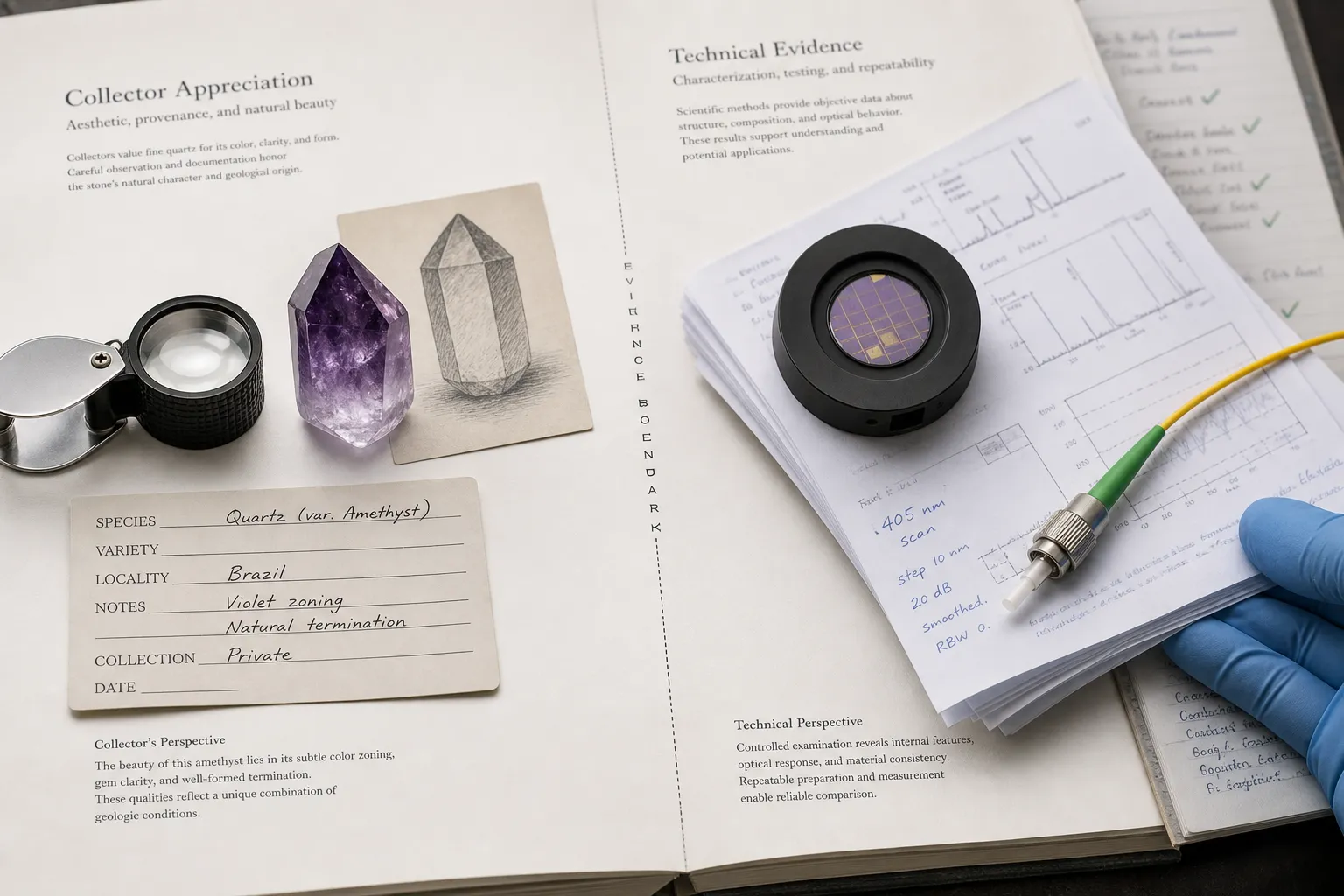
A gem reader hears “amethyst color centers” and thinks of the purple color that gives the stone its appeal. A quantum technology reader hears “color center qubits” and thinks of defects in solids being studied for quantum information. The ideas touch at the level of crystal imperfections and light, but they do not automatically describe the same object or evidence standard.
A colored stone is judged by visible qualities: hue, saturation, zoning, clarity, cut, and overall presence. A possible qubit system is judged by measured behavior. One can be appreciated by eye and experience. The other needs controlled preparation, instruments, and technical publication.
The word “natural” can also pull readers in the wrong direction. In gemstone culture, natural origin often adds interest. In quantum materials work, natural variation may be a problem because a device candidate usually needs control and repeatability. A naturally grown amethyst may be fascinating as a mineral while still being unsuitable as a predictable research platform.
The title of this page should be read in that careful sense. Amethyst can shape how readers understand the topic. It should not be read as a claim that purple quartz is already part of deployed quantum internet infrastructure.
How to Read “Quartz Qubits” Claims
A careful reader can separate quartz quantum framing into four layers.
Educational layer
This layer is reasonable when it says crystals can contain defects, and some defects in some materials are studied for quantum information. In that limited sense, amethyst is a helpful image.
Materials layer
This layer needs more precision. If a source claims quartz color centers are useful qubits, it should identify the defect, sample preparation, and measurement evidence. It should distinguish between quartz as a mineral category, amethyst as a colored variety, and the specific engineered system being studied.
Network layer
This layer needs an actual communication bridge. A claim about quantum internet relevance should address optical readout, photon interaction, wavelength considerations, stability, or integration. Otherwise, the network language is incomplete.
Readiness layer
This layer is the final check. “Studied,” “possible,” “candidate,” and “ready for use” do not mean the same thing. A material can be important to research without being ready for practical systems.
This layered reading keeps both sides honest. It lets amethyst remain a memorable entry point without turning gemstone language into device evidence.
Evidence Limit for This Page
The source set available for this page does not include public, citable technical references. That limits what can be said responsibly here.
This article can explain the conceptual relationship: amethyst helps readers picture color, defects, and crystal structure; quantum color center qubits belong to a technical research context; and jewelry-grade amethyst should not be presented as validated quantum internet hardware.
What this page cannot do is make detailed claims about specific quartz defect centers, amethyst-based qubits, spin coherence values, high-energy ion beam results, telecom compatibility, scalability, or quantum internet readiness.
A stronger technical version would need peer-reviewed materials research, university or national-lab explainers, quantum networking reviews, and sources on defect engineering. Until those sources are available, the answer stays deliberately narrow.
Bottom Line
Amethyst is a beautiful way to begin the conversation, not evidence that completes it. Its color helps readers visualize how crystal imperfections can matter, and that makes it a useful bridge toward color-center qubit ideas.
The careful answer is this: amethyst color centers are shaping the quantum internet conversation only as an accessible framing unless specific, citable research shows a particular quartz or amethyst defect system being used in that technical context. Quantum color center qubits are a real research topic, but ordinary amethyst remains a mineral and collector stone unless evidence places it inside a validated quantum networking material system.