Collector identification note
Is It Lepidocrocite or Hematite? Solving the Amethyst Debate
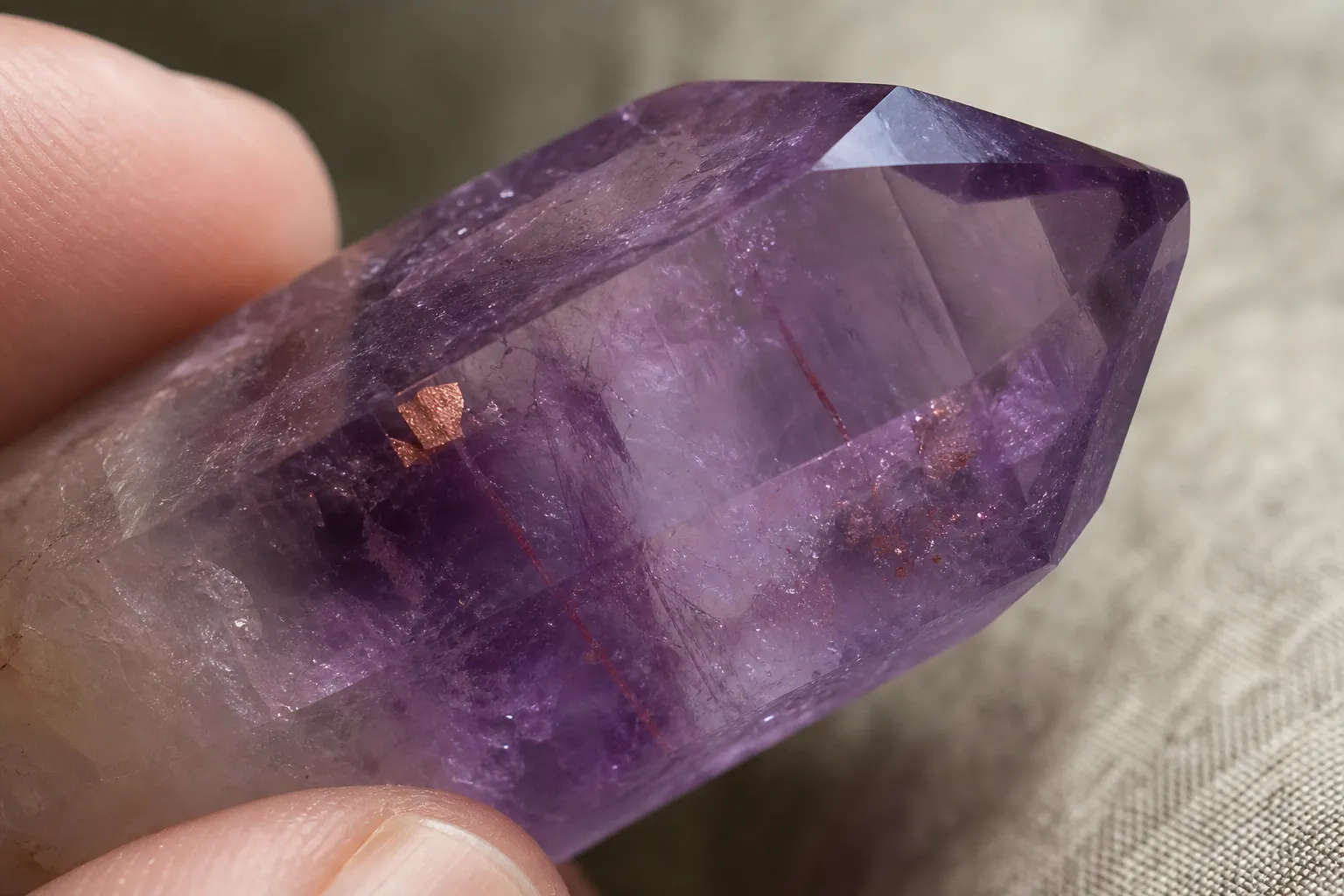
A red glint inside amethyst can look persuasive: a coppery plate, a scarlet thread, a phantom-like veil, or tiny sparks held in purple quartz. The careful answer is simpler than the marketplace often makes it. In the Lepidocrocite vs Hematite debate, red inclusions in amethyst can be described as possible iron-bearing material, but appearance alone usually cannot prove whether the phase is hematite, lepidocrocite, or another related material.
The first distinction matters: amethyst is the quartz host; the red material is the inclusion, coating, growth feature, or associated phase being questioned. Quartz can preserve inclusions as it grows, so red material inside an amethyst crystal is plausible. Naming the exact mineral species is a separate identification problem. If the label affects a sale, collection record, or scientific note, visual inspection should give way to mineralogical testing.
broader context
Begin with the main amethyst page
This narrower page lands better after the broader amethyst context page.
The Short Answer for Collectors
If your specimen has red inclusions in amethyst, it is not careful to call them definitely lepidocrocite or definitely hematite from photos, seller wording, or color alone. A better label is usually “red iron-bearing inclusions,” “possible hematite,” “possible lepidocrocite,” or “hematite-or-lepidocrocite included amethyst,” unless an analytical result supports a firmer name.
That may feel unsatisfying, especially because listings often sound certain. Sellers and collectors may describe red needles in amethyst, platy red inclusions, coppery flecks, reddish clouds, or phantom layers. Those words are useful for describing what the eye sees. They are not the same as mineral identification.
Hematite and lepidocrocite are distinct iron-bearing mineral phases, not two decorative names for one red color. Small inclusions may be tiny, partly hidden, intergrown, altered, or visually similar through a quartz host. In a hand specimen, red color may point toward iron-related material; it does not reliably name the phase.
For everyday appreciation, a cautious descriptive label may be enough. For collector literacy, separate beauty from proof: “This amethyst has red, plate-like inclusions” is safer than “This is lepidocrocite in amethyst” unless the identification has been tested.
What Visual Clues Can Suggest
Visual clues still matter. They help you describe the specimen, compare it with other pieces, and judge whether a seller’s wording is careful or inflated. They may also help a gemologist or mineralogist decide where to look. Their limit is that they suggest; they do not settle the identity.
Thin red needles or acicular forms
They can help describe shape, orientation, and distribution inside the quartz.
They cannot prove the inclusion is lepidocrocite rather than hematite.
Platy red inclusions
They can help describe a flat or plate-like habit visible through the host.
They cannot prove the plate is a specific iron phase.
Coppery, fiery, or deep red areas
They can help describe color and luster under lighting.
They cannot prove the material is one mineral species.
Reddish clouds or phantom layers
They can help describe growth zones, veils, or included material following crystal history.
They cannot prove the seller’s inclusion label is correct.
Sparkling specks
They can help describe reflective inclusions or surface-near features.
They cannot prove the material is internally trapped or analytically identified.
Crystalline forms can be real clues, but they need context. A thin red line may look needle-like because of its actual habit, because it is viewed edge-on, or because a tiny plate is seen through a curved or fractured part of the quartz. A red sheet may appear as a phantom layer, film, cluster of microcrystals, or coating depending on cut, transparency, and lighting.
That is why amethyst inclusion identification is harder than a color chart. A collector can responsibly say a specimen has red, coppery, platy, needle-like, cloud-like, or phantom-like material. The leap from that description to “hematite in amethyst” or “lepidocrocite in amethyst” needs stronger evidence than casual viewing usually provides.
A loupe, microscope, or strong lighting may improve the description. It may show whether the red material appears enclosed, near the surface, along fractures, scattered through a growth zone, or concentrated on a plane. Those observations are useful; they still do not replace phase identification.
Why the Names Get Mixed Together
The amethyst identification controversy is partly mineralogical and partly cultural. Collectors want a name. Sellers need a short listing title. Social media rewards quick answers from photos. Over time, uncertain language can harden into a confident label.
Several names orbit the same visual territory: hematite, lepidocrocite, goethite, rutile, cacoxenite, generic iron deposits, and trade names such as Auralite 23. Some may be relevant in particular specimens; others may come from older labels, market habits, or neighboring debates. The problem is not that every label is false. The problem is that the label often travels farther than the evidence.
A second confusion is mixing the host question with the inclusion question. Before asking whether the red material is hematite or lepidocrocite, the specimen itself needs to be understood as amethyst, meaning purple quartz. Questions about fluorite, surface coatings, or trade-name mineral recipes are different tasks.
A third confusion is treating “iron-bearing” as a final answer. It is more accurate to treat it as a category. Hematite, lepidocrocite, and other iron-related materials are not interchangeable just because they may produce red, brown, golden, or coppery impressions. If the purpose is visual description, “red iron-bearing inclusions” may be adequate. If the purpose is mineral identity, that wording remains intentionally unfinished.
This distinction protects collector records. A display card, inventory note, or listing can keep both parts visible: the observed feature and the uncertainty. “Amethyst with red platy inclusions, sold as hematite/lepidocrocite, untested” is less dramatic than a firm label, but it preserves the specimen’s story more honestly.
When Testing Is Needed
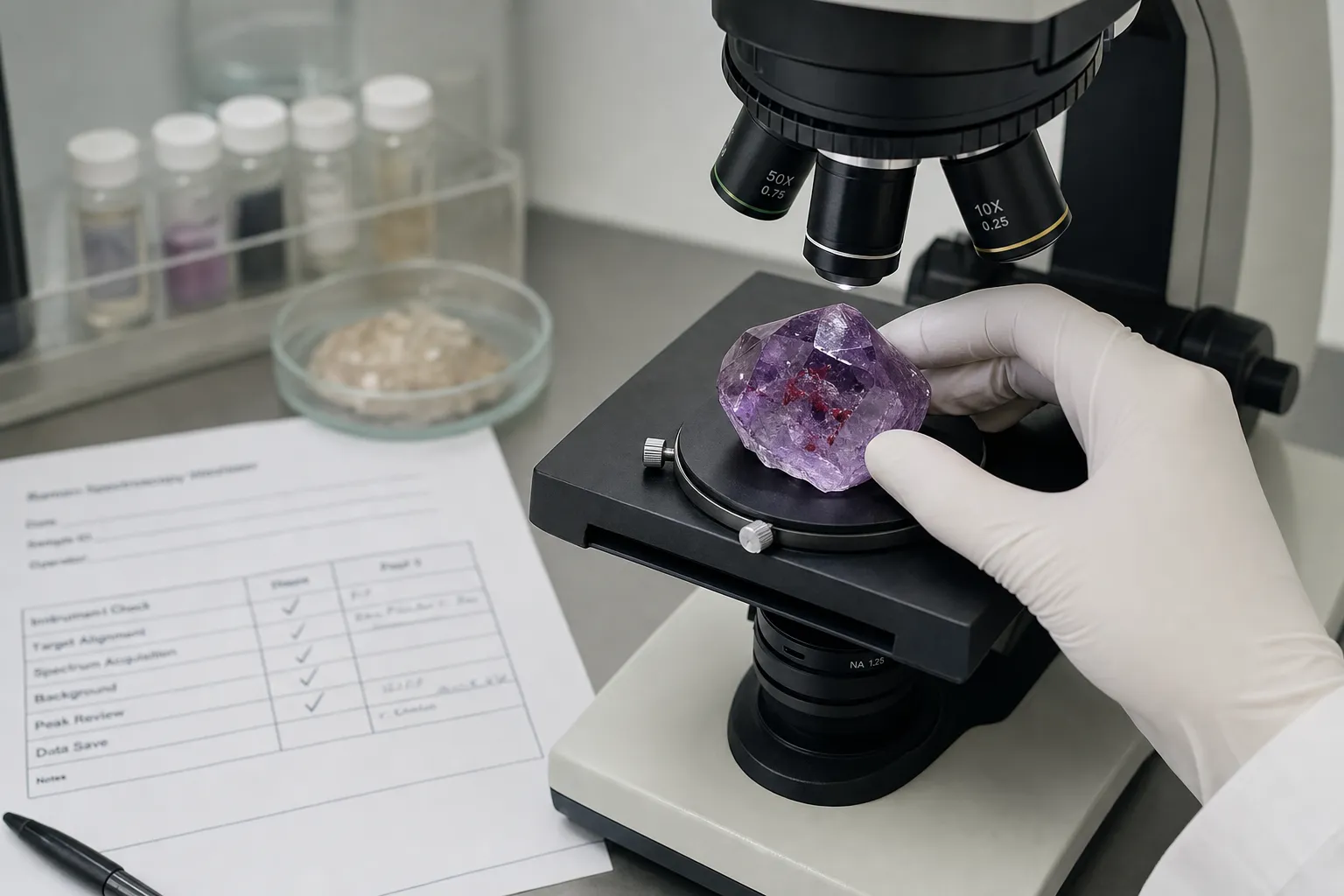
Analytical testing is needed when certainty matters. That may include resale descriptions, higher-value collector records, scientific accuracy, publication, or a personal collection where exact mineral identity is part of the point. At that stage, the question is no longer “What does it look like?” but “What mineral phase is actually present?”
Raman spectroscopy for inclusions is one relevant direction. In mineral contexts, Raman spectroscopy can help distinguish phases because different minerals produce different spectral responses. For this debate, that does not mean every amethyst inclusion is easy to test, or that a general Raman reference has already settled your particular crystal. It means spectroscopy is the kind of evidence that can move the answer beyond visual guesswork.
X-ray mineral testing and related instrumental methods can also be relevant in mineralogical analysis. Studies of amethyst and quartz materials show that laboratory-style approaches can examine mineral properties and distinctions, even when the study question is not specifically red inclusions. That support is useful but limited: it shows that amethyst can be studied instrumentally, not that every red inclusion has one expected identity.
Practical constraints matter. Inclusions may be very small, deep inside the quartz, mixed with other phases, or positioned in a way that complicates measurement. Some techniques require specialist equipment, careful targeting, and interpretation by someone familiar with mineral spectra and inclusion problems. Destructive home experiments are a poor answer; they can damage the specimen and still fail to identify the phase.
A sensible testing request is specific: identify the red inclusion phase, if accessible, rather than merely confirming that the host is quartz or that iron is present somewhere in the sample. The clearer the question, the better the chance that the result addresses the hematite-or-lepidocrocite problem.
A Careful Labeling Framework
For most amethyst owners, the best path is not to erase the debate but to label the evidence level. A specimen can be beautiful, meaningful, and worth keeping without pretending the inclusion has been proven.
Use this three-step wording habit:
- Name the host: “amethyst,” “purple quartz,” or “quartz with amethyst color zoning,” if that part is reasonably established.
- Describe the visible feature: “red needles,” “platy red inclusions,” “reddish phantom-like veil,” or “coppery specks.”
- State the evidence level: “untested,” “sold as hematite,” “possible lepidocrocite,” or “requires spectroscopy for confirmation.”
That structure keeps the record honest. It also makes collection notes more useful later, especially if you compare specimens, ask for review, or decide to sell. “Amethyst with red inclusions, untested” is not weaker than an overconfident name; it is clearer about what has and has not been shown.
Less careful: “Lepidocrocite amethyst”
More careful: “Amethyst with red needle-like inclusions, possible lepidocrocite, untested”
Less careful: “Hematite amethyst, confirmed by color”
More careful: “Amethyst with red to coppery inclusions, sold as hematite, no analytical confirmation”
Less careful: “Auralite 23 proves multiple minerals”
More careful: “Trade-labeled amethyst; individual inclusion identities not confirmed from the label alone”
Less careful: “All red inclusions are hematite”
More careful: “Red inclusions may be iron-bearing, but the mineral phase needs testing if certainty matters”
This language is especially useful in the crystal market, where inclusion names can become part of the aesthetic appeal. Reddish clouds, phantom layers, and sparkling specks can add visual character. They do not automatically add a verified mineral identity, rarity claim, or value conclusion.
For spiritual symbolism, the same boundary helps. A reader may choose an included amethyst because the red against purple feels grounding, vivid, or visually compelling in a room or practice space. That response belongs to personal meaning, not mineral proof. The specimen can carry atmosphere while its inclusion label remains cautious.
What the Current Evidence Does Not Settle
The available source picture supports a cautious answer, not a final verdict. Public material can support the general mechanism that quartz may preserve inclusions, the distinction between visual description and mineral identity, and the relevance of methods such as spectroscopy or X-ray-based analysis. It does not provide a strong, direct rule proving that red inclusions in amethyst are hematite rather than lepidocrocite, or lepidocrocite rather than hematite, by appearance alone.
That is the practical resolution. Red inclusions in amethyst can be described with careful visual language. They can be discussed as possible iron-bearing mineral phases. They should not be given a definitive hematite or lepidocrocite identity unless the evidence rises to that level.
For a collector standing before a purple crystal with a red glint inside, the honest answer still has value: enjoy the visible inclusion, record what can be observed, preserve the seller’s label as a label rather than proof, and seek Raman spectroscopy or appropriate mineralogical testing if the exact name must carry weight. The amethyst remains a specimen first; certainty belongs only where the evidence can support it.