Collector Identification
Red Caps & Hematite: The Unique Fingerprint of Thunder Bay Amethyst
Thunder Bay Amethyst is best recognized as a visual pattern, not a single pass-fail test. Many pieces associated with the Thunder Bay area are described in collector language as purple amethyst with red, rusty, or brown-red caps, sometimes with dark or metallic-looking flecks that sellers may call hematite inclusions. Those features can help explain the look people notice first, but they do not confirm origin, authenticity, value, or mineral chemistry by sight alone.
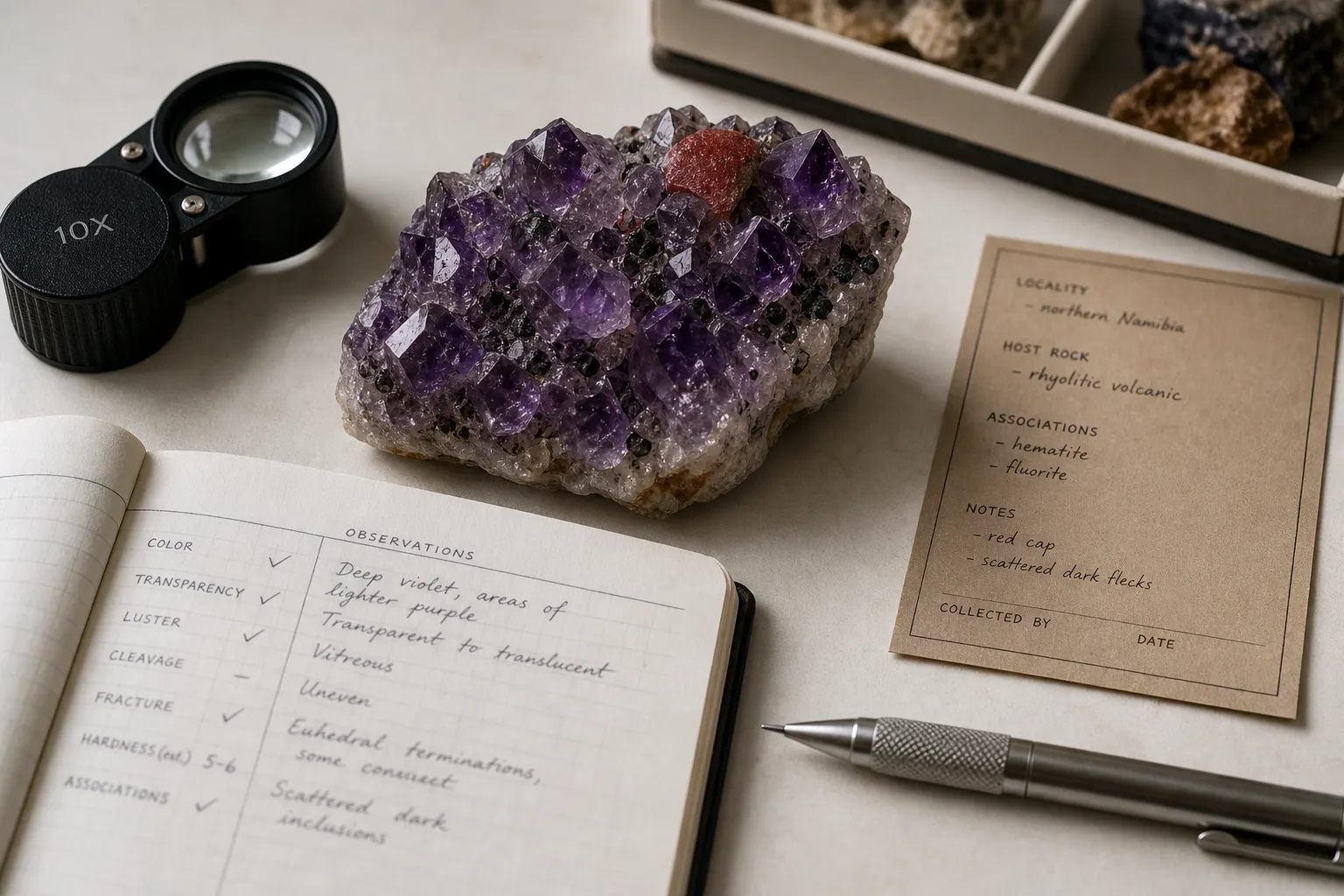
A careful description starts with what is visible: purple quartz, reddish surface areas, possible iron-toned staining, dark included material, crystal form, matrix, and any locality information that came with the specimen.
broader context
Amethyst context note
This narrower page lands better after the broader amethyst context page.
What “Red Cap” Means
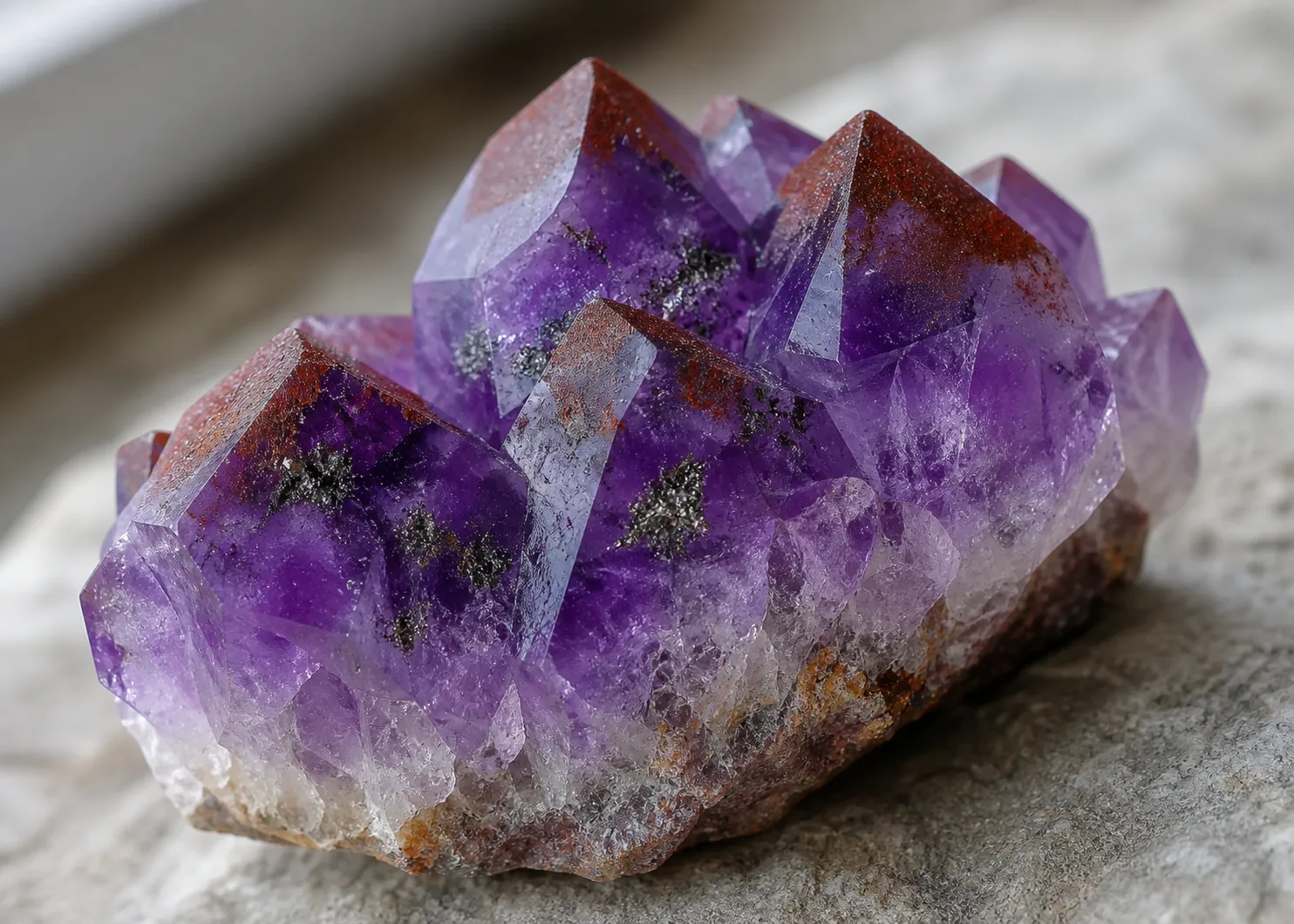
A red cap is a practical visual phrase. It usually refers to a reddish, rust-colored, brick-toned, or iron-toned area on or near the termination of a purple amethyst crystal. The effect stands out because the red area appears to crown the crystal rather than blend evenly through the whole piece.
For Thunder Bay Amethyst, that red-capped look is part of the familiar collector vocabulary. It gives the stone a layered appearance: purple quartz below, a warmer red or brown-red accent above, and sometimes darker spots or reflective-looking material nearby.
The limit is important.
“Red cap” does not identify the mineral cause by itself. A red area may be described as hematite-related, iron-rich, or oxide-stained in market language, but a visual label is not the same as verified mineral analysis. The safer wording is simple: the specimen shows red cap features, or it is being described as red capped.
That distinction keeps the claim honest. “This amethyst has a red cap” is an observation. “This red cap confirms Thunder Bay origin” goes much further than the visible feature can support on its own.
Hematite Inclusions and Metallic-Looking Flecks
“Hematite inclusions” is another useful but easily overstated phrase. In listings and collector talk, it often appears when amethyst shows dark red, black, brown-red, silvery, or metallic-looking material inside the quartz, along fractures, near surfaces, or close to growth features.
The cautious answer: hematite language may describe the expected look, but dark or reflective material does not automatically confirm hematite. It also does not confirm Thunder Bay origin. Inclusions, coatings, stains, fractures, and bits of host rock can be visually complicated, and different materials can look similar without testing.
Appearance
“Metallic-looking inclusions” describes what can be seen.
Interpretation
“Hematite inclusions” suggests a possible mineral reading.
Evidence
“Thunder Bay origin” needs provenance or stronger support.
This matters most online. Lighting, saturation, wet surfaces, polishing, and camera settings can make red and metallic areas look stronger than they appear in hand. A photo may show a convincing red cap, but it cannot answer every question about locality or mineral identity.
The Fingerprint Is a Pattern
“Fingerprint” is useful if it means a recognizable combination of traits. It becomes misleading if it sounds like a guaranteed test.
Thunder Bay amethyst visual cues may include:
- Purple quartz color, sometimes uneven or zoned.
- Red, rusty, or brown-red caps and surface accents.
- Dark or metallic-looking spots, seams, or included material.
- Natural crystal surfaces, fractures, or matrix relationships.
- A stated connection to Thunder Bay, Ontario, or the regional collecting context.
Not every piece has every trait. A specimen may be associated with Thunder Bay without a dramatic red cap. Another may have a red cap but no solid locality support. A third may show metallic-looking inclusions and still come from another source.
The Canadian Shield can belong in the broader origin context, but it should not be used as a shortcut explanation for the red caps unless a reliable geological or mineralogical source supports that specific mechanism. For this question, it is background—not proof.
Where the Look Gets Misread
The common mistake is treating market language as mineral fact. “Red cap,” “hematite inclusion,” and “metallic inclusion” are useful search terms because they match how people talk about these stones. They are not automatically laboratory-level descriptions.
A red cap can be overread in several ways. It may be taken as evidence that a piece is rare, when rarity depends on documentation, quality, condition, size, aesthetics, and collector demand. It may be treated as proof of Thunder Bay origin, even though visual similarity is not enough. It may also be described as hematite-caused without mineral confirmation.
Metallic-looking flecks create a similar problem. A close-up photograph may make one reflective spot look diagnostic, but it may not show whether the material is internal, surface-bound, fracture-related, or part of attached matrix.
There is also a useful distinction around “authenticity.” A crystal can be real amethyst while its locality remains uncertain. It can also be attractive without proving a specific source. Authenticity, locality, inclusion identity, and price are separate questions.
A Cautious Way to Describe a Specimen
If you are trying to recognize the Thunder Bay look, start with a layered description rather than a conclusion.
- First, record what you can see: reddish caps, rusty surface zones, dark included material, metallic-looking flecks, attached host material, or uneven purple color.
- Second, look at how the red areas sit on the crystal: Are they concentrated on terminations, seams, fractures, or matrix contact points? Do they appear naturally integrated with the surface, or do they look superficial? This does not prove origin, but it improves the description.
- Third, ask for locality support if origin matters: A label, mine or regional information, prior collection record, or reputable field reference carries more weight than a red cap alone. For decorative pieces, appearance may be enough. For collector-grade decisions, the evidence should be stronger.
A careful note might read: “Purple amethyst with red cap features and dark metallic-looking inclusions; sold as Thunder Bay Amethyst; locality not independently verified.” That keeps the useful visual information without pretending the appearance settles everything.
What the Look Means
The appeal is easy to understand. Red and purple contrast gives Thunder Bay Amethyst a rugged, mineral-rich look compared with uniformly purple crystals. Metallic-looking inclusions can add depth, texture, and a sense of visible growth history.
But the meaning should stay proportional. Red caps and hematite-related language can help describe the visual identity associated with Thunder Bay Amethyst. They can guide what to look for and what questions to ask. They should not be treated as a promise of origin, rarity, price, or non-visual effect.
The most balanced wording puts appearance first, then evidence level: red-capped, iron-toned, metallic-looking, included, purple quartz, Thunder Bay-attributed, labeled, documented, seller-stated, collection-provenanced, or visually consistent but unverified.
That is the real fingerprint: not one red mark, but the combination of appearance plus context. Thunder Bay Amethyst may be loved for its red caps and dramatic inclusions, while careful identification still rests on provenance—not color alone.
FAQ
Does every Thunder Bay Amethyst have a red cap?
No. Red caps are strongly associated with the look many collectors expect, but absence of a red cap does not automatically rule out Thunder Bay origin.
Does a red cap prove the stone is from Thunder Bay?
No. A red cap is a visual feature. Locality needs supporting context such as labeling, provenance, or stronger documentation.
Are metallic-looking flecks always hematite?
Not by sight alone. They may be described that way in collector language, but confirming the mineral identity requires more than visual inspection.
What is the safest wording for an uncertain piece?
Use appearance-based language: “red-capped amethyst,” “metallic-looking inclusions,” or “sold as Thunder Bay Amethyst.” Add the evidence level if known.