Polished amethyst care
The Mohs 7 Myth: Why Household Dust is Slowly Ruining Your Amethyst's Polish
A polished amethyst can look steady for years, then show a faint haze only when the light skims across the surface. The careful answer is this: quartz dust abrasion is a plausible concern when hard mineral particles are pressed and dragged across polished amethyst, but the available source set for this page does not support the stronger claim that ordinary household dust predictably ruins every amethyst polish.
The better care lesson is narrower. Do not treat “Mohs 7” as permission to scrub, dry-wipe, or rub grit into a finished surface.
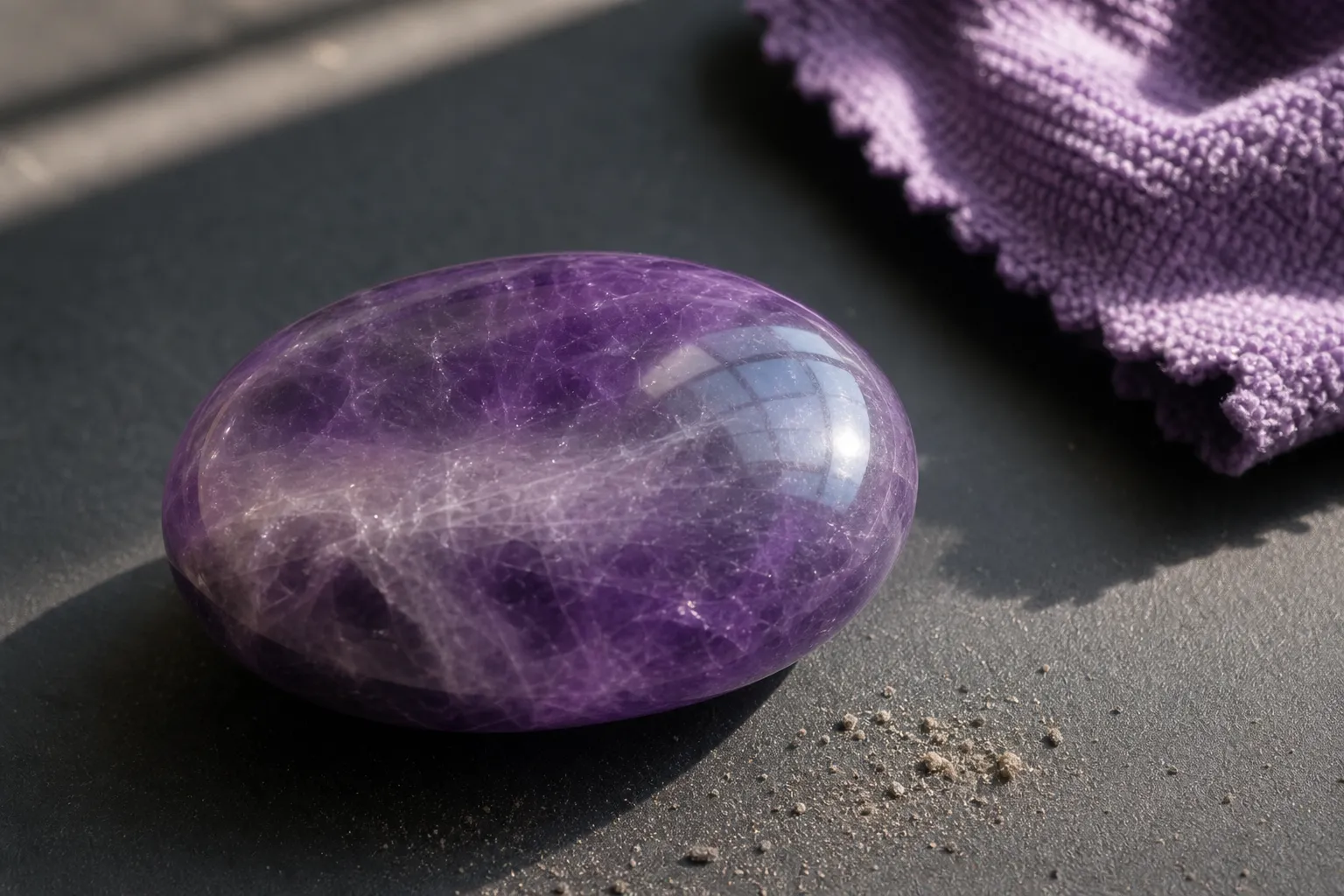
For an amethyst owner, dust resting on the stone is not the main worry. Dust plus pressure plus motion is the problem.
broader context
Broader amethyst guide
This narrower page lands better after the broader amethyst context page.
The Mohs 7 Number Is Not a Whole Care Plan
The Mohs scale gives a simple scratch comparison, and amethyst is commonly discussed as a quartz variety near Mohs 7. That number is useful, but it is not a complete care rule. It does not tell you how a polished face responds to repeated wiping, angular grit, trapped particles in cloth, or pressure from a thumb.
A polished specimen is not only a mineral; it is also a finished surface. Its beauty often comes from reflected light across cabochons, beads, carved points, palm stones, or polished geode edges. A surface can lose crisp reflection before it shows deep scratches. That is why amethyst polish dulling is a different question from a classroom hardness comparison.
The evidence boundary matters. This page has no front-facing reference strong enough to support a tested abrasion rate for household dust on polished amethyst. So the claim should stay modest: the Mohs 7 myth is too simple for cleaning decisions.
Collector conclusion: hardness is a clue, not permission to scrub.
When Dust Becomes an Abrasion Concern
Dust sitting lightly on a shelf specimen is mostly a visual nuisance. Dust becomes more concerning when it is rubbed against the polish.
The higher-risk pattern is familiar: a dry cloth, visible grit, repeated circular wiping, pressure from a thumb, or a piece stored where particles collect and are later dragged across the surface. In that situation, the cleaning action may matter more than the dust itself. Even without a verified dust profile for a specific home, the conservative care logic is sound: do not turn loose particles into a rubbing compound.
“Quartz-bearing household dust” also needs careful wording. The phrase sounds precise, but dust composition varies by region, building, ventilation, outdoor exposure, renovation activity, and storage setting. A desert window ledge, a workshop shelf, and a closed display cabinet should not be treated as the same environment without evidence.
You do not need a laboratory dust analysis to make the safer choice. If the surface looks gritty, do not dry-polish it. Lift loose particles gently before any rubbing motion.
Equal Hardness Does Not Mean Equal Safety
A common misunderstanding sits inside the phrase “quartz amethyst hardness.” If amethyst is quartz, and quartz is associated with Mohs 7, it may seem that quartz-bearing dust cannot matter. Daily care is not that neat.
Real surfaces have polish quality, tiny edges, fractures, inclusions, and pressure points. Dust particles can be angular, mixed with softer material, caught in cloth fibers, or moved repeatedly across the same area. That is not the same as pressing two clean mineral samples together under controlled conditions.
Less concerning
Loose dust resting quietly on a displayed amethyst surface.
More concerning
Dust used as an abrasive during repeated cleaning pressure and wiping.
The useful distinction is not “dust always scratches amethyst” versus “dust never scratches amethyst.” It is simpler: loose dust is less concerning than dust used as an abrasive during cleaning. Amethyst scratching, when it occurs, is more likely to be encouraged by repeated friction and careless wiping than by quiet display alone.
The Mohs 7 idea still has a place. It helps orient the collector, but it does not replace polished-surface maintenance.
What Changes the Answer for Your Specimen
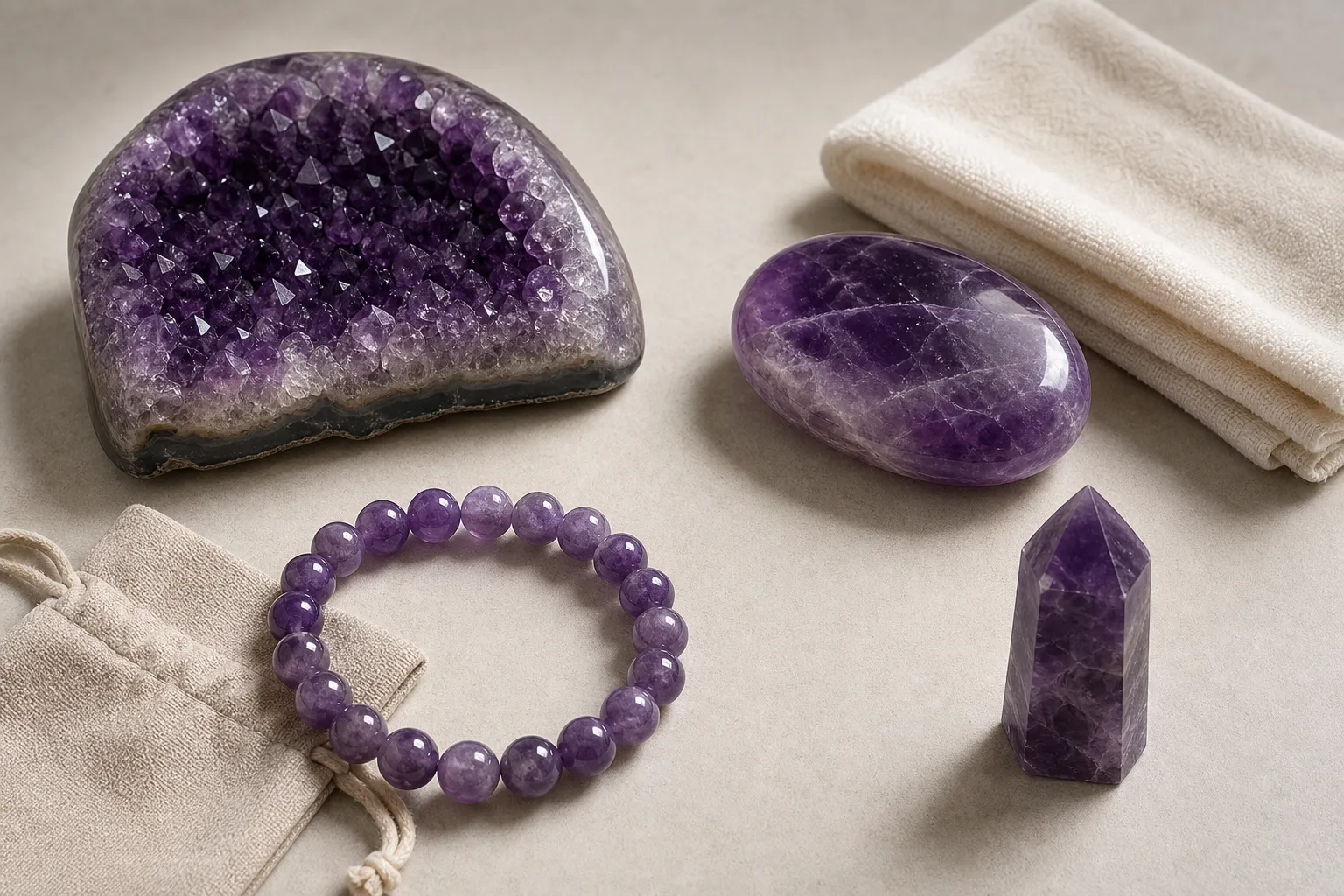
A polished geode face, a tumbled stone, a bead bracelet, and a carved point do not meet dust in the same way. Shape, finish, and use pattern change the care decision.
A specimen behind glass may have little gritty contact. A palm stone may be handled often. A bracelet or pendant may meet fabric, skin oils, storage trays, and repeated motion. A polished point near an open window may collect more airborne material than one kept in a closed cabinet. None of these examples proves damage; they show why the answer depends on conditions.
The finish matters too. A mirror-like polish reveals haze more quickly than a matte or uneven natural surface. Color zoning may hide slight dullness from a distance, while a broad polished face can show small changes in reflected light. Crystal habit changes perception as well: natural points, druzy pockets, and carved surfaces scatter light differently.
Watch for modest signs
- A once-sharp reflection looks cloudy under the same light.
- The surface feels less slick after cleaning.
- Fine marks follow the direction of wiping.
- Dust returns quickly because fibers or oils are catching it.
- The piece looks better after gentle dust removal but worse after dry rubbing.
These are observation points, not proof of quartz dust abrasion. They help you decide whether your cleaning habit is too aggressive for the finish you want to preserve.
A Gentler Cleaning Logic for Polished Amethyst
The care distinction is simple: lift dust first, then wipe only if needed. Many owners combine the two by grabbing a dry cloth and rubbing until the shine returns. That habit is exactly where the Mohs 7 myth becomes unhelpful.
Use the least pressure that works. If grit is visible, avoid pressing it into the polish. If a jewelry setting, carving recess, or geode edge traps particles, treat those places as areas where rubbing can concentrate. A clean, soft material and light contact are safer than force.
This article cannot promise restoration. It should not imply that home cleaning can reverse true polish wear. Once a polished mineral surface is genuinely abraded, restoring the original finish may require lapidary skill, and some pieces are poor candidates for repolishing. A specimen may be valued for crystal habit, inclusions, locality, or form; aggressive refinishing can change more than shine.
For practical amethyst care, the rule is restrained: dust gently, wipe lightly, and stop before cleaning becomes sanding in miniature.
Where the Evidence Ends
The strongest useful statement is also the cleanest one: the simplified Mohs 7 idea is not enough to decide how to clean polished amethyst. The available source set does not verify that household dust, as a broad category, is steadily dulling amethyst polish in all ordinary homes. It also does not give a tested timeline, measured abrasion rate, or confirmed comparison between dust environments.
That limit should make the advice more precise, not more timid. If dust is only resting on the surface, avoid panic. If dust is being rubbed across the same polished area again and again, change the habit. The risk lives in contact, pressure, particle hardness, particle shape, and repetition; the outcome depends on the specimen and the setting.
Spiritual symbolism belongs beside, not inside, the care claim. A polished amethyst may give a room a violet focal point or mark a quiet shelf, but that meaning does not prove anything about surface wear. Care still belongs to the material object in front of you: a finished quartz-family specimen whose polish deserves restraint rather than fear.
Let the stone keep its place in the room, but let the cloth slow down. Amethyst may be hard; its polish is still a surface, and surfaces remember how they are touched.