Geology boundary note
Inside the Neuquén Basin: How Cretaceous Cavities Birthed Pink Amethyst
The careful answer is narrower than the title suggests: the supplied research does not verify that Cretaceous cavities in the Neuquén Basin formed Pink Amethyst through a documented geological sequence. It also does not verify the El Choique mine details, anhydrite host material, volcanic geodes, mine history, stratigraphy, or mineral chemistry behind the pink color.
So Pink Amethyst formation in this setting should be treated as a reported locality explanation, not established geology. The idea can be described, but it should not be repeated as fact until it is checked against geological, museum, government, academic, mine-locality, or other topic-native sources.
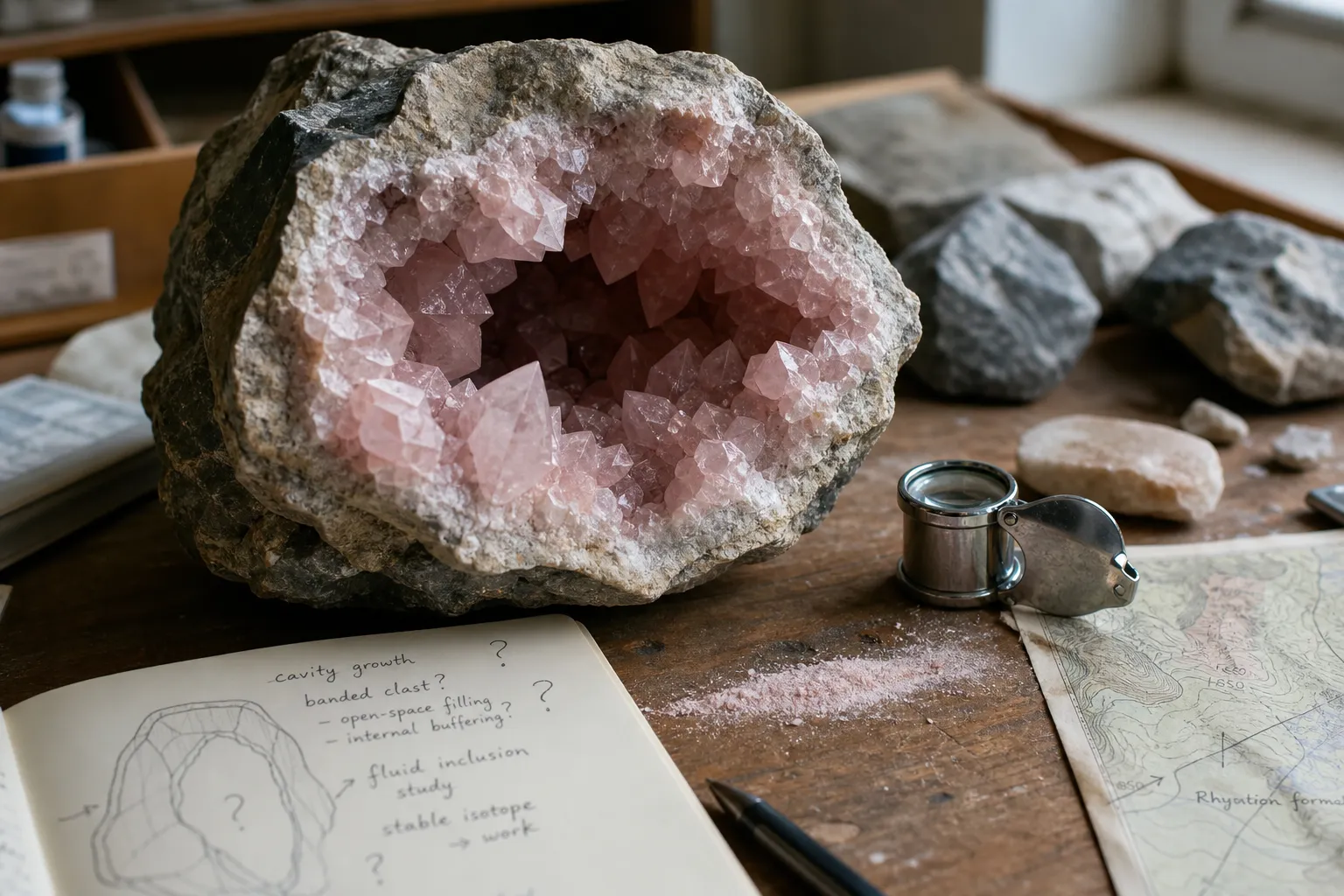
broader context
Amethyst context note
This narrower page lands better after the broader amethyst context page.
What the Neuquén Basin claim includes
When Pink Amethyst is linked to the Neuquén Basin, the El Choique mine, Cretaceous cavities, volcanic geodes, and anhydrite rock, several separate claims are being bundled together.
It usually suggests:
- A locality, often Argentina and the El Choique mine.
- A cavity-grown setting, where quartz formed inside open spaces.
- A possible host relationship involving anhydrite or anhydrite-related rock.
- A Cretaceous context for the cavities, host unit, or surrounding formation.
- A color explanation tied to mineral chemistry or later alteration.
Those details are not interchangeable. A mine name does not prove basin-wide origin. A basin name does not prove the age of a crystal pocket. A geode-like shape does not prove volcanic origin, and a pink color does not identify the chemistry behind it.
That does not make the story impossible. It means the stronger version of the story is not supported by the supplied evidence.
The formation model behind the wording
The phrase “Cretaceous cavities birthed Pink Amethyst” points toward a familiar mineral-formation model: open spaces existed in rock, mineral-bearing fluids moved through those spaces, silica crystallized along the cavity walls, and color developed through mineral chemistry and later conditions.
That broad model is plausible for many cavity-grown quartz discussions. The problem is that it has not been verified for this Neuquén Basin framing.
The timing distinction
For this page, the key distinction is timing. “Cretaceous cavity” might refer to the age of a host unit, the age of a void, the age of a volcanic or sedimentary setting, or simply a market-facing shorthand. A crystal growing inside a cavity is not automatically the same age as the cavity. Mineral growth can happen later than the space it occupies.
To state the sequence confidently, a source would need to connect the cavity, host rock, and amethyst growth in a documented way.
Why “volcanic geode” needs checking
“Volcanic geode” sounds specific, but it can be used loosely in specimen descriptions. A cavity-lined piece may look like a geode to a buyer, and some amethyst occurrences are genuinely discussed in volcanic settings. That does not prove these Pink Amethyst specimens formed that way.
A stronger source would need to identify the host rock, describe the cavity type, and connect that setting to the named locality. Without that chain, “volcanic geode” should be handled as reported wording rather than confirmed formation evidence.
Why anhydrite matters
Anhydrite is one of the most important terms to verify before making a strong formation claim. In this context, it may imply an evaporite-like sulfate environment rather than the more familiar basalt-hosted amethyst setting. That would be meaningful geology, if supported.
But there are several possible levels of association:
- The specimen may be found with anhydrite.
- The surrounding rock may be anhydrite-bearing.
- Associated sulfate minerals may be present.
- The word may come from simplified trade language.
Those are different claims. A careful article should not collapse them into one sentence. Until a reliable source identifies the host material and its relationship to the crystals, “anhydrite host material” remains a verification point.
The El Choique mine as a starting point
The El Choique mine is often the locality name readers are trying to connect with Pink Amethyst from Argentina. In the current evidence set, it can be mentioned only as a reported locality term.
A mine name can help organize provenance, but it does not answer formation questions by itself. To support the stronger explanation, evidence would need to confirm the mine’s location, host unit, stratigraphic position, mineral assemblage, mining history, and relationship to the specimens being discussed.
The most accurate wording is therefore restrained: Pink Amethyst is sometimes discussed in connection with the El Choique mine, but the current evidence does not verify mine-specific geology, chronology, or host-rock relationships.
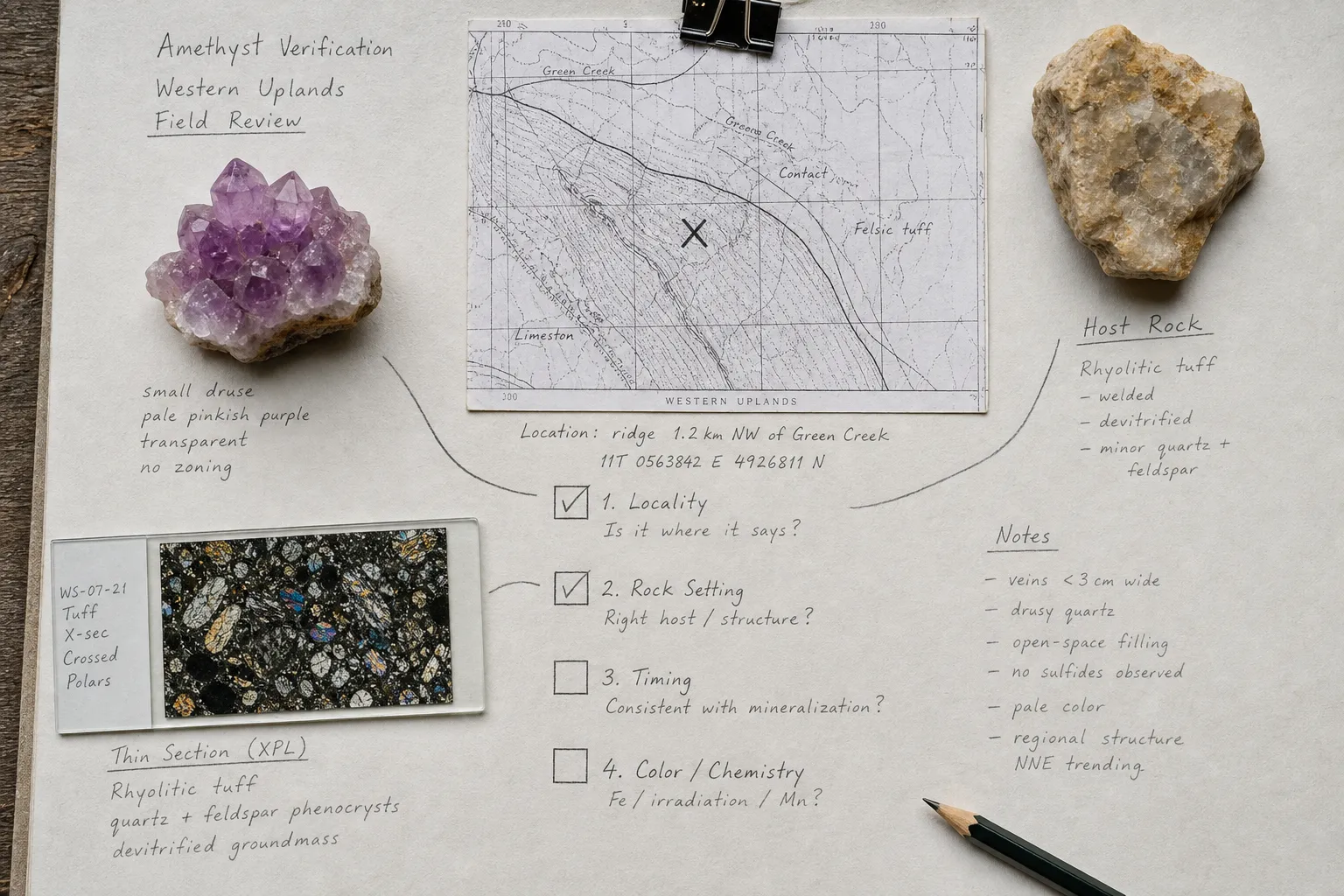
What would make the answer stronger
This topic does not need many sources. It needs the right sources.
The most useful evidence would include:
- Locality documentation tying the specimens to El Choique or another named source.
- A geological description of the relevant host rock and stratigraphic unit.
- Clear identification of whether anhydrite is host material, associated material, or only trade wording.
- Evidence for whether the cavities are Cretaceous, and whether crystal growth is dated or only inferred.
- Mineral chemistry evidence explaining the pink color beyond visual description.
If those pieces were verified, the article could give a more confident geological explanation. Without them, the answer should remain conditional.
Common misunderstanding
The main mistake is treating a polished trade story as a complete geological sequence. A phrase like “formed in Cretaceous volcanic geodes within anhydrite rock” sounds complete, but it may combine locality, age, setting, and host material without showing how each part was verified.
Another mistake is using appearance as proof. A cavity-lined specimen may look geode-like, and a pale pink crystal surface may look chemically distinctive, but visual inspection alone does not establish age, host rock, locality, or color mechanism.
The same caution applies to comparisons with other amethyst regions. Purple amethyst, pink-lavender quartz varieties, and locality-specific specimens may be grouped together in the market, but their formation settings should not be blended without evidence.
A careful working explanation
Pink Amethyst associated with the Neuquén Basin is described in some search and market contexts as cavity-grown quartz linked to the El Choique mine, possible anhydrite-related host material, and a Cretaceous geological context. The supplied evidence does not verify those relationships, so the formation story should be treated as a reported locality narrative until stratigraphy, host-rock identification, mine documentation, and mineral chemistry are confirmed by reliable sources.
That version is less dramatic than saying Cretaceous cavities “birthed” Pink Amethyst, but it is more useful. It shows what the claim is trying to explain without turning unverified wording into geology.
FAQ
Did Cretaceous cavities in the Neuquén Basin form Pink Amethyst?
That has not been verified by the supplied research. The claim may be a reported formation narrative, but the evidence set does not confirm the cavity age, host rock, crystallization timing, or color chemistry.
Is Pink Amethyst from the El Choique mine?
It is sometimes discussed that way, but the current evidence does not verify mine-specific provenance or geology. A reliable locality record would be needed before treating the mine name as confirmed.
Is the host rock anhydrite?
The supplied material does not confirm that. Anhydrite may be used as a host-rock claim, an associated-mineral claim, or a trade description, and those meanings should not be treated as the same thing.
What is the safest way to describe Pink Amethyst formation here?
Describe it as a provisional Neuquén Basin locality explanation: possibly cavity-grown quartz in a reported regional setting, with the key geological details still requiring verification.
The bottom line
Pink Amethyst formation in this Neuquén Basin framing should be understood as an unverified geological claim, not a settled explanation. The current evidence does not confirm Cretaceous timing, volcanic geode settings, anhydrite host material, El Choique mine geology, or the mineral chemistry behind the pink color.
The right next step is not stronger wording. It is stratigraphy verification, mine history verification, locality claims verification, and mineral chemistry evidence from sources that can actually support those claims.