Gem Care Boundary
Scratch Test Risks: How to Check Hardness Without Ruining Your Gem
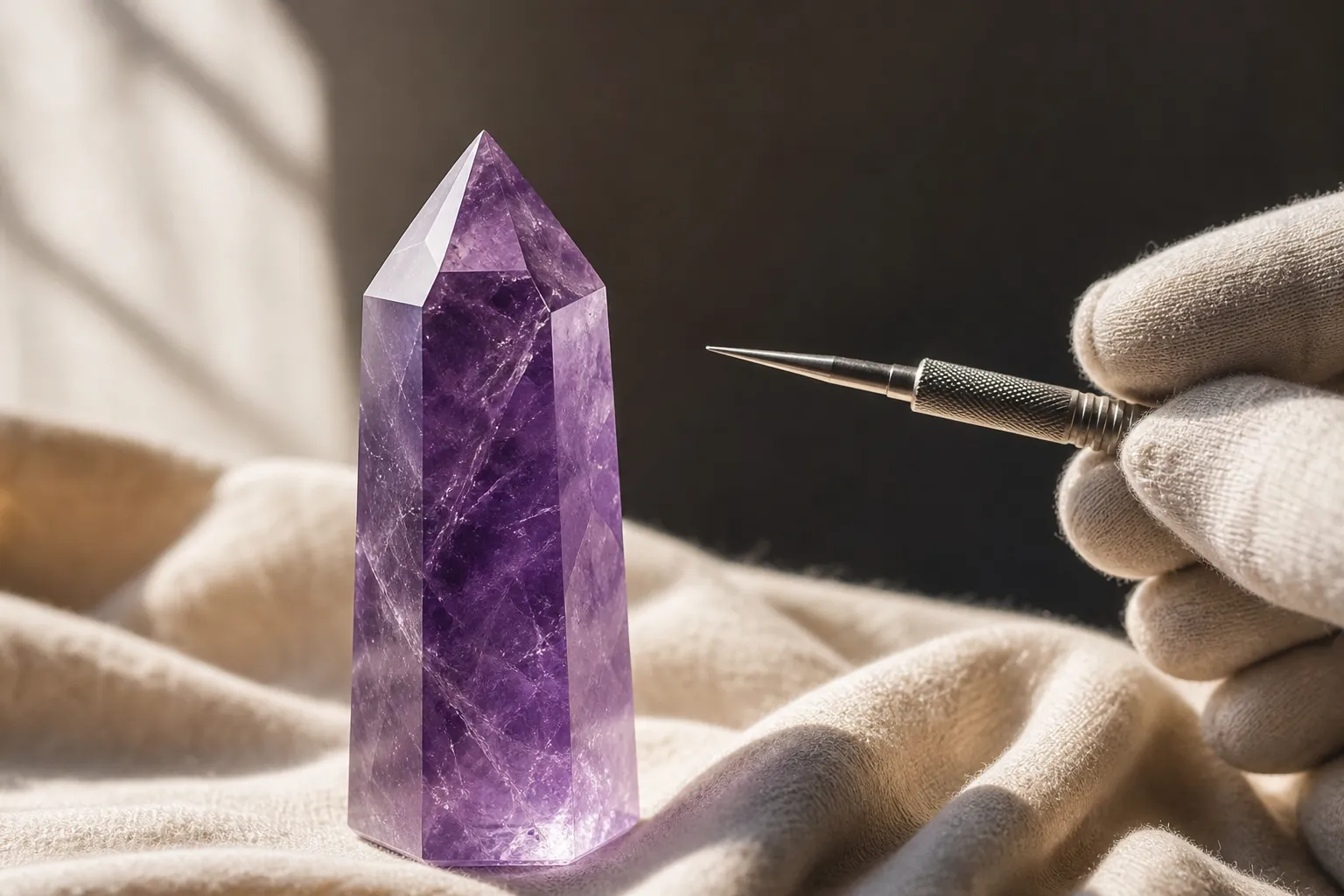
A polished amethyst point can look durable until one pale line interrupts the surface. That is the central risk of a Mohs hardness test: it works by comparing whether one material can scratch another, so the answer may arrive as permanent visible damage.
If the stone is mounted, sentimental, treated, coated, unusually clean, or simply unknown, do not test it on a display surface. Estimate hardness from documentation, known identity, careful visual context, and professional assessment instead of trying to prove hardness with a mark.
broader context
Begin with the main amethyst page
This narrower page lands better after the broader amethyst context page.
Why a Scratch Test Can Damage the Stone You Are Trying to Understand
A hardness scratch test sounds simple because it is often taught as a comparison: one material scratches another, or it does not. On loose mineral samples used for teaching, that may be acceptable when the sample is already meant to be handled and marked. A finished gem is different. Its value, beauty, and personal meaning often depend on an unbroken surface.
The damage does not have to be dramatic. A faint line, a dulled facet edge, or a mark across a polished dome can change how the stone catches light. On amethyst, that matters because color zoning, transparency, crystal habit, and polish all shape how a collector reads the piece. A scratch does not just answer a question; it can remove part of the evidence you were trying to preserve.
Hardness is not the same as permission to test. A gem may resist some everyday contact and still be vulnerable to the wrong tool, too much pressure, grit on a surface, or testing in the wrong place. Treat hardness as one durability clue, not as a reason to mark a finished stone.
The practical rule is narrow: if the gem is finished, mounted, meaningful, or not easily replaced, avoid scratch testing it.
The Glass-Scratching Shortcut Is Not Safe Identification
Many owners reach for a familiar shortcut: “If it scratches glass, it must be real,” or “If glass scratches it, it must be fake.” That shortcut is risky. It reduces a complex identification question to one mark on one object, and it can damage both the gem and the glass.
Scratching glass also does not settle the questions most gem owners actually have. It may not tell you whether a purple stone is amethyst, treated quartz, glass, synthetic material, another mineral, or a composite item. A mark can be misread too; transferred material, loose grit, or surface residue may look like a scratch result under casual home conditions.
Household glass is not a neutral test plate. Windows, drinking glasses, phone screens, and display cases may be coated, tempered, already scratched, dirty, or simply not worth damaging. If your goal is practical gem care, turning a household object into testing equipment usually creates more uncertainty.
For an amethyst owner, the better question is not “Can I make it scratch glass?” It is “Do I have enough non-damaging evidence to treat this as amethyst, or should someone qualified examine it?” That shift protects the stone first.
How to Estimate Hardness Without Scratching the Gem
You can often reduce uncertainty without putting a point, cabochon, bead, pendant, or crystal cluster through destructive hardness testing. The aim is not to prove everything at home; it is to avoid ruining gems while choosing a better next step.
Start with the least invasive evidence:
- Check reliable purchase documentation, appraisal language, lab reports, or collection labels that came with the gem.
- Compare the identity claim with visible form, color distribution, setting style, and wear pattern, without treating appearance alone as proof.
- Inspect for existing chips, scratches, residue, or surface changes under good light before deciding whether any test is necessary.
- Keep the gem away from harder materials, loose grit, and mixed storage until you know more.
- Ask a jeweler, gemologist, museum educator, or lapidary professional when the piece has financial, sentimental, or collection value.
For amethyst, this means treating the stone as a specimen first and a symbol second. Its purple color may carry personal meaning in a room, meditation corner, or jewelry box, but that role does not make a home scratch test safer. If the crystal matters to you, preserve the surface and use gentler evidence.
A professional assessment may involve observations and tools beyond a simple scratch comparison. This page is not a lab-testing manual, and the available draft material does not support detailed claims about specific instrument methods. The useful principle remains clear: non-destructive gem testing is the safer direction when the stone is finished, unknown, or meaningful.
When a Scratch Test Is Especially a Bad Idea
Some situations make scratch test risks much higher. Do not test hardness by scratching the gem if any of these apply:
- The stone is mounted in jewelry, because the setting limits control and may hide treatments, backing, adhesives, or vulnerable edges.
- The piece is an heirloom, gift, devotional object, or emotionally important specimen.
- The surface is polished, carved, coated, dyed, filled, repaired, or otherwise altered.
- The gem is part of a matched set, strand, inlay, mosaic, or decorative object where one damaged area affects the whole piece.
- The identity, value, or treatment history is unknown.
- The test would be done on a visible face, point, facet, bead surface, or display side.
A raw teaching sample, broken chip, or sacrificial offcut belongs in a different category from a finished gem. Even then, a scratch test needs proper reference materials, a clear reason, and acceptance that the sample may be marked. Without that, it becomes guesswork with a sharp edge.
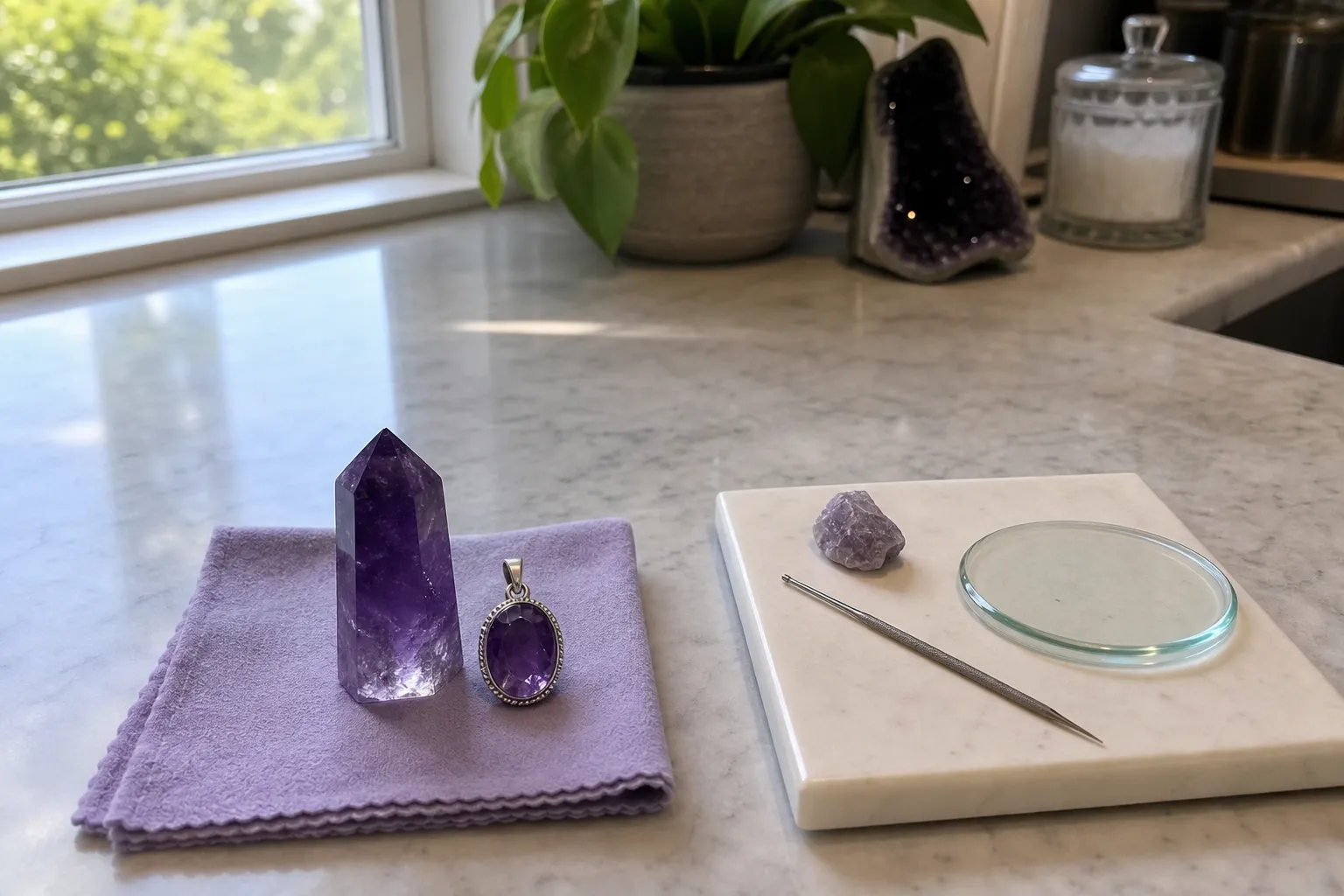
The distinction is not that scratch testing is always wrong. It is that destructive testing belongs, if anywhere, on material you can afford to mark and interpret carefully. A finished amethyst pendant, geode face, wand, bead, or display cluster is usually the wrong candidate.
What Hardness Can and Cannot Tell You
Hardness describes resistance to scratching in a specific comparison. It does not describe every form of durability. A stone can resist scratching better than another material and still chip, crack, abrade at edges, react poorly to cleaning, or suffer damage from heat, pressure, vibration, or a fall. Gemstone durability should not be reduced to one scale.
Hardness also does not prove authenticity by itself. Two materials may fall into similar hardness ranges, and many identification questions depend on multiple observations. Color, inclusions, growth features, optical behavior, density, treatment signs, and setting context may all matter, but not every one is safely judged at home.
For amethyst, the caution is useful because the stone is common enough to feel familiar and meaningful enough to be mishandled. A purple crystal on a shelf may be kept for atmosphere, collection interest, spiritual symbolism, or simple beauty. None of those reasons requires scratching it. If the concern is care, store and handle it cautiously. If the concern is identity, gather documents and seek an informed look.
This article avoids exact hardness numbers, tool procedures, and firm glass-comparison rules because no public citation-ready sources were supplied for this draft. Those details should be added only when supported by reliable gemology, mineralogy, museum, lapidary, or professional identification references.
A Safer Decision Path for a Cautious Gem Owner
If you are holding a stone and wondering what to do next, use a slow sequence rather than a scratch test.
- First, decide whether the stone can be damaged without regret. If the answer is no, stop. Finished gems, heirlooms, mounted pieces, and meaningful amethyst specimens should not be used as test material.
- Second, define the real question. Are you trying to know whether it is amethyst? Whether it is glass? Whether it is safe to wear? Whether it can sit beside other stones in storage? Each question may need different evidence. A Mohs hardness scratch test is a blunt answer to a more delicate problem.
- Third, preserve the surface while you gather context. Photograph the stone in daylight, keep seller or family information, note existing scratches or chips, and separate it from harder or rougher objects. These steps do not authenticate the gem, but they keep your options open.
- Fourth, choose a non-damaging next step. For an inexpensive loose stone with no sentimental value, you may decide the risk does not matter. For a ring, pendant, carved object, collector specimen, or amethyst kept for room atmosphere or symbolic use, ask for professional help before testing.
The best hardness check is sometimes restraint. A stone left unmarked can still be examined tomorrow; a scratched surface cannot be unscribbled.
Small FAQ for Home-Testing Questions
Can I test the back or underside instead?
Only if damage there truly would not matter and you understand the limits of the test. On many gems, the underside still affects value, fit, setting stability, or personal meaning. Hidden does not always mean harmless.
Is a scratch test useful for rough amethyst?
It may be more plausible on rough, expendable material than on a polished or mounted piece, but this article does not provide sourced procedures for testing rough samples. If the specimen is attractive, collectible, or meaningful, treat it as non-expendable.
What should I do if I already scratched it?
Do not keep testing around the mark. Clean only with a gentle method appropriate to the item, keep the stone separate from abrasive contact, and ask a jeweler, lapidary, or gem professional whether polishing, repair, or simple acceptance is the better path.
A hardness question begins in mineral behavior, but a care decision happens in your hand. For amethyst, keep the material fact separate from the meaning you give the stone: hardness can inform collector judgment, while restraint protects the surface, the color, and the quiet role the specimen holds in a room or collection.