Cautious crystal care
The Saltwater Protocol: Safely Clearing Raw Geodes Without Structural Damage
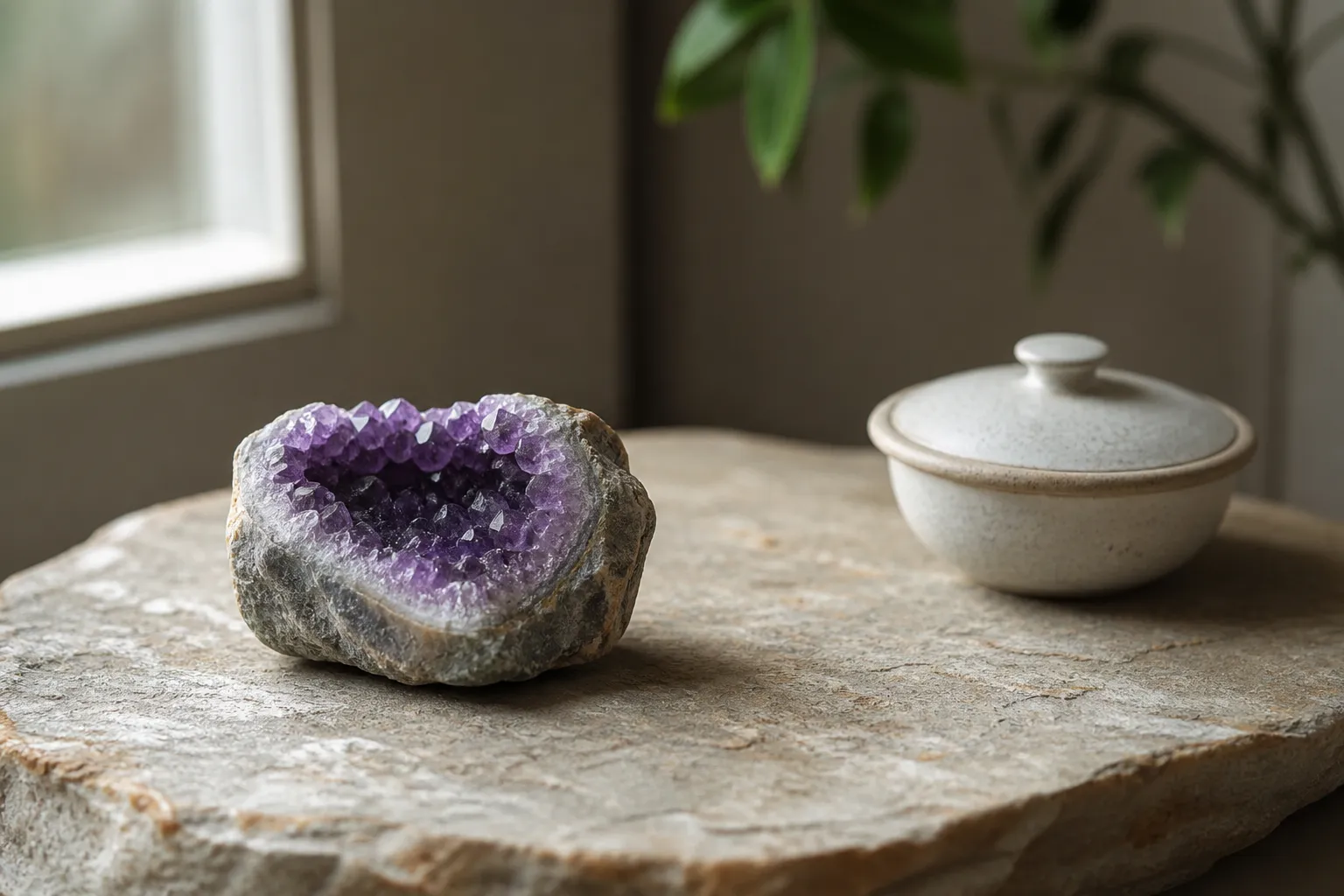
A raw amethyst geode is a purple crystal pocket held inside a less predictable body: matrix, edges, seams, dust, small fractures, possible repairs, and the wear that comes with display. For Saltwater Crystal Clearing, the most cautious protocol is not to put saltwater on the geode at all. Keep the saltwater separate from the specimen, use it only as part of the ritual setting, and reserve physical cleaning for dry or nearly dry care.
That distinction matters. Saltwater clearing belongs to symbolic practice; geode care belongs to material handling. With the source material available for this page, there is no reliable basis for saying that saltwater contact is safe for raw amethyst geodes, their matrix, or repaired areas.
broader context
Begin with the main amethyst page
This narrower page lands better after the broader amethyst context page.
The direct answer: keep saltwater off the geode
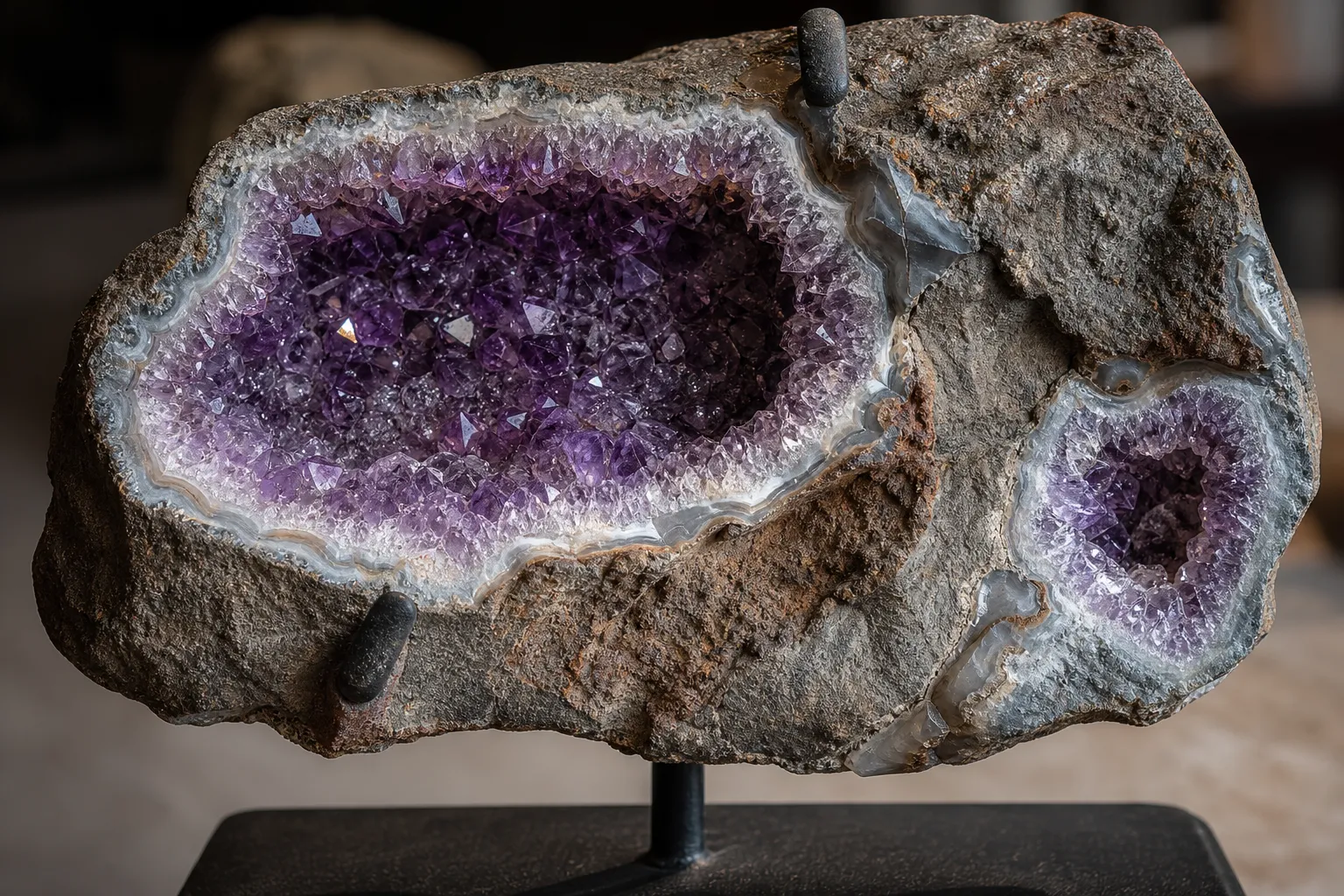
Do not immerse a raw amethyst geode in saltwater, and do not pour saltwater across the crystal pocket or outer stone. Raw geodes are not uniform objects. The amethyst points may look stable while the underside, matrix, old seams, glued areas, or display base behave differently.
The evidence boundary is narrow here. No usable public references were supplied for specific claims about saltwater exposure, mineral solubility, salt residue, hygroscopic properties, matrix stability, or long-term structural effects on raw amethyst geodes. So the answer stays conservative: when the specimen is irregular and the evidence is thin, avoid the exposure rather than trying to correct damage later.
If saltwater has meaning in your spiritual or Vastu-adjacent practice, use distance. Place a covered glass or ceramic bowl of saltwater near the geode, not on it. The geode remains a specimen first; the ritual can happen around it.
A low-contact saltwater clearing protocol
This is not a tested conservation method or a guarantee against damage. It is a cautious sequence for readers who want the language of saltwater clearing without making saltwater touch a raw geode.
- Step 1
Inspect the geode first. Look for loose grains, powdery matrix, open seams, chips, glued areas, repaired bases, wobbly stands, or any area that seems weaker than the amethyst points.
- Step 2
Keep the specimen dry. Set it on a stable cloth, tray, or shelf where it will not be splashed. For a heavy geode, use a surface that will not flex while you move nearby objects.
- Step 3
Put saltwater in a separate covered vessel. A small lidded bowl or jar keeps the ritual element present while reducing spills, spray, and loose salt crystals.
- Step 4
Use non-contact practice as the clearing action. Intention, placement, sound, breath, or quiet time may be meaningful to the user, but they should not be described as changing the stone’s physical condition.
- Step 5
Remove the saltwater before handling the geode. This keeps salty moisture from transferring by cloth, sleeve, fingertip, or tray.
- Step 6
Separate cleaning from clearing. Dust removal is material care. Saltwater clearing is symbolic language. Mixing the two is where avoidable risk often enters.
Saltwater can be part of the setting. It does not need to become a cleaning liquid.
What changes the risk for raw amethyst geodes
A polished point, a tumbled stone, and a raw geode do not present the same care problem. A raw geode can include exposed crystal faces, outer matrix, narrow cavities, old dirt, display adhesives, and small fractures that are difficult to inspect.
Matrix risk matters because the stone around the amethyst supports the object, even when the purple crystal pocket gets most of the attention. If the matrix sheds, stains, softens, or crumbles, the geode may become harder to display. This page cannot verify a specific saltwater damage mechanism for every matrix type; the practical decision is simpler. If the material is mixed, porous-looking, repaired, or unknown, keep saltwater away.
Surface risk is also about appearance. Tiny crystal pockets and rough edges can hold residue, moisture, or cleaning marks. Without stronger source support, it would be too much to claim exactly how salt behaves on every amethyst surface. A cautious collector can still choose not to introduce a substance that may be hard to remove from small crevices.
Structural risk often comes from handling as much as from liquid. A soaking ritual requires lifting, turning, rinsing, drying, and resetting the specimen. For large, heavy, or mounted geodes, each step adds pressure points and chances for knocks. If the care goal is risk reduction, fewer contact events are usually the better choice.
Repairs and bases need particular restraint. Some geodes are mounted, stabilized, filled, or previously repaired, and those details may not be obvious from the front. Without specimen-specific information, wet salt should stay away from adhesives, fillers, finishes, labels, metal mounts, and painted stands.
Safe cleaning is not spiritual clearing
“Safe cleaning” and “Saltwater Crystal Clearing” are often blended in casual crystal language, but they answer different questions. Cleaning asks how to remove dust or debris without harming the object. Clearing marks a symbolic reset, devotional pause, or energetic intention within a belief practice.
For a raw amethyst geode, safe crystal cleaning should stay minimal unless stronger specimen-specific guidance is available. Dry dusting with a soft tool is usually the gentlest category of action, and even that should be light around delicate points or loose matrix. A barely damp cloth may be reasonable for some outer display surfaces, but this page cannot turn that into universal advice for every raw geode. Inspect first, touch less, and stop if grains loosen or the surface changes.
Energetic language needs its own boundary. Some traditions or sellers describe salt as an energy conductor, or frame saltwater as absorbing or clearing unwanted energy. Vastu practices may also use salt and placement in home ritual contexts. Those statements can carry meaning inside a belief system, but they are not mineral safety statements. They do not show that saltwater is compatible with amethyst, matrix stone, repairs, or display hardware.
The same caution applies to technical-sounding phrases such as hygroscopic properties. Without reliable sources in the supplied material, this article should not make a precise claim about salt, moisture behavior, or residue on raw geodes. The grounded point is enough: saltwater introduces salt and moisture into an object with crevices and mixed surfaces. If the goal is cautious crystal care, keep that mixture off the specimen.
Common confusion around saltwater and amethyst geodes
Symbolism is not material compatibility
Amethyst may be associated with clarity, protection, calm, or sacred placement in personal practice, but symbolism does not tell you how a raw geode will respond to wet salt.
Not all amethyst forms behave alike
A small polished piece has fewer exposed irregularities than a raw geode. A geode has more places where moisture or residue can hide. That does not prove a specific outcome, but it changes the care decision.
Marketplace language is not evidence
Product descriptions and social posts often compress clearing, charging, cleansing, decorating, and display into one appealing routine. Those phrases may show how people talk about crystals; they should not carry factual authority for mineral damage risks, structural stability, or safe cleaning.
A quick dip still creates contact risk
Brief exposure still means wetting, lifting, rinsing, drying, and inspecting afterward. The better question is not how short the exposure can be. It is whether the exposure is needed at all.
When to avoid saltwater contact completely
Avoid direct saltwater contact if the geode has loose crystals, sandy or powdery areas, visible cracks, glued sections, repaired bases, labels you want to preserve, metal mounts, painted stands, or sentimental value that makes damage unacceptable. Also avoid it if you cannot inspect the underside or interior well enough to see where water could collect.
Be especially cautious with newly purchased geodes. You may not know the cleaning history, repair history, storage conditions, or materials used to mount or stabilize the piece. A seller’s brief assurance is not the same as specimen-specific documentation.
Avoid contact when the ritual purpose can be met another way. A dry placement practice, a covered saltwater bowl nearby, a quiet pause before returning the geode to its shelf, or a non-contact Vastu-inspired arrangement can preserve the symbolic layer without adding wet salt to the stone.
If a geode has already been exposed to saltwater, do not respond with aggressive cleaning. Stop further exposure, place the specimen somewhere stable and dry, and inspect for residue, loosened grains, or surface changes. Without reliable care references for the exact specimen, forceful scrubbing, soaking, or chemical correction should not be treated as a universal remedy.
The boundary this page can stand behind
The careful answer is not that every saltwater ritual damages every geode. The careful answer is that this page does not have the source base to promise safety for raw amethyst geodes under saltwater contact.
So the protocol is a boundary: keep saltwater separate, keep the geode dry, inspect before handling, clean only when cleaning is actually needed, and treat Vastu or energetic language as personal practice rather than proof of material compatibility. For raw amethyst geodes, the most respectful clearing method is often the one that lets the crystal pocket remain undisturbed while the meaning happens around it.