Wholesale pricing method
How to Calculate Wholesale Amethyst Prices Per Kilogram in Today's Market
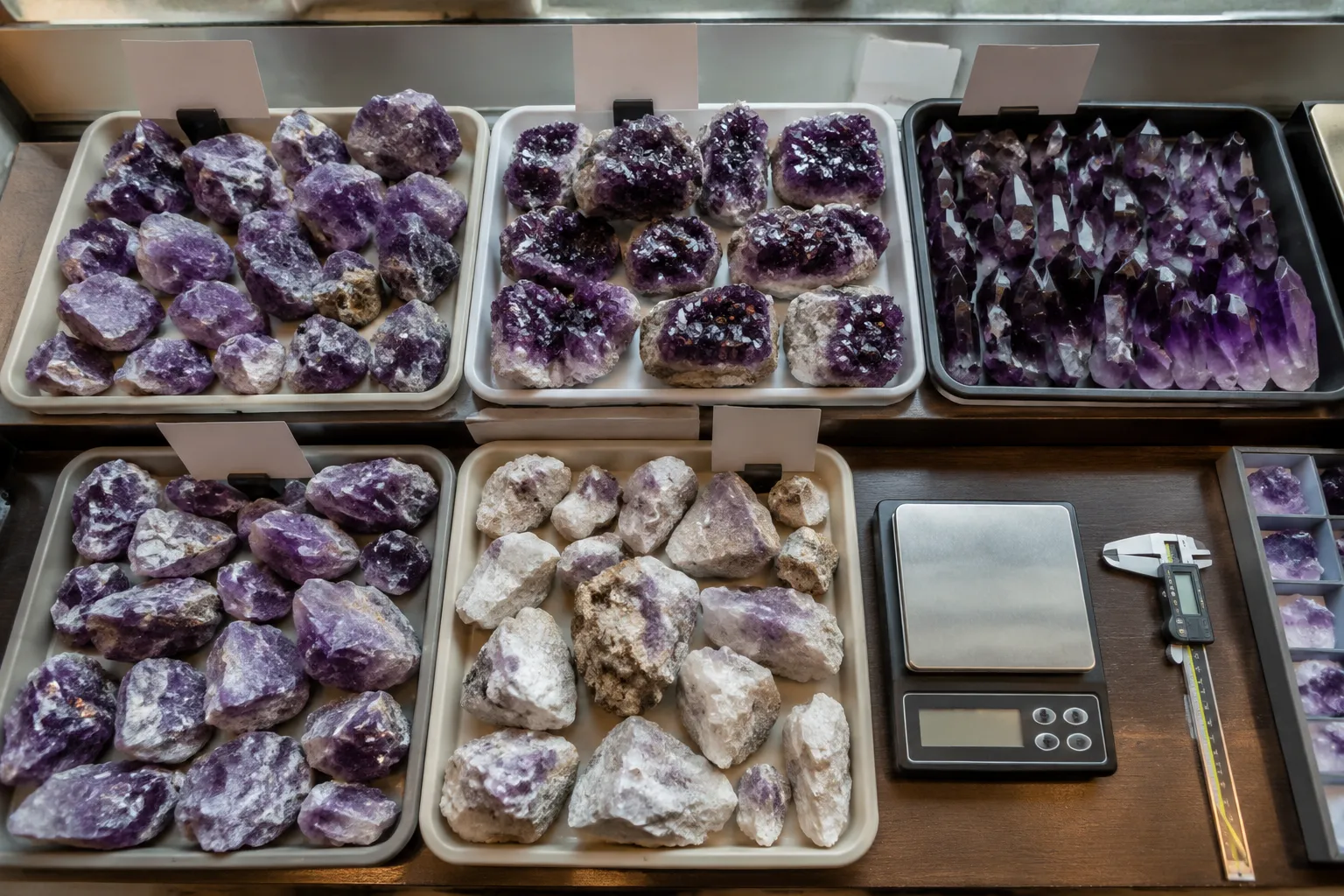
Color zoning is often the first sign that a purple lot cannot be priced by weight alone. Two parcels may both weigh one kilogram, yet one may hold bright, evenly colored crystal points while the other carries pale quartz, broken matrix, mixed sizes, or grade language that fades under close inspection.
The practical answer: calculate Wholesale Amethyst Prices by classifying the lot first, then converting every quote into the same weight unit and comparing only similar material. A usable wholesale amethyst price per kilogram is not a universal market number. It is a worked estimate built from product form, crystal weight, color quality, visible zoning, clarity, origin disclosure, treatment disclosure, usable yield, shipping risk, and sales channel. A single online listing can be a clue; it should not become the market baseline.
broader context
Broader amethyst guide
This narrower page lands better after the broader amethyst context page.
Start With Lot Classification, Not the Price Tag
Before asking whether a quote is cheap or expensive, name what the kilogram actually contains.
A kilogram of facet-grade rough is not comparable to a kilogram of decorative druzy clusters. A polished point lot is not the same as a broken rough parcel. A geode, cathedral, or display cluster carries decorative value that may depend on face coverage, shape, stability, color distribution, and how it sits in a room. Faceted stones are usually discussed in per-carat terms, so converting those prices into bulk rough or geode kilo prices creates a false comparison.
Commercial listings often mix vocabulary from mineral collecting, jewelry, home decor, resale lots, and crystal-shop marketing. Phrases such as “premium grade,” “top grade,” “bulk deal,” or “below wholesale” may describe seller positioning rather than a recognized grading system. Treat them as prompts for inspection, not as finished evidence.
Normalize the Weight Before Comparing Quotes
Once the form is clear, put every number into kilograms.
1 kilogram
1 kg
1 gram
0.001 kg
1 pound
about 0.454 kg
1 ounce
about 0.02835 kg
1 carat
0.0002 kg
Price per kilogram = total lot price ÷ total lot weight in kilograms
If a lot costs $180 and weighs 4.5 kg, the visible price is $40 per kg. That is only the opening number. It still needs adjustment for usable yield, shipping, breakage, channel markup, and comparability.
For a mineral dealer or reseller, this second formula is usually more useful:
Adjusted price per usable kilogram = total landed cost ÷ usable saleable weight
Total landed cost includes purchase price, shipping, import or handling charges where relevant, payment fees, and expected loss from breakage or unsaleable pieces. Usable saleable weight excludes mud, excessive matrix, cracked waste, filler pieces, mixed minerals, or pieces too small for the intended channel.
If a 10 kg lot costs $300 landed but only 7.5 kg is saleable in your channel, your working cost is $40 per usable kg, not $30 per listed kg. That difference is the heart of crystal weight normalization.
Build a Baseline From Comparable Amethyst Lots
A market baseline should come from comparable amethyst lots, not from the most dramatic price you find. Public gemological references support the idea that quality factors matter, but they do not provide a clean, current, universal wholesale amethyst price per kilogram. Government gemstone data can describe broader reporting limits; it does not function like a live commodity quote for amethyst kilos.
A stronger workflow looks like this:
- Identify the product form.
- Convert every quote to kilograms.
- Remove listings with unclear form, mixed stones, missing weight, or obvious retail gift packaging.
- Keep only lots with similar size distribution, color, clarity, origin language, and disclosure level.
- Convert the seller price into landed cost.
- Estimate usable yield or decorative value.
- Compare the adjusted per-kilogram result against the remaining similar lots.
This does not produce a perfect number. It produces a defensible range for the specific kind of material in front of you.
A one-kilogram rough lot promoted for cutting, an 11 lb box of Brazilian rough, a small ounce-scale chevron piece, and a Uruguay display cluster may all appear in the same search results. They do not belong in the same price average. The more your comparison set mixes forms, the less useful the average becomes.
The same caution applies to per-carat amethyst pages. Per-carat language belongs mainly to finished or jewelry-facing stones. It can help explain why color, clarity, and cut matter, but it should not be multiplied into wholesale rough, clusters, geodes, or mixed parcels.
Grade What Can Be Observed
Amethyst grading standards in ordinary wholesale trade are not as uniform as the labels make them sound. Still, gemological references give useful quality anchors. GIA material commonly emphasizes color, zoning, brightness, clarity, and cutting in amethyst value discussions. Strong reddish purple to purple color, good brightness, and limited visible color zoning are generally treated as more desirable than pale, grayish, or uneven material.
For a per-kilogram calculation, examine these features before assigning a number:
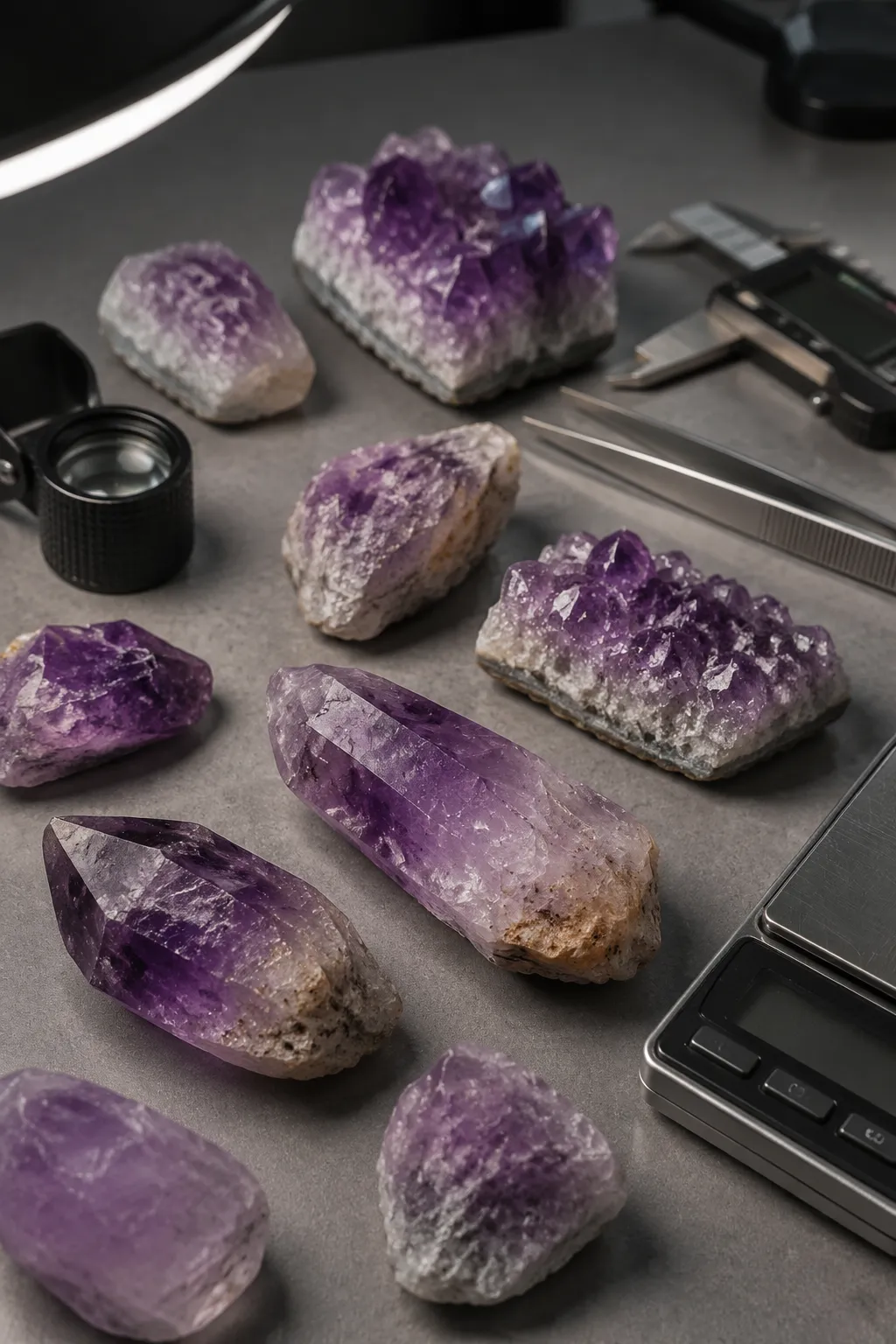
Color grading for bulk amethyst should be practical rather than theatrical. Use a white or neutral background, consistent light, and several sample pieces from the lot. Do not judge a kilogram by one attractive top piece. If the best stones are placed on the surface and the lower layers are pale or broken, the lot price should follow the average usable material, not the display photo.
For decorative clusters and geodes, clarity is less important than face coverage, color distribution, stability, and presence. A heavy piece with only a small purple opening may have a lower effective decorative value per kilogram than a lighter piece with a broad, bright crystal face.
Check Origin, Treatment, and Disclosure
Amethyst origin disclosure can affect buyer confidence, especially when sellers use familiar locality language such as Brazil or Uruguay. Mineral locality references are useful for understanding that amethyst is a quartz variety found in many places, and that specimen identity and locality are separate questions. A seller naming a country is not the same as independent provenance proof.
Use origin language as one pricing input, not as the whole price. A stated Uruguay piece may attract attention in decorative markets, but the calculation still depends on color, form, face quality, size, condition, and documentation. A vague origin does not automatically make a lot poor; it simply adds uncertainty.
Treatment disclosure also belongs in the calculation. GIA buyer information notes that lower-quality light-colored amethyst or quartz may be dyed purple, and buyer inspection is part of ordinary amethyst evaluation. Trade and laboratory discussions also show that synthetic quartz and disclosure issues can be difficult to resolve by casual viewing alone. That does not mean every inexpensive parcel is synthetic, dyed, or misrepresented. It means the price should reflect what is disclosed, what is inspectable, and what remains uncertain.
Useful checks include:
- Does the seller distinguish natural amethyst, dyed quartz, synthetic quartz, and treated material?
- Are photos taken in neutral light, or do they rely on heavy saturation?
- Is color concentrated in cracks, pits, or surface areas in a way that deserves closer inspection?
- Does the description use “untreated” or “unheated” without supporting context?
- Would a gem identification report make economic sense for this lot, or would the report cost exceed the value of the parcel?
For many ordinary wholesale amethyst purchases, formal reports may not be requested because the economics do not justify them. That makes clear disclosure and careful comparison more important, not less.
Adjust for Usable Yield, Decorative Value, and Channel
The listed kilogram is not always the kilogram you can sell, cut, display, or carry in inventory.
For cutting rough, estimate usable yield. Fractures, zoning, pale sections, awkward shapes, or heavy waste can reduce the effective value. A cheaper kilo of rough may be more expensive than it appears if only a small portion can become usable stones.
For decorative amethyst, think in display value rather than yield. A geode or cathedral carries weight in stone, matrix, base, and empty interior. The buyer is not paying only for purple quartz mass; they are paying for a stable object with visible crystal surface, pleasing color, and a size that fits a shelf, shop display, meditation corner, or room setting. Spiritual symbolism may shape how some buyers describe or place amethyst, but it should not be used as proof of material value or guaranteed effect.
For resale lots, channel changes the number. A mineral dealer buying by the box, a crystal shop buying small display pieces, and an online seller breaking parcels into individual listings do not face the same costs. Photography, labeling, storage, returns, platform fees, shipping materials, and breakage all alter the workable wholesale price.
Working wholesale estimate = comparable landed price per kg × quality adjustment × usable-yield adjustment × channel adjustment
The multipliers do not need to pretend toward false precision. They are a disciplined way to avoid treating all kilos as equal.
Where Buyers Misread Wholesale Amethyst Prices
The most common mistake is copying a single online number and calling it the market. Commercial pages and marketplace snippets may show 1 kg rough lots, 10 lb boxes, 2-3 oz pieces, mixed parcels, sale prices, and per-gram figures side by side. Those numbers are not useless because they are online; they are incomplete without form, grade, date, channel, and disclosure.
Another mistake is treating “wholesale” as a verified status. On many public-facing pages, wholesale may mean bulk-style retail, minimum-order pricing, a sale bundle, or a reseller pitch. Mineral dealer pricing is often negotiated around repeat buying, inspection rights, quantity, consistency, and risk allocation.
A third mistake is trusting grade language more than the stone. “Premium grade” can mean a carefully sorted parcel, or it can be a marketing phrase. The calculation should return to visible color zoning, brightness, clarity, size distribution, breakage, and disclosure.
A buyer who sees a wide euro-per-kilo spread online for a Uruguay piece is facing the real problem: the visible numbers may not describe the same material. That kind of example is useful as marketplace language, not as evidence that any quoted range is the market.
A Short Calculation Workflow for a Real Lot
Use this checklist when a seller gives you a kilo price or a total lot price:
- Name the form: rough, facet rough, cluster, geode, cathedral, polished piece, faceted stones, or mixed parcel.
- Convert the full lot weight into kilograms.
- Convert the quote into price per listed kilogram.
- Add shipping, fees, handling, and expected breakage to get landed cost.
- Inspect color, brightness, visible color zoning, clarity, piece size, and condition.
- Estimate usable saleable weight or decorative value.
- Check origin and treatment disclosure, noting what is stated and what is unsupported.
- Remove non-comparable listings from your comparison set.
- Compare only similar lots in similar channels.
- Set a range, not a single “true” price.
The most useful wholesale amethyst calculation is therefore not a price chart. It is a filtering process. It asks what the kilogram contains, how much of it is usable, how confidently it is described, and which market channel would actually buy it.
A purple kilo on a scale is only the beginning. The price becomes meaningful when the specimen is placed back into its material facts: quartz variety, color, zoning, form, disclosure, weight, and buyer use. Collector judgment can sit beside aesthetic or symbolic appeal, but the calculation itself should stay with observable features and comparable lots.