Amethyst treatment reversibility
Can Faded Amethyst Be Restored? The Truth About Re-Irradiating Gemstones
A faded amethyst should not be expected to regain its exact original purple color through re-irradiation or any other laboratory intervention. The practical answer is: it may be possible to change the color in some cases, but reliable restoration is not something an owner should assume.
That is the key limit behind amethyst treatment reversibility. The available source base for this page does not support confident claims that re-irradiating amethyst can consistently bring back the same depth, tone, zoning, or long-term color stability the stone once had.
This does not mean every faded amethyst is worthless or beyond evaluation. It means “restoration” should be treated as a cautious gemological question, not a promised result. If the stone has sentimental, collector, or resale importance, the next step is documentation and professional assessment, not home experiments or seller-style guarantees.
broader context
Begin with the main amethyst page
This narrower page lands better after the broader amethyst context page.
Why “Restore” Is Too Simple a Word
“Restore” makes the problem sound like a switch: the stone was purple, it faded, and a process turns the same purple back on. Amethyst is not that simple.
A faded stone has already changed in visible appearance. The cause may involve light exposure, heat exposure, earlier treatment, natural color instability, or more than one factor at once. Without a reliable history and laboratory examination, an owner often cannot know which factor matters most.
Re-irradiating amethyst is sometimes discussed as if it were a direct undo button. That is a stronger claim than the evidence here can support. A laboratory process may influence color in some gemstones under some conditions, but that is different from proving that a specific faded amethyst can recover its original purple color.
Even if a purple color returns, it may not be the same purple. It may differ in saturation, evenness, undertone, zoning, or how it behaves over time.
Can faded amethyst be made more purple again?
Possibly in some cases, but it should not be promised.
Can it return to its exact original color?
That should not be assumed.
Will the new color stay stable?
Color stability would need case-specific evaluation.
Does treatment erase the fact that the stone changed?
No. Treatment history can still matter for description, resale, and trust.
The grounded answer is not a confident “yes” or a blanket “never.” Restoration claims need proof, and the proof has to be tied to the individual stone.
What Affects Whether Color Can Come Back
A faded amethyst is not one uniform problem. The answer can change depending on what the stone is, what happened to it, and what kind of intervention is being proposed.
Identity
A natural amethyst, a previously treated amethyst, and a misidentified purple stone may not respond in the same way. If the stone was altered before purchase, the owner may be trying to recover a color that was not its untreated baseline.
Fading History
A crystal displayed in strong sunlight for years, a faceted stone exposed to heat during repair, and a specimen with uneven original color are different situations. The word “faded” describes what the owner sees, not the full cause.
Intervention Type
Re-irradiation, heating, coatings, and other alteration ideas should not be treated as interchangeable. Casual market language may group them together, but they are separate actions with different risks and disclosure issues.
Standard of Success
A collector may care whether the color matches the original zoning. A jewelry owner may mainly care whether the gem looks attractive again in its setting. A seller may care about accurate description and documentation. A stone can look more purple and still fail the stricter test of original color recovery.
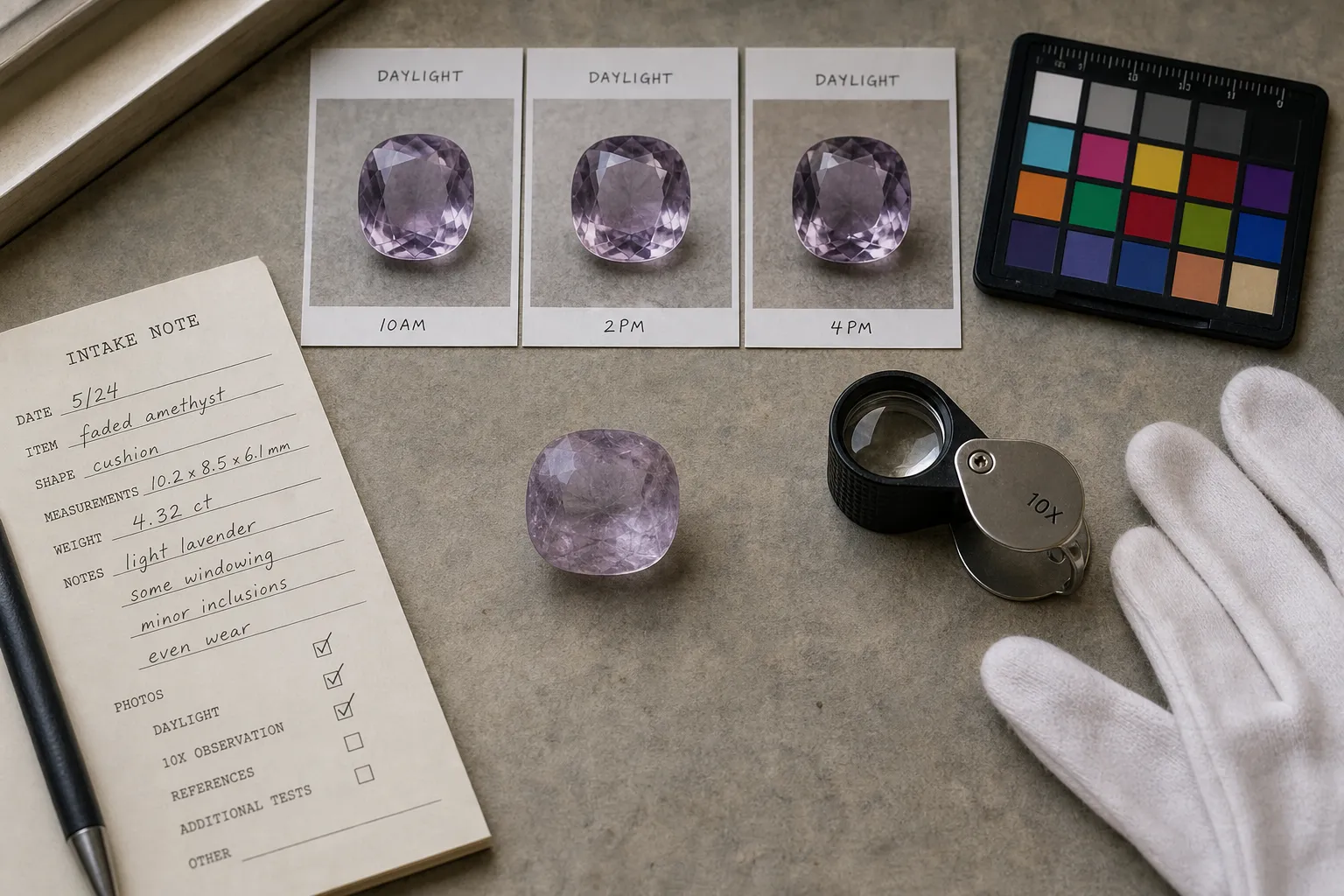
The fifth variable is documentation. Before-and-after photographs under consistent lighting, purchase records, prior treatment notes, and a laboratory report can all matter. Without them, “it used to be darker” may be true, but it is hard to turn into a clear restoration target.
Why Re-Irradiation Claims Need Caution
The phrase “re-irradiating amethyst” sounds technical enough to feel definitive. That is why it needs careful handling.
For this page, there is no authoritative public source material available that confirms reliable success rates, permanence, original-color matching, or gemstone re-irradiation limits for faded amethyst. Because of that, it would be misleading to present re-irradiation as a standard consumer repair with predictable results.
Separate These Three Claims
- A process can influence gemstone color in principle.
- A specific faded amethyst can become more purple.
- That same amethyst can recover its exact former appearance and remain stable.
The first is a broad mechanism idea. The second and third are outcome claims. Outcome claims need evidence connected to the stone, the treatment, and the post-treatment condition.
Disclosure also matters. If a gemstone has been treated, altered, or re-treated, that history may be relevant to future sale, appraisal, collection records, or buyer trust. This article is not giving a legal conclusion about disclosure duties, but an owner should not treat laboratory intervention as invisible or irrelevant.
Do not buy, sell, or value a faded amethyst on the assumption that “re-irradiated” means “returned to original.”
What to Do Before Deciding
If the stone is inexpensive and decorative, the best decision may be to accept the fading and change how it is displayed. Moving it away from strong light and heat is a conservative care choice, but it is not a restoration method.
If the amethyst has sentimental, collector, or resale importance, slow down before authorizing any intervention. Preserve information first.
Practical Pre-Decision Checklist
- Photograph the stone in neutral, repeatable lighting before any further handling.
- Record where and how it was displayed, stored, or worn.
- Gather purchase records, prior descriptions, treatment notes, or appraisal documents.
- Decide whether the goal is appearance, documentation, resale clarity, or preservation.
- Consult a gemological laboratory or qualified gem professional before considering treatment.
- Avoid any home attempt involving radiation, heating, chemicals, coatings, or improvised alteration.
That last point is not just a formality. Irradiation is not a household restoration technique. Home heating can change or damage appearance, and chemical or coating experiments can create new problems. Evaluation should come before intervention.
There is also an economic boundary. Laboratory evaluation or treatment may cost more than an ordinary amethyst is worth in market terms. That may not matter for a sentimental piece, but it does matter for expectations. “Can something be attempted?” and “does it make sense?” are different questions.
How to Read “Restored Color” Descriptions
When you see phrases such as “restored amethyst color,” “permanent purple,” or “original color returned,” treat them as claims that need support, not as proof.
A trustworthy description should make clear what was done, what was examined, and what remains uncertain. Attractive before-and-after language is not enough. An owner should want to know whether the stone was evaluated before treatment, whether the treatment is documented, whether color stability was assessed, and whether the final description distinguishes improved appearance from original-color recovery.
The common misunderstanding is that faded amethyst limits are only cosmetic. They are also informational. Once the stone’s appearance has changed, the earlier state may not be reconstructable with certainty. Even if a laboratory process produces a pleasing purple, the history of fading and intervention remains part of the stone’s record.
This matters especially for collectors. Amethyst is valued not only as a purple object, but as a mineral specimen or gemstone with identity, origin context, color character, and condition. A treated or re-treated stone may still be beautiful and meaningful. It just should not be described as though nothing happened.
The Practical Bottom Line
A faded amethyst can be evaluated, and in some cases laboratory intervention may be discussed. But this page does not have evidence to support a confident promise that re-irradiating amethyst restores the exact original purple color, produces lasting color stability, increases value, or removes the need to disclose treatment.
For most owners, the useful answer is:
- Do not assume fading is reversible.
- Do not attempt home treatment.
- Do not accept “restored” as proof without documentation.
- Do seek professional evaluation if the stone is valuable, sentimental, or intended for resale.
- Do consider preservation and honest description as valid outcomes.
A faded amethyst is not necessarily ruined. But it should be approached as a changed gemstone, not a simple repair project. The best expectation is not “make it exactly as it was.” It is “understand what changed, protect what remains, and avoid turning uncertainty into a promise.”