Crystal habit note
Euhedral Clarity: Why True Pink Amethyst Forms Perfect Crystals
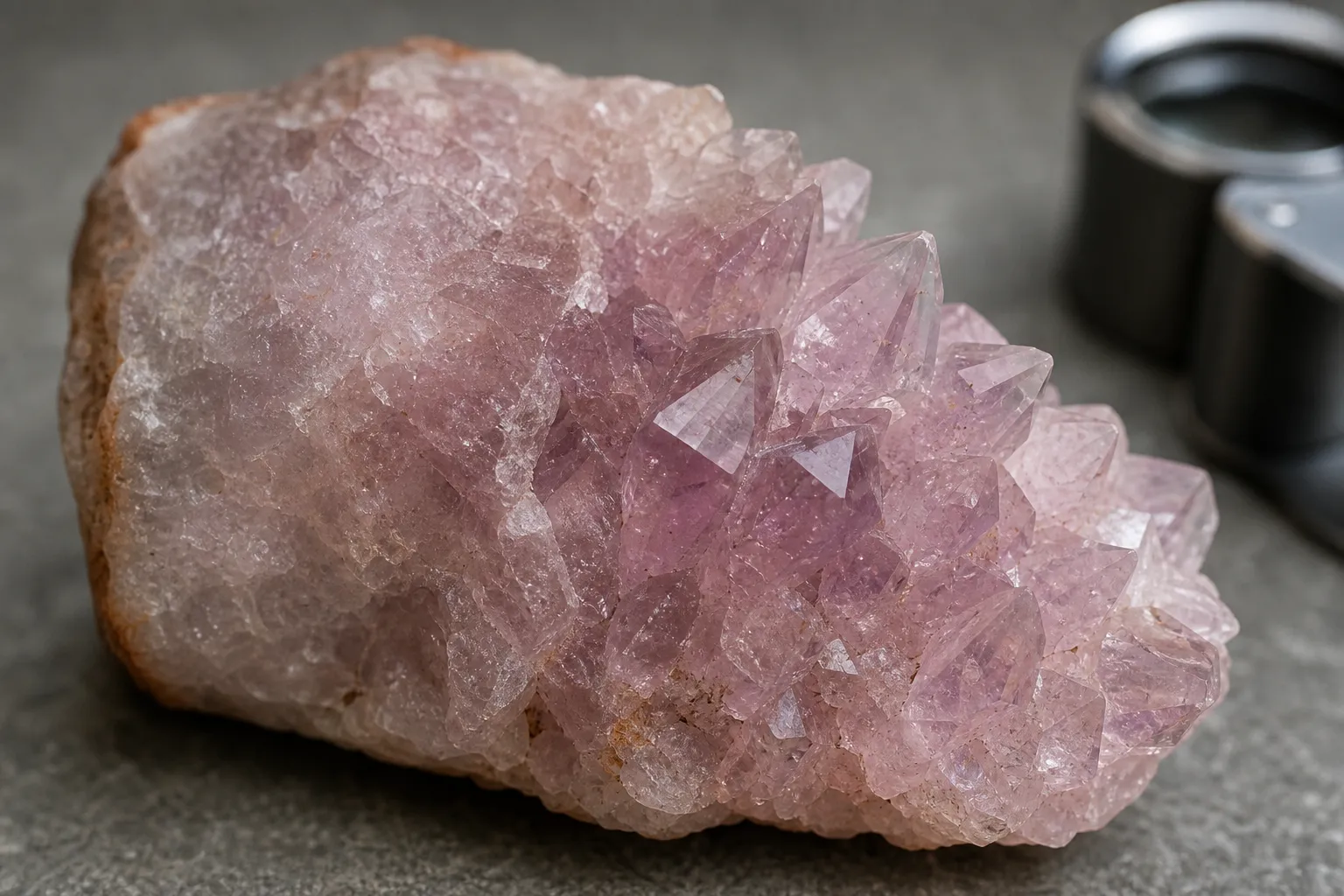
A pink amethyst specimen may look as if it formed “perfect crystals” when quartz had enough open space to grow outward and preserve recognizable crystal faces. In the language of Euhedral vs Anhedral quartz, the stronger question is not whether the crystal is perfect, but whether its shape still shows natural faces, edges, and a readable quartz habit.
A euhedral-looking pink amethyst crystal suggests that at least part of its growth surface was not blocked. An anhedral piece lacks its own well-formed outer shape because it grew against other material, became interlocked with neighboring grains, or lost its form through later breakage or overgrowth.
That is the direct answer, with one limit: this page does not have public authoritative references attached for pink amethyst formation, hematite-related color, or specimen-specific geology. The explanation below is a careful collector framework, not a lab identification.
broader context
Amethyst context note
This narrower page lands better after the broader amethyst context page.
What “Euhedral” Means on Pink Amethyst
“Perfect crystals” is collector language. It usually points to neat points, flat planes, crisp edges, and a surface that feels complete on a shelf or in the hand. Mineralogical language is less romantic and more precise. A euhedral crystal shows its own natural crystal faces clearly enough for its habit to be read.
Pink amethyst complicates the wording because many readers meet it through market photographs and short seller descriptions. A label may say “true pink amethyst crystals,” but that phrase does not confirm identity, color cause, growth setting, or crystal habit. It only tells us how the specimen is being presented.
The safer wording is this: a pink amethyst specimen can show a euhedral quartz crystal habit when some crystals preserve well-developed external faces. The visible habit is one clue about growth conditions; it is not a complete identity test.
A specimen first; a sales phrase second.
Euhedral vs Anhedral Quartz in Collector Terms
The difference between euhedral and anhedral quartz is mainly a difference in preserved outward form.
Euhedral quartz
Euhedral quartz shows readable crystal faces. The faces may be sharp, worn, interrupted, or clustered with other crystals, but the eye can still follow an individual shape. On pink amethyst, this may appear as small points or faceted terminations across part of the surface.
Anhedral quartz
Anhedral quartz does not show its own complete external form. It may appear as interlocking grains, massive material, broken surfaces, or quartz that filled a space without leaving distinct individual faces. Anhedral material can still be quartz, attractive, and part of an amethyst-related specimen. It simply does not preserve the same visible record of free outward growth.
Subhedral material
Subhedral material sits between the two. It has some recognizable faces, but they are incomplete or partly masked. This middle category matters because many real specimens are mixed: a pink amethyst cluster may hold euhedral-looking points beside broken, massive, or partly formed areas.
The collector-facing conclusion is simple: euhedral describes form, not automatic value, authenticity, rarity, or spiritual importance.
Why Growth Space Matters More Than “Perfection”
Euhedral quartz needs room around its growing surfaces. If quartz grows into an open cavity, pocket, vein opening, or similar available space, its outer faces may remain visible. If it grows pressed against other material, or if later events break or cover the surface, the result may look anhedral or only partly formed.
This is where terms such as cavities, veins, hydrothermal settings, and pegmatitic environments often enter the conversation. They can be relevant to quartz growth in general, but they should not be attached to a specific pink amethyst specimen without stronger evidence. For this leaf answer, they are better treated as questions to ask, not proof supplied by a photograph.
Translate the claim into an observation question.
So when a seller or collector says a pink amethyst piece formed “perfect crystals,” translate that into a more useful question: does the specimen preserve quartz crystal faces that suggest open growth space?
That question begins with observation. The final answer still needs evidence.
Where Macroscopic Hematite Fits
“Macroscopic hematite” can sound more decisive than it is. In collector language, it may point toward visible iron-rich material, reddish tones, or inclusions that can be seen without magnification. In a cautious mineral explanation, visible reddish material should not automatically be treated as confirmed hematite, confirmed color cause, or confirmed pink amethyst identity.
Color and habit are separate questions. A specimen can show crystal faces and still require separate support for its pink, lavender, or reddish appearance. Another specimen can be pink-toned and still be anhedral.
Keep the questions apart
- Habit asks whether quartz preserves recognizable crystal faces.
- Color asks what causes the pink, lavender, or reddish appearance.
- Identity asks what mineral or variety is actually present.
- Evidence asks what reliable observation or testing supports the claim.
This separation protects the collector from a common marketplace shortcut. A label that mentions hematite, pink color, or “true” amethyst does not by itself explain euhedral crystal form.
The Common Confusion Around “True Pink Amethyst Crystals”
The phrase “true pink amethyst crystals” blends three ideas: authenticity, color, and shape. Listings often collapse them into one attractive phrase, but a careful reading separates them.
Authenticity concerns whether the material is properly identified. That may require gemological or mineralogical support beyond visual inspection, especially where color names and trade terms overlap.
Color concerns the visible pink, blush, lavender, or reddish appearance. It may relate to inclusions, iron-bearing material, internal features, or other causes depending on the specimen, but this page cannot assign a mechanism without stronger sources.
Crystal habit concerns form. A pink amethyst piece may show quartz crystal faces, or it may appear massive, broken, druzy, or irregular. Euhedral habit does not prove “true” identity. Anhedral habit does not disprove it.
The useful correction is this: “perfect crystals” is not a mineral identification category. It is a visual phrase. The more careful term is euhedral habit, and it should be applied only to the parts of the specimen where natural crystal faces are actually visible.
A Practical Check for Crystal Faces
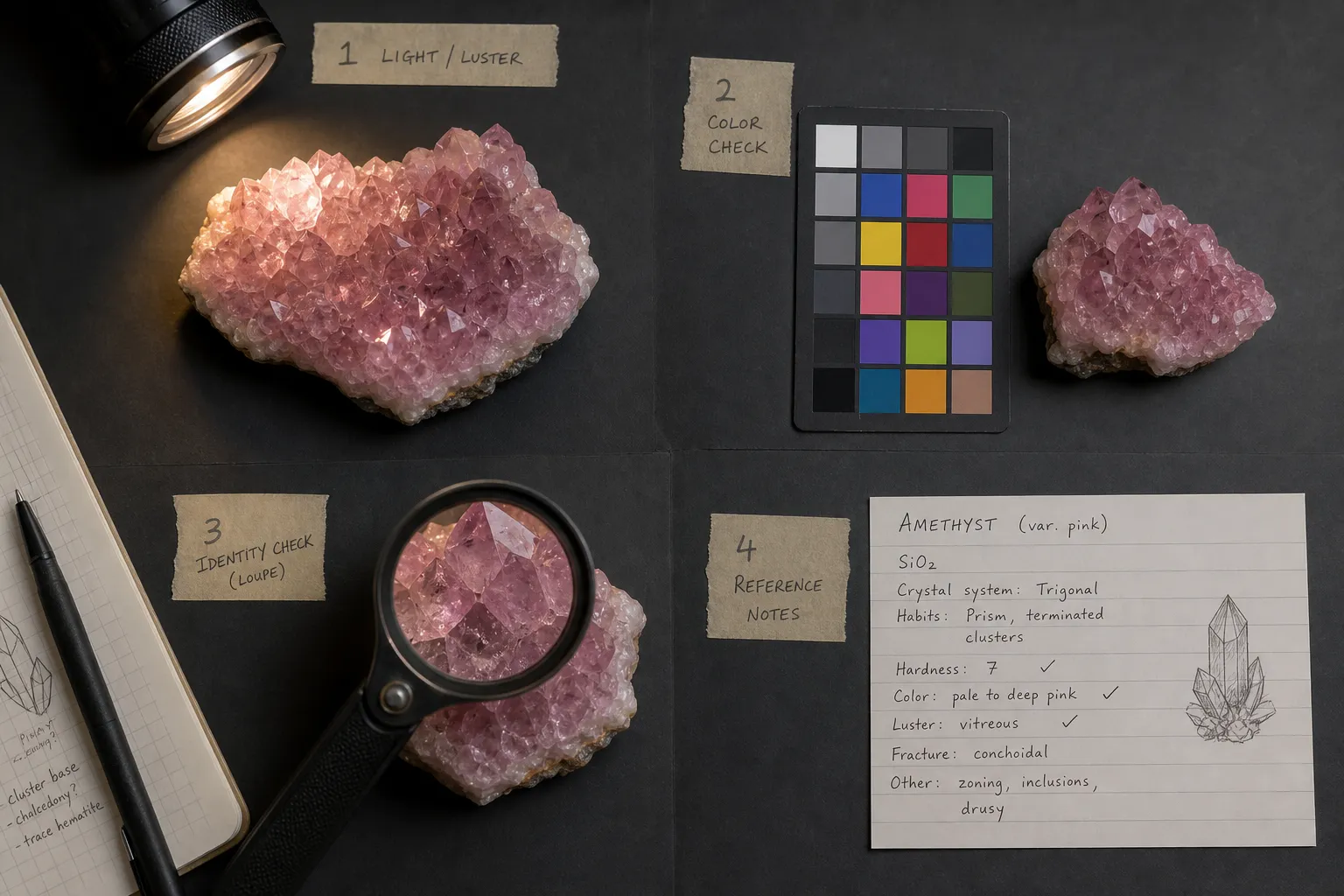
Start with repeated flat planes, not sparkle alone. Sparkle can come from tiny reflective surfaces, broken areas, or polished texture. Crystal faces are more orderly; they meet at edges and suggest a repeated habit.
Then look for individual crystals. A cluster may contain many small points, while a massive piece may show color and texture without distinct outlines. If the surface looks granular, compact, or broken, it may not support a strong euhedral description.
Separate surface condition from growth habit. A broken euhedral crystal may still preserve some faces. A polished or cut surface may look smooth without showing natural crystal faces. One specimen can also contain mixed zones: face-rich in one area, anhedral or damaged in another.
Finally, do not let the word “pink” answer the shape question. Pink amethyst crystal habit is judged by form. Color belongs to a different line of evidence.
A calm viewing habit is better than a dramatic label.
Why Pegmatites and Hydrothermal Settings Need Careful Wording
Pegmatites and hydrothermal settings appear in many quartz discussions because they belong to the wider language of mineral growth. They can help explain how crystals may develop in spaces, fractures, pockets, or fluid-influenced environments. But naming a setting for a specific pink amethyst specimen requires more than a visual impression.
Here, those terms serve a boundary function. They remind us that quartz crystal faces do not appear because a stone is marketed as rare or beautiful. They reflect physical growth circumstances and later preservation. Without citable geology, locality information, or specimen-specific evidence, it is too strong to say that a given pink amethyst cluster came from a pegmatitic environment or a hydrothermal cavity.
The better phrasing is conditional: euhedral-looking quartz faces are consistent with growth into available space. The exact setting must be supported separately.
What This Can and Cannot Tell You
Visible crystal faces can help you describe a pink amethyst specimen more accurately. Depending on what is actually present, they may support wording such as “euhedral-looking quartz faces,” “partly developed crystal habit,” or “anhedral massive quartz.” They can also help a collector ask better questions before accepting broad sales language.
They cannot, by themselves, confirm pink amethyst identity, hematite-related coloration, locality, rarity, treatment history, or quality. They also should not be used as a bridge into personal-outcome or spiritual-certainty claims.
Some readers may still prefer euhedral-looking crystals because orderly faces feel clear, architectural, or serene in a room. That is an aesthetic or symbolic reading, not geological evidence. It belongs beside the specimen, not inside the mineral claim.
For the narrow question of Euhedral vs Anhedral quartz, the answer is enough: true pink amethyst may show euhedral faces when quartz growth and preservation allow recognizable crystal form; anhedral quartz lacks that preserved outward shape. The rest—color cause, authenticity, geological setting, and meaning—needs its own evidence before it should be treated as settled.