Collector evidence note
The Role of Infrared (FTIR): When Visual Tests Aren't Enough
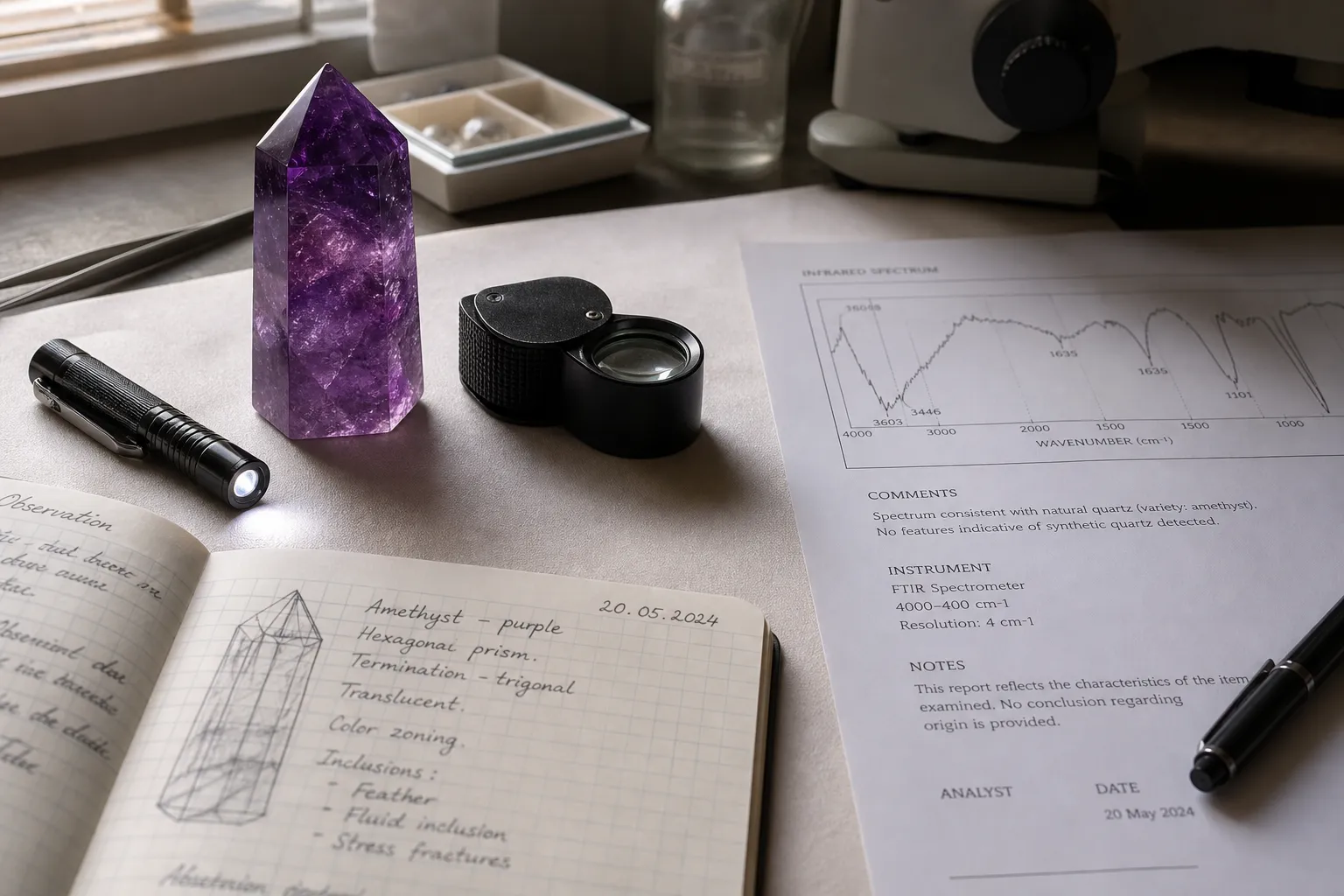
FTIR spectroscopy can help when an amethyst or quartz specimen raises questions that visual inspection cannot settle. It is not an authenticity button. In a gemological or mineral-identification setting, FTIR may add infrared absorption data that a trained interpreter can compare with the stone’s visible features and other test results. That is different from saying the spectrum alone establishes that a stone is natural, untreated, valuable, or synthetic.
For collectors, the practical role is narrow: use visual inspection for what can be seen, and consider FTIR when the question moves beyond surface appearance.
broader context
Amethyst context note
This narrower page lands better after the broader amethyst context page.
Where Visual Inspection Starts to Run Out
Visual inspection is still the first filter for most amethyst questions. Color zoning, transparency, fractures, inclusions, crystal habit, polish quality, and obvious coating or dye concerns can all shape an initial judgment. For many everyday purchases, that may be enough to decide whether a piece fits a collection, display, gift, or personal use.
The limit appears when the claim attached to the stone is more specific than the evidence in front of you. A listing may describe an amethyst as “natural,” “untreated,” “lab tested,” “rare,” or “synthetic-free,” while the buyer can only judge color, clarity, and finish. That is where visual tests may not be enough: the marketing promise is more detailed than the inspection method can support.
Use the gap test
FTIR becomes relevant only after that gap appears. It is usually not necessary for every tumbled stone, small cluster, or decorative point. It is worth considering when the cost, collection record, resale context, or strength of the claim makes additional evidence meaningful.
What FTIR Can Add
FTIR stands for Fourier-transform infrared spectroscopy. In simple terms, it examines how a material interacts with infrared light and produces a spectrum. In a quartz or amethyst question, that spectrum may contain absorption features that a qualified analyst can interpret as part of a broader material assessment.
The key phrase is “part of a broader assessment.” A spectrum is not a verdict by itself. It has to be read in relation to the sample, the instrument method, the question being asked, and any other observations available. A careful report does not reduce the whole stone to one visual impression or one isolated spectral feature.
For amethyst identification, FTIR may be considered alongside standard gemological observations, microscopy, refractive behavior, growth features, or other appropriate methods, depending on the laboratory and the question. The exact testing sequence matters, and the available source set for this page does not support a universal workflow.
The collector-level conclusion is therefore modest: FTIR can add a specialized laboratory layer when visual inspection leaves unresolved questions, but it does not automatically answer every concern buyers have about authenticity, treatment, origin, or value.
Why the “3543 Peak” Is Not a Buyer Shortcut
Searches around FTIR for quartz sometimes focus on the “3543 peak.” The number can sound reassuring because it feels precise. A peak, a spectrum, and a technical method can create the impression of certainty.
That impression should be handled carefully. The current evidence set for this page does not support explaining what the 3543 peak means, how it should be assigned, or whether it can reliably separate natural and synthetic quartz. This article should not treat its presence, absence, position, or shape as a diagnostic rule for amethyst.
Spectral interpretation depends on context. A single feature may be affected by sample condition, measurement method, overlapping absorptions, instrument settings, preparation, and the reference framework used by the interpreter. Without stronger laboratory or mineralogical sources, turning one peak into a buyer rule would overstate the evidence.
A better question is not “Does this stone have the 3543 peak?” A better question is: “Has a qualified laboratory interpreted the spectrum in relation to the specific identification question?”
If a seller uses a peak reference as a sales argument, ask what laboratory produced the result, what the report actually says, and whether the claim is narrow or stretched beyond the evidence.
When Lab Testing Is Worth Considering
FTIR for amethyst is most relevant when the uncertainty matters enough to justify specialized testing. The test should match the stakes and the question.
Lab testing may be worth considering when:
- The specimen is expensive or important to a collection record.
- The seller makes unusually strong claims about natural growth, treatment, or synthetic status.
- Visual inspection leaves more than one plausible explanation open.
- Documentation matters for resale, insurance discussion, donation, or long-term cataloging.
- A report would change what you are willing to pay or how you describe the piece.
The request should be framed clearly. “Is this real?” is usually too broad. Quartz identification, amethyst identification, treatment assessment, synthetic quartz identification, and origin language are not the same question. A lab may answer some of these more confidently than others, and some may require methods beyond FTIR.
Useful questions include:
- Is the material consistent with quartz or amethyst?
- What specific seller claim is being checked?
- Is the concern natural growth, synthetic growth, treatment, or documentation?
- What methods were used, and what are their limits?
- Does the report give a conclusion, or only describe observations?
These questions do not require the buyer to become a spectroscopist. They help prevent a mismatch between the concern and the test.
What FTIR Should Not Be Asked to Carry Alone
FTIR should not be presented as a stand-alone guarantee of authenticity, natural origin, treatment history, value, or market grade. It may contribute evidence, but it should not carry claims that require a broader basis.
This matters because buyers often want one clean answer: Is the amethyst natural? Is it synthetic? Has it been treated? Is it worth the price? Is the seller trustworthy? These are not the same question. Some are material questions, some are market questions, and some depend on documentation outside the stone itself.
FTIR may be relevant to material analysis, but it cannot replace provenance records, transparent seller practices, pricing research, or a fuller gemological evaluation. A spectrum does not establish that a mine name is accurate, that sourcing claims are sound, or that a price is fair.
The same caution applies to “lab tested.” A lab phrase is only useful if you can see the method, the competence behind the work, and the actual wording of the conclusion. A vague sales line is not the same as a qualified interpretation. A report with limited observations is not the same as a broad certificate for every claim attached to the piece.
A Practical Way to Read an FTIR Claim
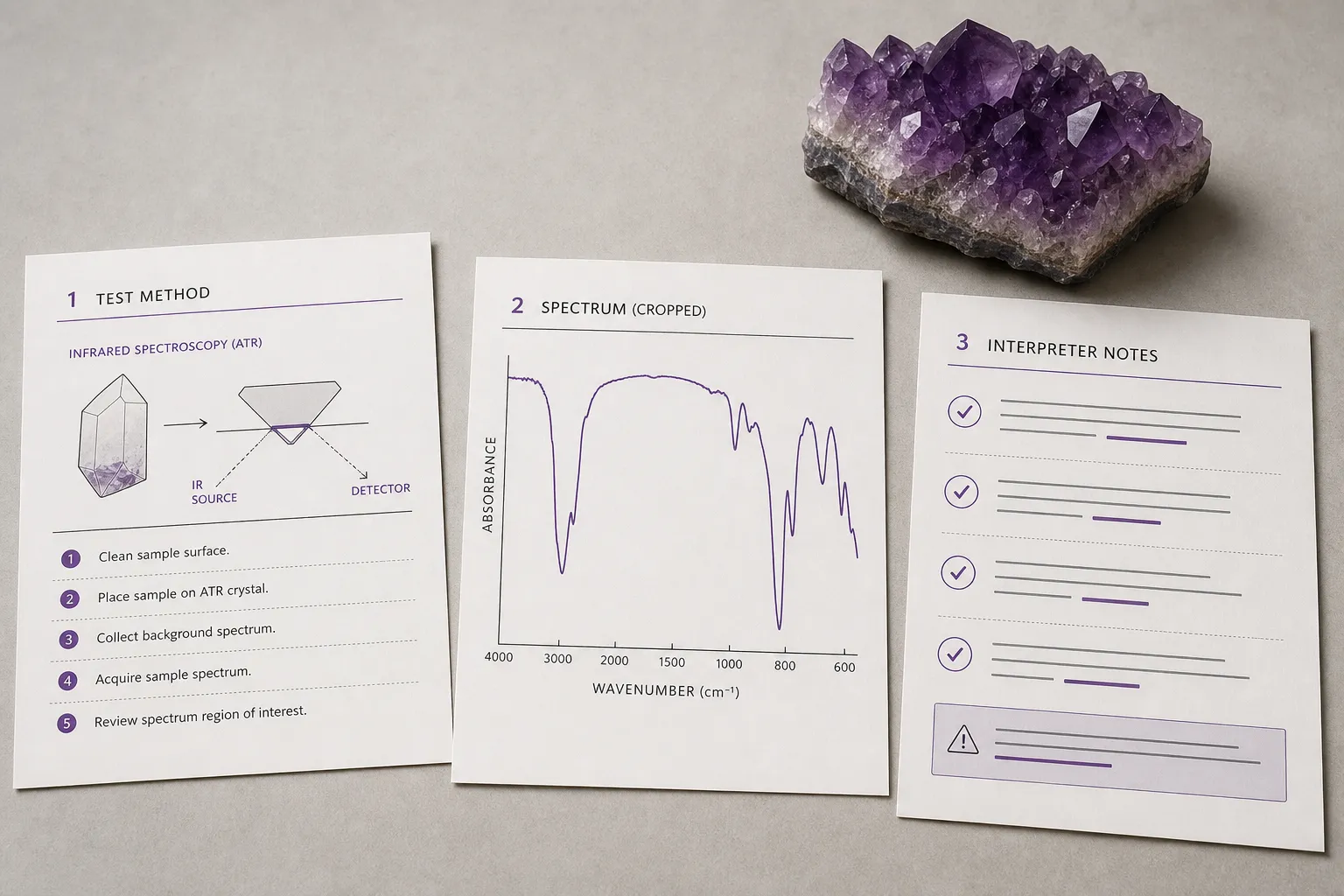
When you see FTIR language in an amethyst listing or report, separate three things:
The method
FTIR spectroscopy.
The observation
What the spectrum shows.
The conclusion
What the interpreter says those observations support.
Confusion starts when a seller jumps from method to certainty without showing the middle step.
A careful collector can ask:
- Who performed the testing?
- Is there an actual report, or only a sales phrase?
- What question was the test meant to answer?
- Does the report state limits?
- Was FTIR used with other observations?
- Is a narrow technical note being turned into a broad authenticity promise?
These questions are especially important when identifying synthetic quartz is part of the claim. This page cannot reduce synthetic quartz identification to one visible sign, one peak, or a casual checklist. If that question matters, it belongs in qualified interpretation.
The Collector’s Bottom Line
FTIR spectroscopy has a real place in the amethyst conversation, but its role is narrower than many buyer-facing claims make it sound. It is most useful when visual inspection leaves a meaningful uncertainty and when the result will be interpreted in context.
For everyday amethyst appreciation, visual observation, seller transparency, and reasonable expectations may be enough. For higher-stakes collecting, lab testing can add another layer. The mistake is expecting one laboratory technique to settle every concern at once.
A practical rule is: use visual inspection to decide what can be seen; consider FTIR when the question moves beyond the visible; rely on qualified interpretation before turning spectral evidence into a claim. Until stronger public sources are attached to specific FTIR peak assignments, synthetic quartz rules, or detailed workflows, the accurate answer stays measured: FTIR may help when visual tests are not enough, but it is not a shortcut to certainty.