Architecting Space: Building a Sacred Geometry Grid with Quartz
A clear quartz point on a windowsill reads differently from an amethyst cluster: one gives the eye structure and brightness, the other gives purple depth, zoning, and mineral presence. For Heart chakra geometric gridding, that difference is useful. Use quartz as the organizing stone in a sacred geometry layout, then treat the whole grid as a symbolic object for reflection, not as a verified energetic or health process.
The practical answer is simple: choose a quiet surface, place one quartz center stone on a Flower of Life pattern or a simple radial layout, arrange smaller quartz pieces around it, and pair the grid with one written intention. The meaning comes from attention, symmetry, and personal symbolism.
broader context
Begin with the main amethyst page
This narrower page lands better after the broader amethyst context page.
A Quartz Grid, Kept in Its Proper Lane
A quartz sacred geometry grid is an intentional arrangement of stones around a center point. In this article, it is not being treated as a scientific device, clinical tool, or source-backed spiritual mechanism. It is a small piece of spatial ritual design: clear stone, visible pattern, and a chosen theme.
That distinction matters because terms such as sacred geometry, heart chakra, and clear quartz amplification can carry strong claims in crystal-practice language. Here, they stay symbolic. The supplied material does not support public claims about energetic effects, therapeutic outcomes, historical certainty, or mineral-based mechanisms.
For a heart chakra grid design, the theme is usually love, compassion, emotional openness, forgiveness, or relational awareness. Those are reflection themes, not promised results. The grid gives the question a shape; it does not answer the question for you.
The Layout: Center Stone, Pattern, and Points
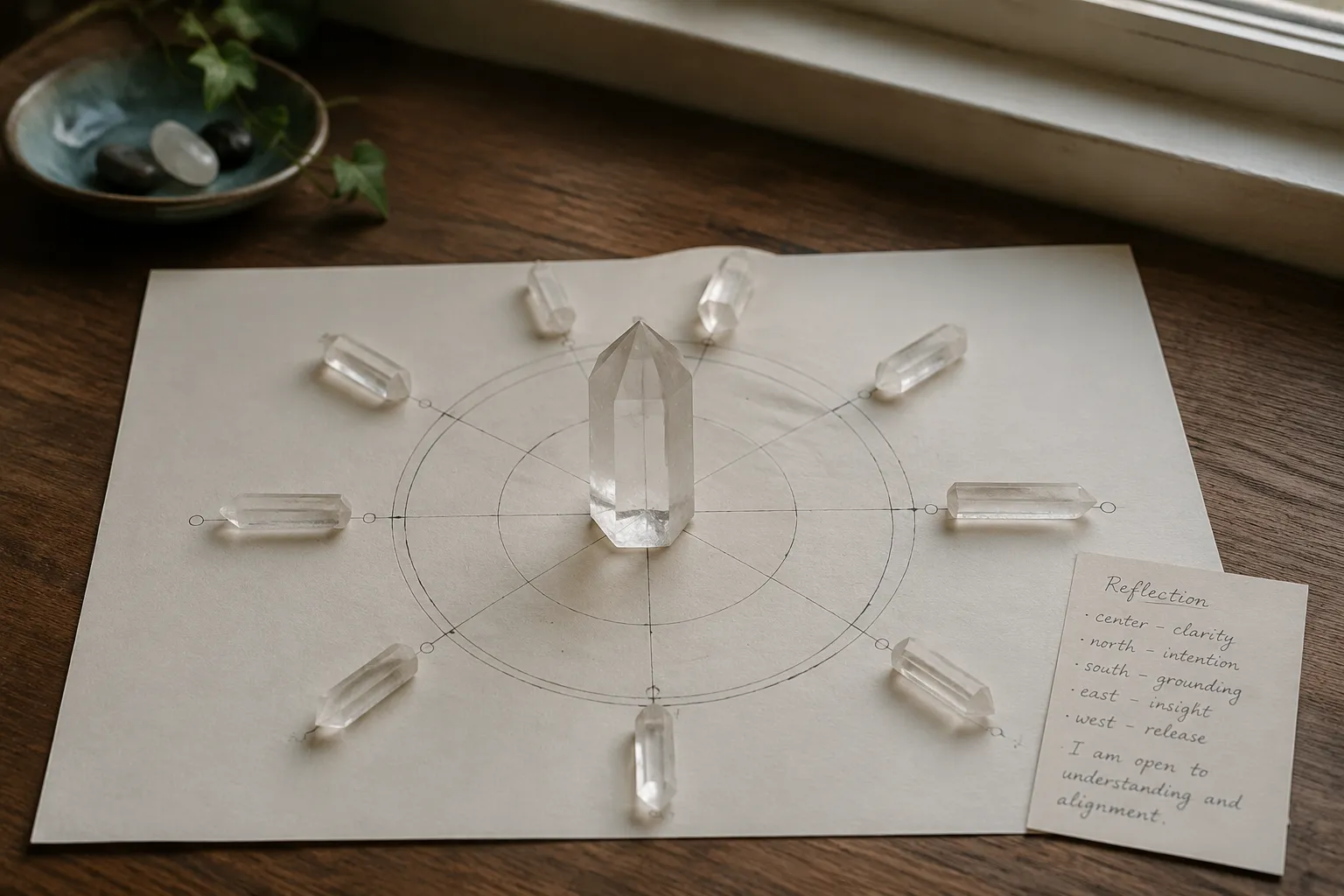
Start with a clean, stable surface: a low table, altar shelf, tray, cloth, or paper pattern. A printed Flower of Life grid can give the arrangement a recognizable sacred geometry structure, but a hand-drawn circle with six or eight points can work just as well. The useful feature is visual order, not proof of authority.
Place the quartz center stone first. It can be a tumbled clear quartz, a small point, a polished sphere, or a natural piece that sits securely. If you keep amethyst nearby, let it remain a companion specimen rather than the claim-carrier. Its color may deepen the room atmosphere, but this grid is built around quartz-based structure and heart-focused reflection.
A simple layout can use
- One quartz center stone for the main intention.
- Four small quartz pieces at the cardinal points for balance.
- Four additional pieces between them for a softer circular rhythm.
- Optional green or pink stones only if they already mean something in your practice.
- A written note under or beside the center stone to keep the intention specific.
If you use quartz points, decide their direction before placing them. Points aimed inward can symbolize gathering attention toward the center. Points aimed outward can symbolize extending a chosen quality into the room. Neither direction is an evidence-backed force; it is a visual metaphor. The value is in making the choice deliberate.
For a Flower of Life grid, use the repeated circles as placement cues. Put the center stone at the central circle or intersection, then place smaller stones on matching outer points so the design feels balanced from every side. If the pattern becomes crowded, remove stones. A symbolic crystal grid is often stronger when the eye can still read the structure.
What “Clear Quartz Amplification” Means Here
Clear quartz amplification meaning needs careful handling. In crystal-practice language, people often use “amplification” to describe the way clear quartz is assigned a focusing or strengthening role. On this page, the word is symbolic. It does not mean the stone has been shown to intensify energy, emotion, intention, or physical conditions.
A more grounded reading is this: clear quartz can become the visual focus of the practice. Its clarity, brightness, and central placement help you remember the intention. The “amplification” is therefore ritual and editorial in the ordinary sense; the design repeats one idea until it becomes easier to notice.
A collector’s eye helps here. A clear quartz point with chips, internal veils, or a cloudy base may still work well in a reflective grid. Aesthetic fit matters more than claims of superior power. If the center stone wobbles, scratches the surface, or distracts from the pattern, choose another piece.
If you include amethyst as an edge stone, keep its role modest too. Its purple color can support the atmosphere of the room and connect the arrangement to broader spiritual symbolism, but color and meaning should not be treated as proof of an outcome.
A Heart Chakra Grid You Can Actually Build
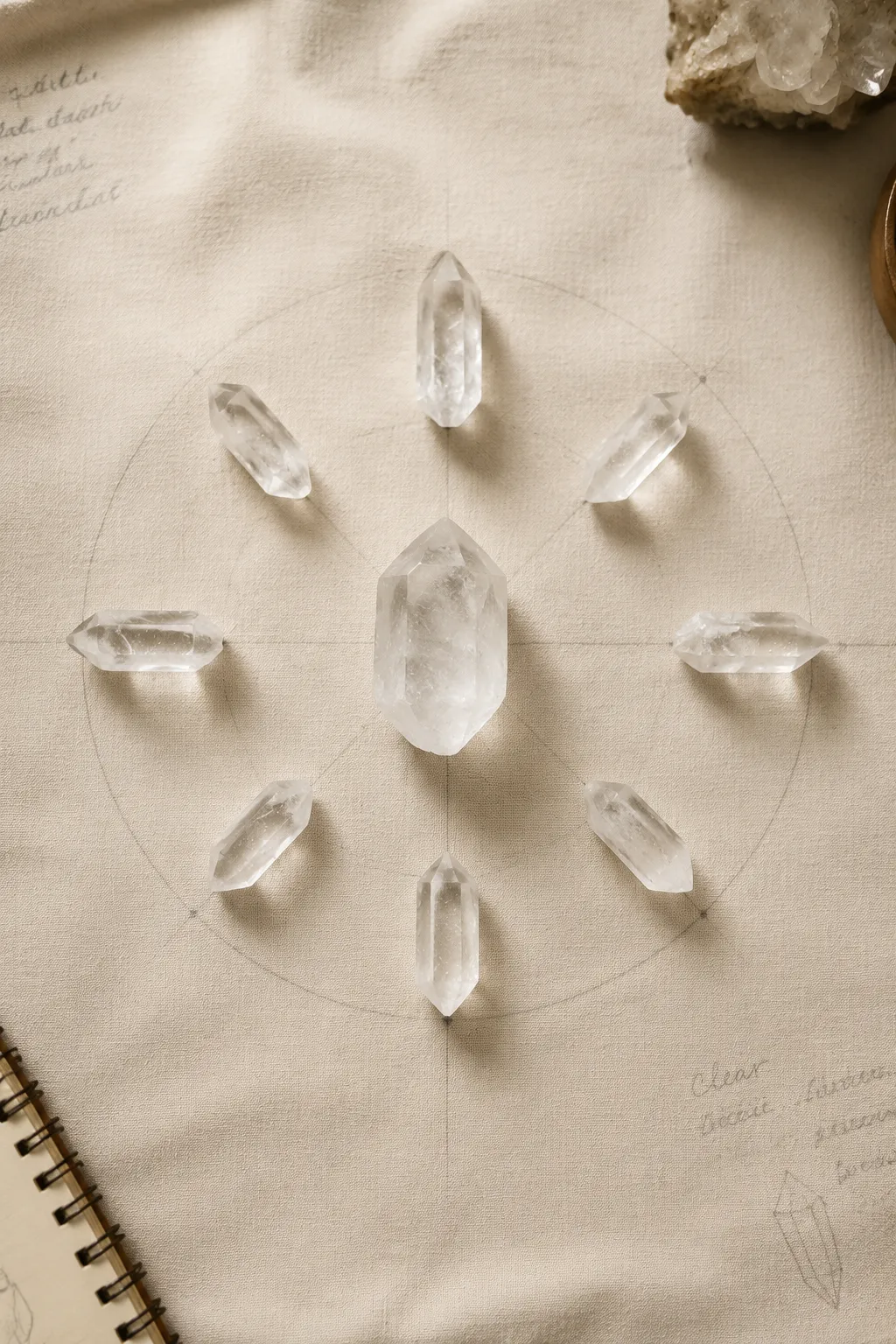
For a concise heart chakra geometric gridding practice:
- Place a cloth, tray, or printed pattern where it will not be disturbed.
- Put one quartz center stone in the middle.
- Write one plain-language intention.
- Place four quartz stones around the center in a cross.
- Add four more stones between them to create a circle or flower-like rhythm.
- Sit with the grid for a short reflective interval.
- Close by writing one observation, not a verdict.
The intention should be specific enough to hold attention and gentle enough to avoid overclaiming. Instead of asking the grid to produce a result, use language that names what you want to contemplate.
Useful reflective grid prompts include
- “Where am I practicing more patience than I notice?”
- “What relationship needs clearer boundaries and softer language?”
- “What would a generous response look like without ignoring my own limits?”
- “Which part of my home feels ready for more calm attention?”
- “What am I willing to release as a symbolic gesture today?”
These prompts keep the practice inside reflection. They do not ask the quartz to change another person, resolve a condition, or guarantee an emotional shift. The grid becomes a still point for attention; the writing keeps the practice honest.
For timing, a few minutes may be enough. If you leave the grid in place, treat it like any displayed mineral arrangement: keep it stable, away from edges, and easy to dust. Practical care belongs beside spiritual use.
What Changes the Answer
The best layout changes with the surface, stone shape, and intention. A tall quartz point may suit the center of a larger table, while a flatter tumbled stone is better on a narrow shelf. A complex Flower of Life grid may look beautiful on paper but feel busy with too many stones; a simple radial layout may work better in a small apartment or shared room.
The number of grid points also changes the tone. Four points feel steady and architectural. Six points lean toward a flower or hexagonal rhythm. Eight points create a fuller circular arrangement. The current materials do not support claims that one number is more effective than another, so choose the count that makes the design legible and calm to use.
The heart chakra theme can shift the arrangement as well. For self-compassion, place the written intention close to the center stone. For relational repair as a reflective theme, use paired stones opposite each other to symbolize dialogue. For boundaries, leave more empty space between the stones. In each case, the symbolism is chosen by the practitioner; it is not a universal rule.
One practical exception is worth keeping: if the stones are fragile, sharp, unstable, or placed where pets, children, or guests may knock them over, simplify the grid. A smaller aesthetic quartz arrangement on a tray is better than a complex pattern that cannot be maintained in the room.
Common Confusion Around Sacred Geometry and Quartz Grids
Treating pattern as verified effect
A Flower of Life grid may be meaningful to many spiritual readers, and it can provide a pleasing repeated structure. In this article, use it as a pattern, not as proof.
Assuming more stones make the grid stronger
More stones often make the arrangement harder to read. If the center stone disappears into visual clutter, the grid has lost its main function as a focus object.
Mixing authenticity talk with spiritual claims
A quartz piece can be examined as a mineral object in one conversation and used symbolically in another, but those are different kinds of judgment. Visible clarity, inclusions, polish, or crystal habit do not verify the grid’s meaning. Seller language about rarity, quality, or metaphysical strength should not replace your own careful observation.
Expecting the grid to do the reflective work
The stones can hold a shape on the table. The practice comes from the attention you bring to that shape.
A Small Closing Checklist
Before you consider the grid complete, ask five grounded questions:
- Is the quartz center stone stable and visually clear in the layout?
- Can I describe the heart-focused intention in one sentence?
- Does the sacred geometry grid layout look balanced rather than crowded?
- Have I kept “amplification” as symbolic language?
- Is the arrangement placed where it can be respected as an object in the room?
If the answer is yes, the grid is complete enough. You do not need a larger ritual, rarer stones, or stronger claims.
A quartz-based heart chakra grid works best as a visible arrangement for reflection: center stone, repeated points, chosen pattern, and quiet attention. Amethyst, clear quartz, and sacred geometry can belong on the same shelf, but they should not be asked to carry the same kind of certainty. Let the mineral remain observable, the care practical, and the meaning chosen with restraint.