Quartz identification
Rust or Inclusion? Identifying and Managing Surface Iron on Newly Mined Quartz
A rust-colored patch on newly mined quartz is not enough to tell you what it is. For a first look, color that seems to sit on exposed faces, in pits, along fractures, or around attached dirt can be described as possible surface iron staining. Color that appears sealed beneath an intact crystal face, follows internal veils, or stays visually inside the quartz should be treated as a possible inclusion or internal feature.
That is the practical answer to iron oxide staining vs inclusions: surface observation can point you in a useful direction, but it cannot confirm the mineral name, whether the material can be removed, or what processing would be appropriate.
The collector’s question is usually, “Is this just rust I can clean off, or is it part of the quartz?” A hand inspection can help you decide whether to pause, document, rinse loose dirt, or seek better identification. It should not be used to confidently label every orange, red-brown, or yellow-brown area as goethite, hematite, “limonite,” or another iron-bearing mineral.
broader context
Broader amethyst guide
This narrower page lands better after the broader amethyst context page.
Start with where the color seems to sit
Look at the relationship between the color and the quartz surface before trying to name the material.
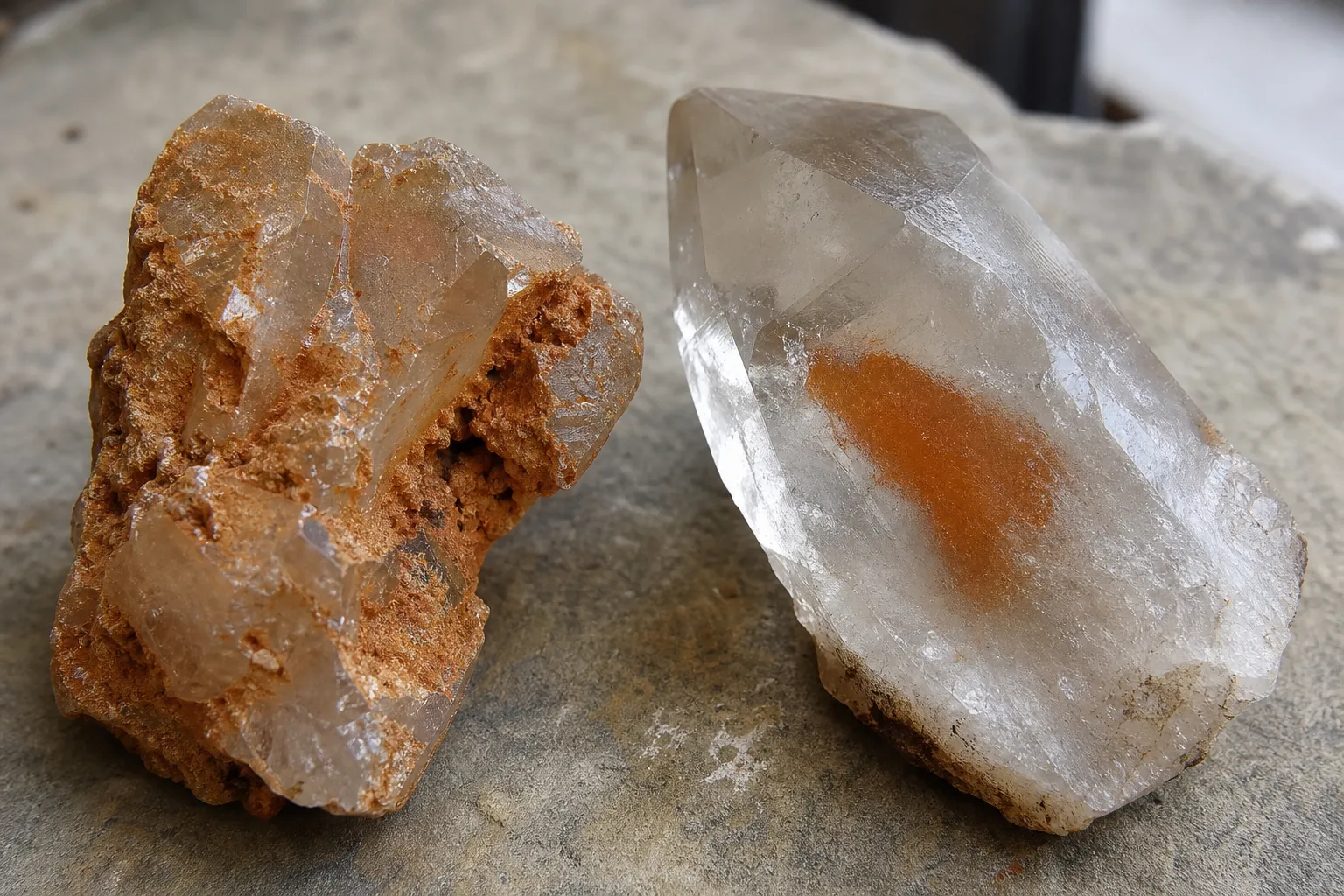
Rust-colored material leans surface-related when it looks patchy, powdery, earthy, or concentrated on the outside of the specimen. On newly mined quartz, this may show as orange-brown coating on exposed crystal faces, staining in small pits, or darker material gathered where clay, soil, or broken matrix remains. Collectors often call this “rust,” “iron,” “heavy iron,” or “iron oxide staining,” but those are field descriptions, not confirmed identifications.
Surface-looking color often follows the outer geometry of the crystal. It may collect around contacts, sit more heavily on damaged areas, or cross over several exposed surface features without looking enclosed by the quartz. That pattern supports a surface observation.
Possible quartz inclusions look different because the color appears within the body of the crystal. It may sit behind a clear face, follow a veil or internal fracture, appear suspended in a zone, or become visible only at certain angles. If an orange-brown shape seems covered by uninterrupted quartz, do not assume it is removable surface iron. It may be an internal inclusion, a coating trapped on an older growth surface, or another feature that surface cleaning will not reach.
The important word is “possible.” Newly mined quartz can carry external coatings, trapped dirt, broken contacts, internal veils, and included material on the same piece. One specimen may need more than one description.
Signs that lean toward surface iron staining
A rust-colored area leans toward surface staining when it appears on exposed surfaces you can physically access without pressing into the crystal. It may be strongest in low spots, along rough contact areas, or where the quartz was attached to host rock. It may look thinner on raised points and darker in protected crevices.
Signs that lean toward an inclusion
A rust-colored area leans toward an inclusion when it appears enclosed by quartz rather than lying on it. If the crystal face over the colored area is smooth, continuous, and unbroken, the color may be behind the surface.
Signs that lean toward surface iron staining
Edge behavior also helps. If the orange or brown color has a visible edge on top of the quartz, like a film, crust, or patch, it may be external. If it changes around chips, broken faces, or pits, that also suggests a surface relationship. In collector language, this is the kind of observation often called quartz iron oxide staining.
Freshly mined pieces can also carry ordinary mine dirt or matrix residue that looks iron-rich. Without stronger identification, it is better to describe this as rust-colored surface material rather than declare a specific mineral. “Goethite on quartz” may be a familiar phrase, and goethite is a real iron-bearing mineral term, but appearance alone is not enough to confirm it here.
A surface-leaning observation does not mean the stain is easy to remove or that processing is automatically appropriate. It only means the color appears accessible from the outside.
Signs that lean toward an inclusion
As you rotate the specimen, it may seem to shift in depth. It may look like a plume, veil, speck, sheet, or zone instead of a crust.
These features can be easy to misread. A stain inside a narrow open crack may look internal from one angle and surface-accessible from another. A coating on an older growth surface can appear trapped inside later quartz growth. A broken edge may expose material that was once enclosed. A single photo or quick glance rarely settles the question.
Quartz inclusions are not automatically a problem. Some collectors value internal iron-colored zones, veils, phantoms, or mineral-looking shapes. Others prefer cleaner-looking crystals. Either way, the management decision changes if the feature is internal: surface cleaning should not be expected to remove color sealed inside the quartz.
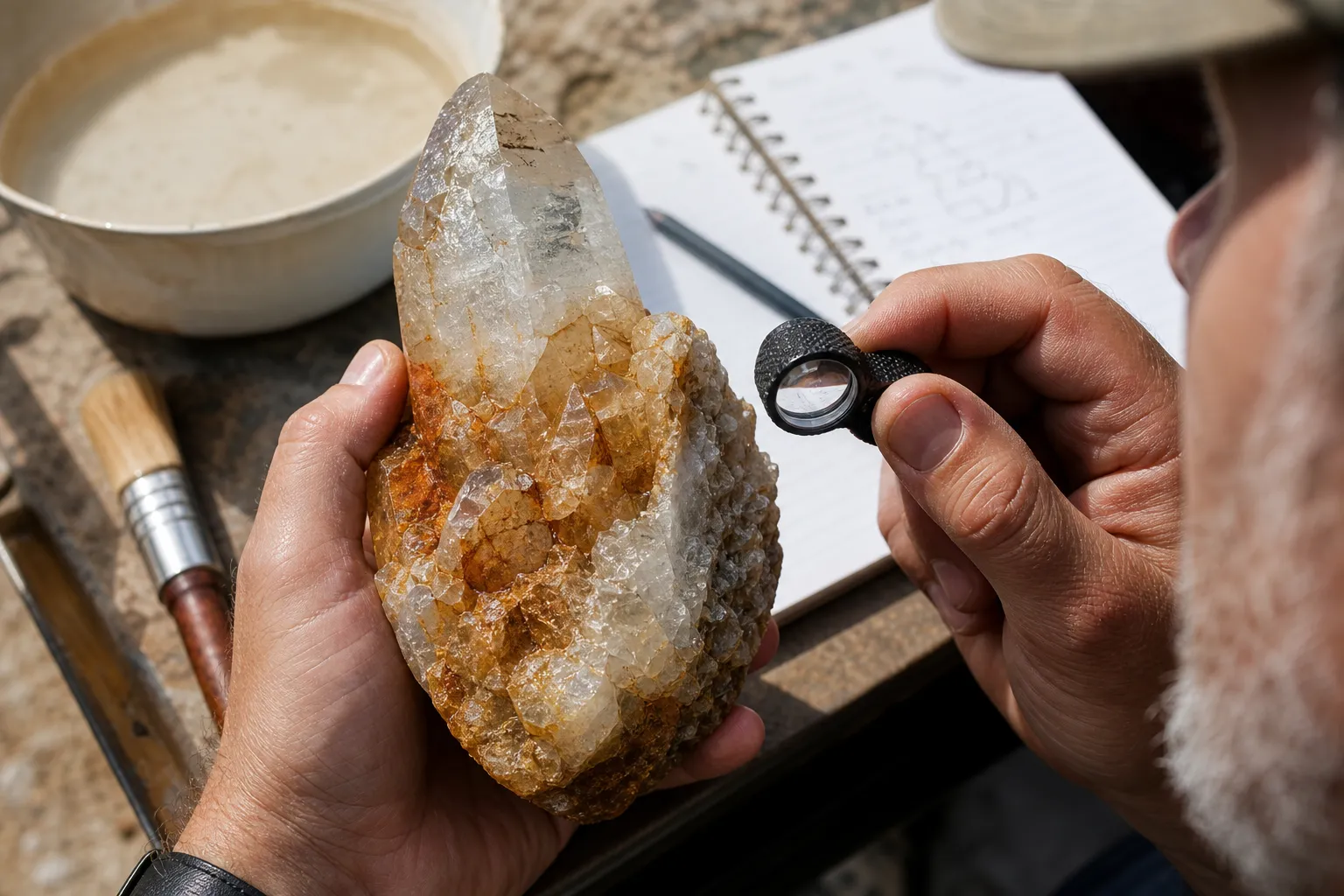
If you are unsure whether the color lies on or under the surface, keep it unresolved. View it dry, view it wet, change the light angle, inspect from several sides, and note whether the color aligns with outer surfaces, cracks, or internal planes.
What “heavy iron rust” should mean
“Heavy iron rust” is useful collector shorthand, but it is not a precise identification. It usually means the specimen has strong orange, red-brown, or brown staining that looks iron-rich. It may refer to surface coating, dirt mixed with iron-colored material, residue in cracks, or included material.
That distinction prevents two common mistakes. The first is assuming every orange-brown mark on quartz is removable surface rust. Some color may be internal, trapped, or part of the specimen’s growth history. The second is assuming every iron-colored feature is a named mineral such as goethite. Without better evidence, the name should stay provisional.
Useful specimen notes sound more like this
- “Orange-brown material on outer faces and pits; possible surface staining.”
- “Brown color visible behind intact face; possible internal inclusion.”
- “Mixed surface coating and internal-looking zones; evaluate separately.”
- “Unidentified iron-colored material; no treatment decision yet.”
This wording may feel less satisfying than naming the material, but it keeps observation separate from conclusion.
Managing the specimen without overclaiming
Management begins with restraint. If the quartz is newly mined and still dirty, avoid irreversible action until you have a clearer sense of what is surface material, what may be internal, and what the specimen might lose through processing.
A first-pass approach is observational rather than chemical: photograph the specimen dry, inspect it under steady light, view it from several angles, and mark where the rust-colored material appears to sit. If the specimen is later compared after gentle loose-dirt removal, the photos help show what changed. This is documentation, not a cleaning protocol.
This article does not provide chemical handling steps, concentrations, soak times, neutralization methods, disposal guidance, or promised cleaning outcomes. Those decisions need reliable mineralogical and safety guidance, especially if acids, rust removers, abrasion, heat, or long soaking are being considered.
Processing limits matter because the “best” result is not always the whitest or clearest crystal. A surface coating may be unwanted grime, but it may also be part of the specimen’s context. An internal feature may not be reachable without damaging the piece. A stain in a fracture may be open in one area and sealed in another.
If the specimen has strong aesthetic, monetary, locality, or personal value, do not use it as a test piece. Set it aside until you can compare it with lower-value material or get better identification.
Where surface observation stops
Surface observation is useful because it sorts possibilities. It cannot prove chemistry, origin, or removability. A rust-colored area on quartz may be surface staining, included material, a coating in a fracture, residue from surrounding matrix, or a mix of those.
A practical boundary is simple:
- If the color is visibly on the outside, describe it as possible surface iron staining.
- If it is visibly under an intact face, describe it as possible internal material.
- If the view is mixed or ambiguous, leave it unresolved.
- If the piece matters to you, stop before aggressive processing and seek better identification.
That is not evasive; it is the level of certainty a careful first-pass inspection can support. “Rust” can describe color. “Iron staining” can describe a visual category. “Goethite” should be reserved for better-supported identification. “Inclusion” should be used when the feature appears enclosed or internal, not simply because the color did not come off.
Newly mined quartz can show both surface iron-colored staining and internal iron-bearing-looking features. The first clue is where the color sits. The final identification needs more than color, confidence, or a seller’s label.
FAQ
Can I tell iron oxide staining from inclusions by color alone?
No. Orange, yellow-brown, red-brown, and dark brown color can appear in surface material, fracture coatings, dirt, matrix residue, or internal features. Placement is more useful than color alone.
Does “rust” always mean surface staining?
No. In collector language, “rust” often describes the look of the color. It does not prove that the material is external, iron oxide, or removable.
If the color does not wipe away, is it an inclusion?
Not necessarily. It may be in a narrow crack, attached as a stubborn coating, mixed with matrix residue, or sealed inside the quartz. Resistance to simple contact is only one clue.
Should I call it goethite?
Only if the identification is supported by more than appearance. For a first-pass note, “possible iron-bearing surface material” or “possible internal iron-colored inclusion” is more careful.
What should I do first with newly mined quartz?
Document it before processing. Photograph it dry, inspect it under steady light, check several angles, and separate loose dirt from the question of whether the color is on the surface or inside the crystal.