Intentional Crystal Journaling
Stream-of-Consciousness: Using Heavy Quartz as a Somatic Writing Anchor
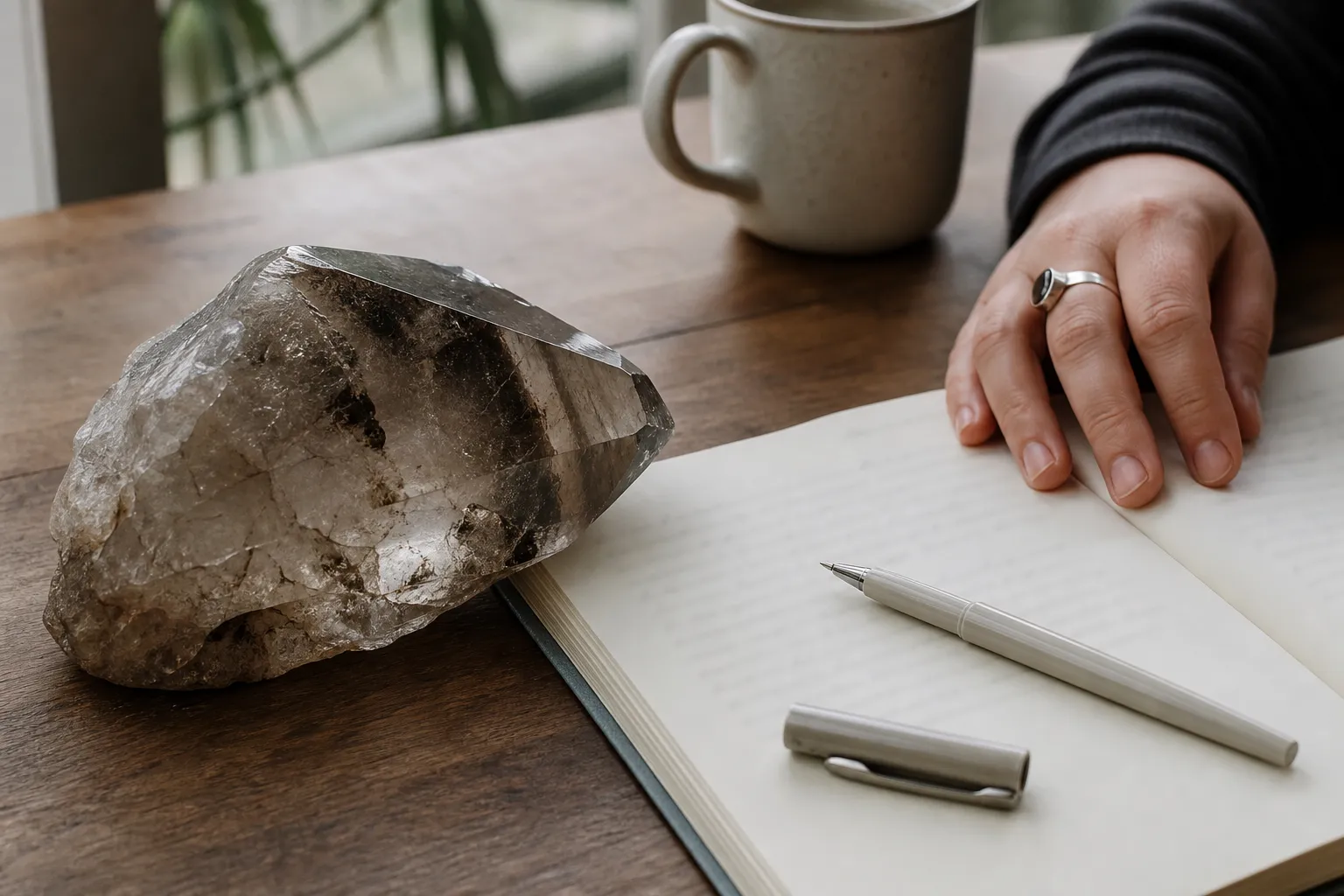
A heavy quartz piece can support intentional crystal journaling when it is used as a tactile anchor: something to hold, rest a hand on, or keep near the page so your attention has a simple place to return. The stone is not a source of authority, a method for changing your mental state, or a way to force hidden meaning out of the page. In this practice, quartz works best as a personally meaningful object, a sensory cue, and a small ritual frame for stream-of-consciousness writing.
The useful part is modest: a solid object gives your hand something to notice. That moment of noticing can become a pause, a breath, and then the next sentence. If quartz already carries symbolic meaning for you — clarity, steadiness, quiet attention — that meaning can shape the tone of the session without turning the practice into a health-outcome claim.
broader context
Amethyst context note
This narrower page lands better after the broader amethyst context page.
How Heavy Quartz Can Change the Writing Session
Stream-of-consciousness writing asks you to keep moving across the page without editing every phrase as it appears. That sounds simple until the mind starts judging the wording, waiting for a clearer thought, or trying to make the entry useful before it has even begun.
A heavy quartz piece gives the session a physical center. Instead of starting with an abstract command like “write freely,” you begin with a concrete action: feel the stone, notice its weight, and write the next line. The quartz becomes a cue, not a verdict.
Where to Place the Stone
For a bounded heavy quartz journaling session, place the stone where it helps without getting in the way:
- Hold it in your non-writing hand if that feels comfortable.
- Rest it on the desk under your palm so you can touch it between lines.
- Keep it beside the notebook as a marker that this is a deliberate reflective space.
The goal is not a perfect ritual. The goal is fewer decisions at the start. You are not deciding whether the entry is profound, polished, or complete. You are returning to a small loop: touch, notice, write.
That loop can help when you tend to over-edit. If the sentence is clumsy, write the clumsy sentence. If the thought changes mid-line, let it change. If nothing arrives, write a plain observation: “I am holding the quartz, and I do not know what I want to say yet.”
That kind of sentence is not a failure. It is often the practice beginning without performance.
A Simple Way to Use Quartz as a Tactile Writing Anchor
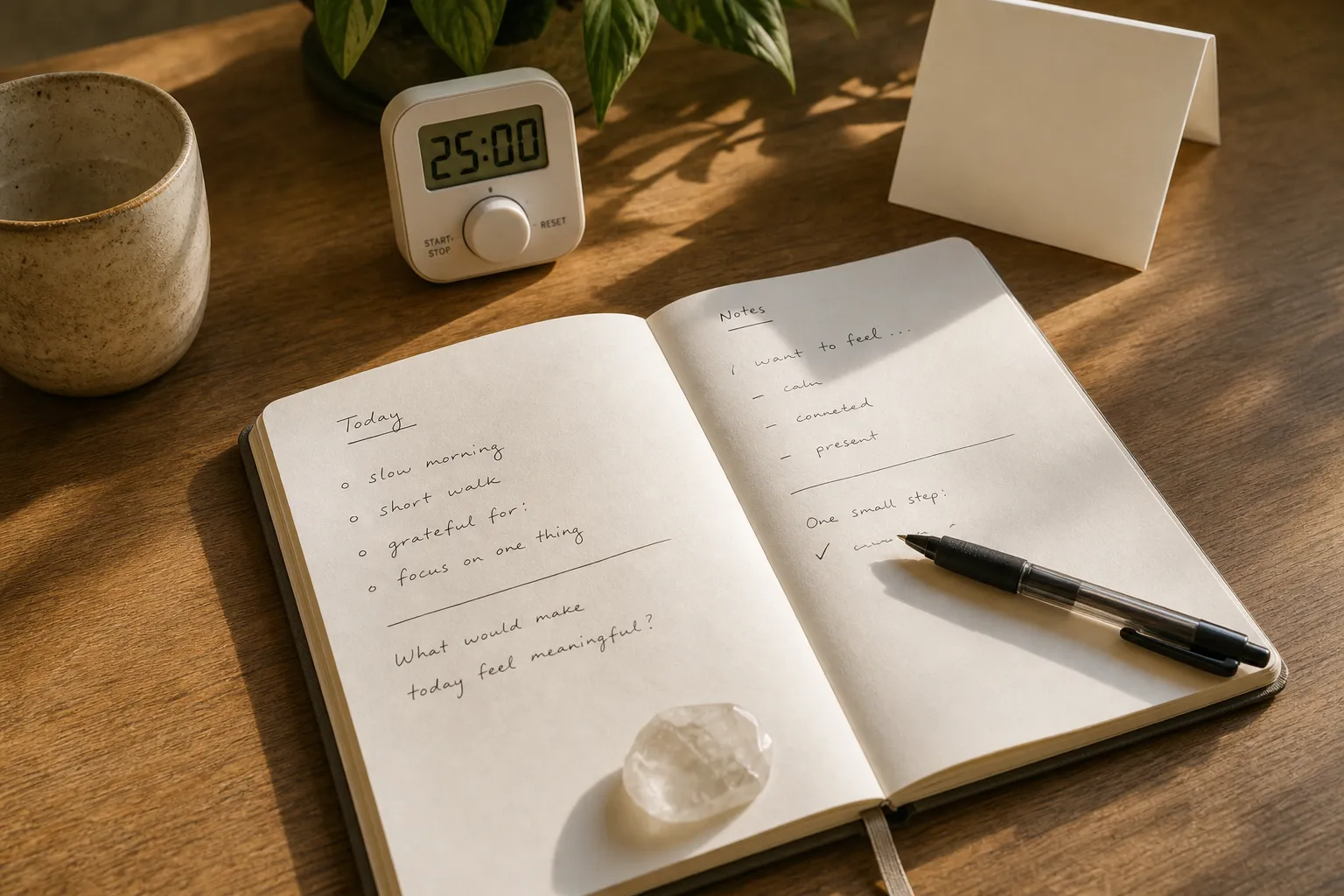
Keep the first session short. Five to ten minutes is enough to learn whether this style of reflective journaling suits you. Treat that time limit as a practical container, not a formal protocol.
Choose a quartz piece that is physically comfortable. “Heavy” should mean reassuringly solid, not awkward, sharp, unstable, or difficult to hold. If the stone distracts you, makes your wrist tense, or feels too precious to handle freely, use a smaller piece or place it nearby instead.
Plain-Language Intentions
Set one plain-language intention before you begin:
- “I want to write without correcting myself.”
- “I want to notice what is already on my mind.”
- “I want to give this page ten honest minutes.”
- “I want to stay with simple words.”
Sensory Punctuation
When you get stuck, touch the quartz again and write one sentence from that contact:
- “The stone feels cool in my hand.”
- “The weight makes me slow down.”
- “I am noticing my fingers more than my thoughts.”
- “I want this entry to mean something, and that pressure is getting in the way.”
Then write continuously. Full sentences are fine. Fragments, questions, repeated phrases, and observations about the room are also fine. The stream does not need to be elegant. It does not need to reveal anything. It only needs to keep moving long enough for your usual self-editing to loosen.
These lines are not evidence of a hidden mechanism. They are ways of giving attention a place to land. Quartz works here because you have chosen to use it as part of the writing frame.
At the end, stop before you analyze everything. Put the pen down. Move the stone away from the page, or close the notebook for a moment if that feels right. Then read back only enough to mark one phrase, image, or question worth carrying forward.
What Affects Whether This Practice Feels Useful
The answer depends less on quartz itself and more on the conditions around the writing. A heavy stone may feel steady to one person and distracting to another. A ritual frame may help one writer begin, while making another writer self-conscious. The value is personal, optional, and not guaranteed.
Comfort Comes First
A stone that is too large, rough, cold, or unstable pulls attention away from writing. Comfortable stone journaling means the object supports the session without becoming the main task. If you keep adjusting the quartz, worrying about dropping it, or noticing strain in your hand, change the setup.
Expectations Shape the Page
Stream-of-consciousness writing becomes harder when every entry is expected to uncover something deep. The word “subconscious” is sometimes used around freewriting, but it needs care. This exercise is better understood as a place where thoughts, moods, associations, and language may surface in an unpolished way. The page can be meaningful without being final.
Timing Changes the Experience
Writing while rushed, exhausted, or emotionally overloaded may not bring the clarity you hoped for. A short session can still be useful, but it is reasonable to stop if the writing becomes agitating rather than clarifying.
Symbolism Is Optional
Finally, consider your relationship to crystal symbolism. If quartz represents clarity or steadiness for you, let that meaning support the atmosphere. If it does not, there is no need to force it. A stone can be beautiful, weighty, and symbolically useful without being treated as a device that changes the body or mind.
Common Confusion Around “Somatic” Language
“Somatic” can be useful here in a plain-language sense: the practice includes the body because you are using touch, weight, hand position, and physical noticing as part of writing. That does not make heavy quartz journaling a clinical method.
For this specific practice, ordinary language is clearer. You might feel more present because you are sitting down, reducing distractions, touching a familiar object, and giving yourself a defined writing task. That is enough. The practice does not need stronger claims to be worthwhile.
The same care applies to “subconscious writing.” Stream-of-consciousness writing can bring up unexpected phrases because you are writing faster than you are editing. It may reveal recurring concerns, images, or patterns of attention. But the page is not an oracle. A repeated theme can be worth noticing without becoming a conclusion about who you are.
Another common misunderstanding is that a heavier stone is automatically better. Weight can make the anchor more noticeable, but too much weight becomes a distraction. The right quartz piece is the one you can use without fuss. If a small tumbled stone works better than a large point or cluster, use the smaller stone.
Optional Prompts for a Bounded Session
Prompts help only when they keep the writing open. Choose one and hold it lightly. If the writing moves away from the prompt, let it.
Try One of These
- “What am I trying too hard to phrase correctly?”
- “What do I notice when I stop improving the sentence?”
- “What does this object help me return to?”
- “What feels present before I explain it?”
- “What would I write if this entry did not need to become useful?”
Pair the prompt with a simple time boundary. Set a timer, touch the quartz, write until the timer ends, and stop. If you want to continue, pause first. That pause separates freewriting from reflection.
Choose One Closing Action
After writing, avoid mining the page too aggressively. Choose one closing action:
- Circle one phrase that feels alive or accurate.
- Write a one-sentence note about what the entry seemed to orbit.
- Close the notebook without analysis and return later.
Reflection asks, “What do I notice now?” Correction asks, “How do I make this sound better?” For intentional crystal journaling, the first question is usually more useful.
When to Pause or Use a Different Anchor
This practice should stay gentle. If the writing brings up difficult feelings, physical unease, spiraling thoughts, or a sense that you cannot step away from the page, pause. Put the quartz down, look around the room, drink water, or do something ordinary that reconnects you with the present setting. If distress feels persistent or hard to manage, seek qualified support rather than trying to work through it with journaling or crystal ritual alone.
It is also fine to choose a different anchor. A mug, smooth shell, folded cloth, pen cap, or plain stone can serve the same practical role if quartz feels too symbolically loaded or distracting. The reflective structure matters more than the object.
Use heavy quartz when it helps you begin, stay with the page, and close the session with care. Leave it aside when it adds pressure, performance, or discomfort. That boundary keeps the ritual honest: the stone is a companion object for attention, not proof that the writing is deeper, safer, or more true.
Intentional crystal journaling is strongest here when it stays small and deliberate. Hold the quartz if it helps. Write without over-editing. Notice what appears. Stop when the session is complete. Let the page be a record of attention, not a demand for certainty.