The 50kg Statement Piece: Integrating Massive Specimens into Luxury Interiors
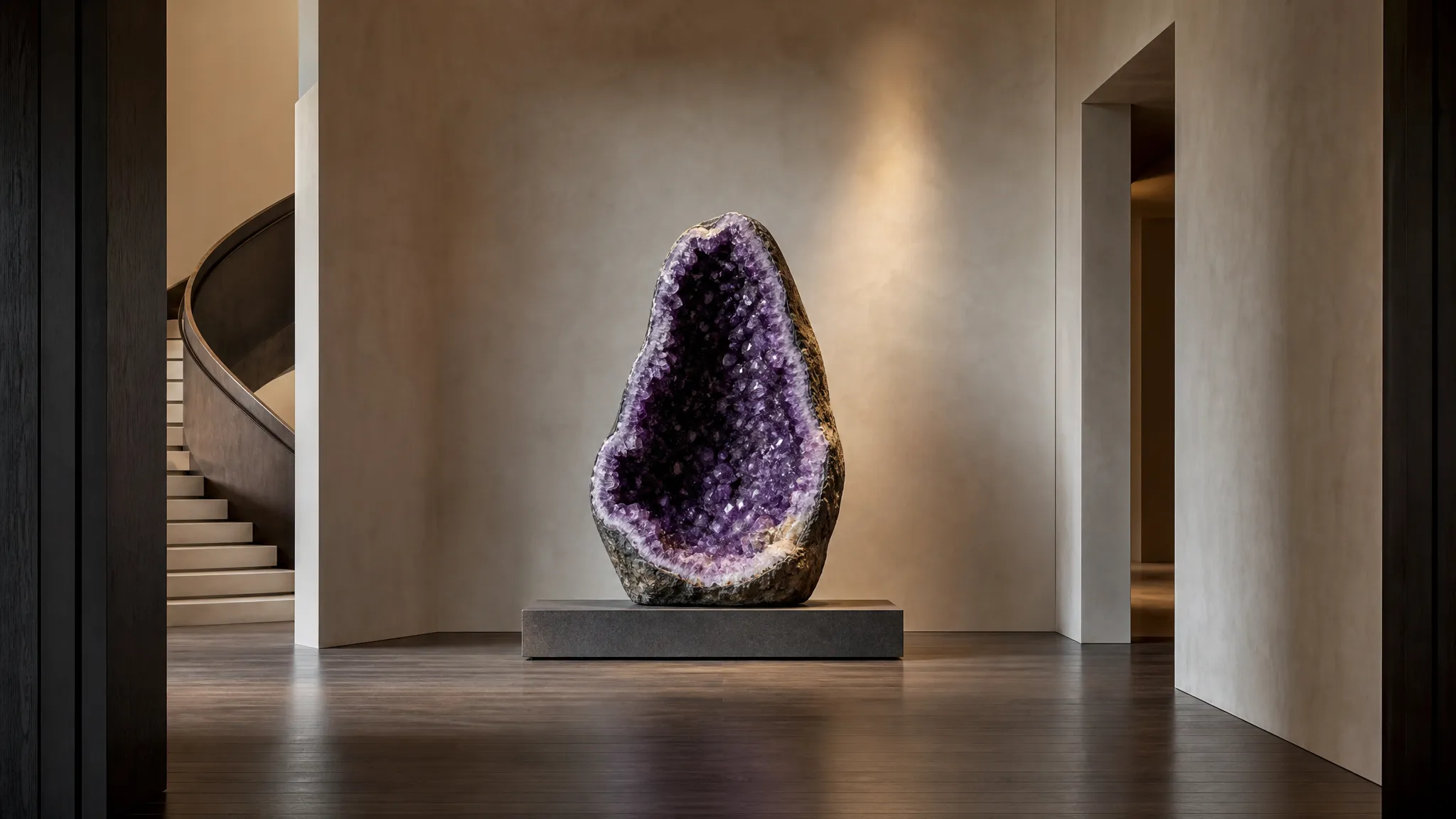
A 50kg amethyst geode or crystal specimen belongs in a luxury interior when it is treated as a sculptural installation, not oversized tabletop decor. In practical terms, successful Luxury interior crystal design means choosing one commanding location, giving the specimen negative space, confirming the support surface or pedestal, planning the delivery route before arrival, and lighting the mineral with restraint.
At roughly 110 pounds, the piece is heavy enough that proportion, circulation, stability, and access matter as much as color and sparkle. The goal is not to make the room “more crystal-filled.” It is to let one substantial mineral object hold architectural presence without visual clutter, awkward maintenance, or avoidable handling risk.
broader context
Amethyst context note
This narrower page lands better after the broader amethyst context page.
Put it where the room can support the statement
A large amethyst statement piece works best where the architecture already expects a focal point: a foyer, a reception area, the end of a gallery-like corridor, a quiet corner of a formal living room, or a composed executive office. In a corporate headquarters, it can work as a memorable reception anchor or leadership-space object, but that should be treated as a plausible design use, not as proof of a documented corporate case study.
The first question is not “Where will it look dramatic?” It is: Where can it be seen, approached, cleaned, and protected without interrupting the room?
A 50kg crystal specimen display needs:
- A clear sightline. The piece should be visible from the natural entry point of the room, not hidden behind seating, plants, or console styling.
- Enough negative space. Leave breathing room so the geode reads as sculpture rather than retail display.
- A calm background. Soft white walls, warm neutrals, stone, dark wood, or simple plaster usually let the purple quartz carry the visual appeal.
- Low collision exposure. Avoid tight corridors, crowded elevator lobbies, chair backs, rolling luggage paths, and places where guests may brush against crystal points.
- Cleaning access. If the specimen is wedged into a corner or placed too close to glass, upholstery, or millwork, routine dusting becomes harder and riskier.
For a foyer crystal statement piece, a central position can be powerful only when the base is stable and circulation remains generous. In many interiors, a protected side placement against a calm wall looks more luxurious than a dramatic center-of-room position that people must constantly walk around.
Make the pedestal quiet, deliberate, and verified
A custom pedestal for a geode has two jobs: make the object look intentional and provide appropriate support. This article cannot give a universal pedestal specification because the available evidence does not establish one-size-fits-all rules for base design, floor loading, anchoring, or furniture capacity. That is why the support question should be settled before styling begins.
A large amethyst geode may have an irregular base, uneven weight distribution, and a center of gravity that is not obvious from the front. Even a cut-base geode can appear visually stable while still needing careful placement. A normal console, floating shelf, thin slab, or decorative side table should not be assumed suitable for a 50kg mineral object.
A stronger luxury approach is visually quiet and technically deliberate:
- Dark plinths can make the purple interior appear more luminous and gallery-like.
- Stone or wood bases can connect the specimen to architectural finishes already in the room.
- Low, broad pedestals often feel more grounded than tall, narrow stands, though the actual design still needs project-specific review.
- Floor protection matters on marble, timber, polished concrete, and delicate rugs.
- Verified support is especially important for upper floors, reception desks, built-in cabinetry, floating consoles, and public-facing settings.
The pedestal should not compete with the geode. The specimen already has texture, depth, and color; the base should provide proportion, calm, and confidence.
Plan the route before the piece reaches the door
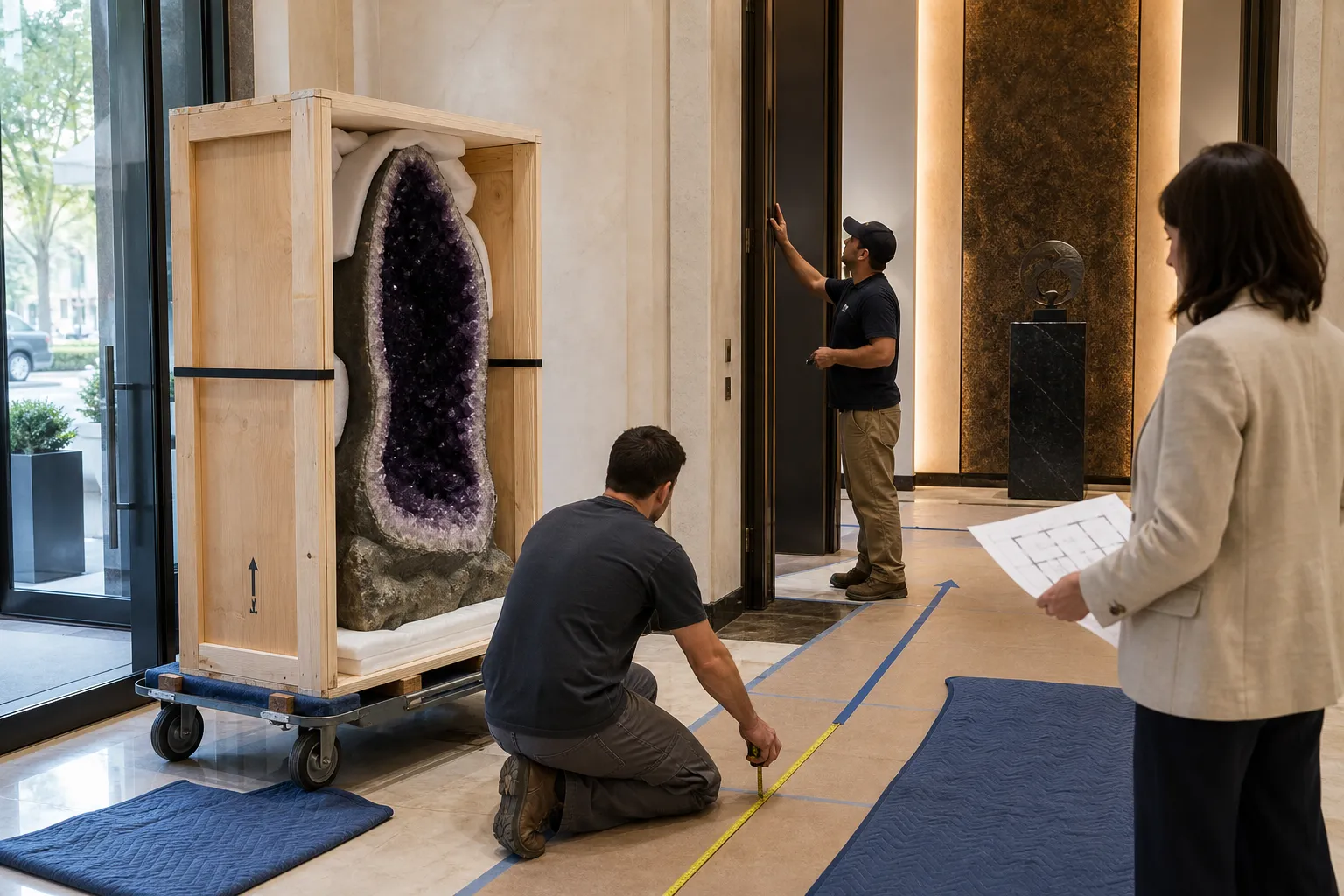
Heavy crystal installation planning begins with the route, not the final vignette. General handling guidance from HSE, OSHA, and NIOSH supports a simple principle: heavy-object movement should consider weight, posture, access, equipment, and risk before the object is moved.
For this page, the design rule is plain: do not let the delivery team discover the problem at the stair turn.
Before the piece arrives, confirm:
- actual weight, height, width, depth, and bottom contact area;
- whether the geode is open-faced, cut-base, irregular, or already mounted;
- doorway widths and thresholds;
- elevator limits and interior dimensions;
- stair turns, landings, and corridor angles;
- floor protection needs;
- whether the final position allows controlled maneuvering;
- whether the support surface has been reviewed by an appropriate project professional when uncertain;
- whether the object could tip, rotate, or be struck in normal use.
This matters even more for an executive office crystal display or corporate headquarters crystal installation, where building management, public circulation, after-hours access, elevator use, and insurance procedures may affect the plan. The available sources do not support a universal number of handlers, a specific lifting threshold, or a standard bracket method. Depending on the setting, a specialist mover, installer, designer, furniture maker, or structural professional may need to be involved.
When the planning is done well, the result should not look overworked. The room simply feels composed, and the crystal appears inevitable rather than improvised.
Use light to reveal depth, not spectacle
Amethyst is a variety of quartz, and gemological and mineral references support treating it as a real mineral material with care limits, not as an indestructible decorative prop.
Large crystal lighting design should reveal the form of the specimen. A geode often looks best with soft directional light that grazes the crystal points and shows the inner cavity. The aim is depth, shadow, and saturation, not glare.
Good lighting choices may include:
- an adjustable ceiling spot aimed from a moderate angle;
- soft wall washing behind the specimen;
- concealed lighting that highlights the cavity without overheating the object;
- warm-to-neutral light that does not distort the purple color;
- dimming control in hospitality, reception, or evening residential settings.
Avoid turning the geode into a nightclub object. Colored LEDs, over-bright uplighting, and glitter-heavy styling can make even a striking specimen feel less architectural. In luxury interior crystal design, restraint usually gives the amethyst more authority.
Direct sun is not the only way to create impact. A specimen may look beautiful in dramatic daylight, but long-term placement should still consider heat, fading concerns, and general gemstone-care cautions. If the room receives strong sunlight, the placement and lighting plan deserve extra attention.
Keep the room restrained around it
A 50kg amethyst geode can fail visually from excess as easily as from poor support. Too many smaller crystals, candles, bowls, metallic accessories, and decorative books around the main piece can weaken its presence. The room begins to look like a product display rather than a considered interior.
In a foyer
Let it greet the eye from a protected side position, with minimal objects nearby.
In a living room
Place it near a focal wall, fireplace zone, or low plinth rather than scattering crystals across every surface.
In an executive office
Pair it with sober materials such as wood, leather, stone, linen, or matte metal.
In a reception area
Keep it out of traffic flow and give people space to admire it without touching.
In a gallery-style display
Let the pedestal, wall tone, and lighting do the work instead of adding labels, clusters, or decorative competition.
Negative space for crystals is not emptiness. It is the design tool that lets texture and scale register. The larger the specimen, the more important that space becomes.
Care should match the object’s weight and fragility
Museum object-handling guidance reinforces a useful attitude for valuable, fragile, or irregular objects: handle less, plan more, and avoid unnecessary contact. A large geode may be heavy, but its crystal points and edges can still be vulnerable.
For routine care:
- Dust with appropriate soft tools rather than aggressive scrubbing.
- Avoid harsh cleaning chemicals unless their suitability for amethyst is verified.
- Do not lift or reposition the piece by crystal points.
- Keep drinks, planters, and loose accessories away from the specimen.
- Maintain enough access around the base for cleaning.
- In public or semi-public interiors, use placement to discourage touching rather than relying on signage alone.
The object’s mass can create a false sense of ruggedness. A 50kg specimen is difficult to move, but individual points, thin edges, and polished surfaces can still be damaged by impact, poor handling, or careless cleaning.
What not to claim about a crystal focal point
Large amethyst pieces are often surrounded by ambitious language: premium, museum-quality, investment-grade, authenticated, ethically sourced, protective, energy-clearing, or suitable for reducing electromagnetic noise. Some of those phrases appear in commercial crystal decor contexts, but they should not be treated as facts unless independent documentation supports them.
For this design question, the useful boundaries are:
- Origin does not automatically prove superiority. Uruguayan and Brazilian amethyst both appear in the market, but the evidence here does not support broad claims that one origin is always better for luxury interiors.
- “Museum-quality” and “AAA Grade” are not automatically independent certifications. They may be seller language unless tied to verifiable standards or documentation.
- A decorative amethyst specimen should not be presented as technical electromagnetic protection. The available evidence does not support claims that an interior geode reduces electromagnetic noise, shields office equipment, creates measurable occupant benefits, or changes building performance.
- A heavy geode is not an investment recommendation. Value, provenance, condition, and market demand require evidence beyond this design discussion.
- A beautiful placement is not a safety guarantee. Support, delivery, tipping risk, and public contact still need project-specific review.
This does not make the specimen less meaningful. Amethyst can carry geological depth, symbolic resonance, and strong visual presence without being assigned unsupported technical powers.
Quick checklist for a 50kg crystal specimen display
Before committing to the final location, run the decision through this short checklist:
- Does the room have one natural focal point for the specimen? If not, the piece may feel imposed rather than integrated.
- Is there enough negative space around it? A massive specimen needs visual room, not decorative crowding.
- Has the support surface or pedestal been verified? Do not assume ordinary furniture can carry the load.
- Can the delivery route actually work? Measure doors, elevators, stairs, turns, and access points before delivery.
- Is the piece protected from casual impact? Avoid tight circulation, chair backs, rolling bags, and public pinch points.
- Can it be lit without glare or harsh exposure? Controlled lighting gives better architectural presence than indiscriminate brightness.
- Can it be cleaned without risky handling? Leave enough access for careful dusting and base maintenance.
If the answer is weak on support, route, or collision exposure, the design is not ready, no matter how compelling the visual appeal may be.
The final design principle
A 50kg amethyst or crystal geode succeeds in a luxury interior when it is given the dignity of sculpture and the planning discipline of a heavy object. The most persuasive installations are not crowded with crystal symbolism or seller-style claims. They are proportioned, supported, lit, and placed with restraint.
Use the specimen as one architectural presence: a foyer anchor, a gallery-style focal point, a corporate reception object, or a quiet executive-office statement. Verify the practical conditions before the styling begins. Then let the amethyst do what it does best: hold color, mineral texture, and deep natural form in a room that gives it enough space to be seen.