Buyer’s checklist
The 2026 Buyer’s Checklist: Asking Dealers the Right Questions
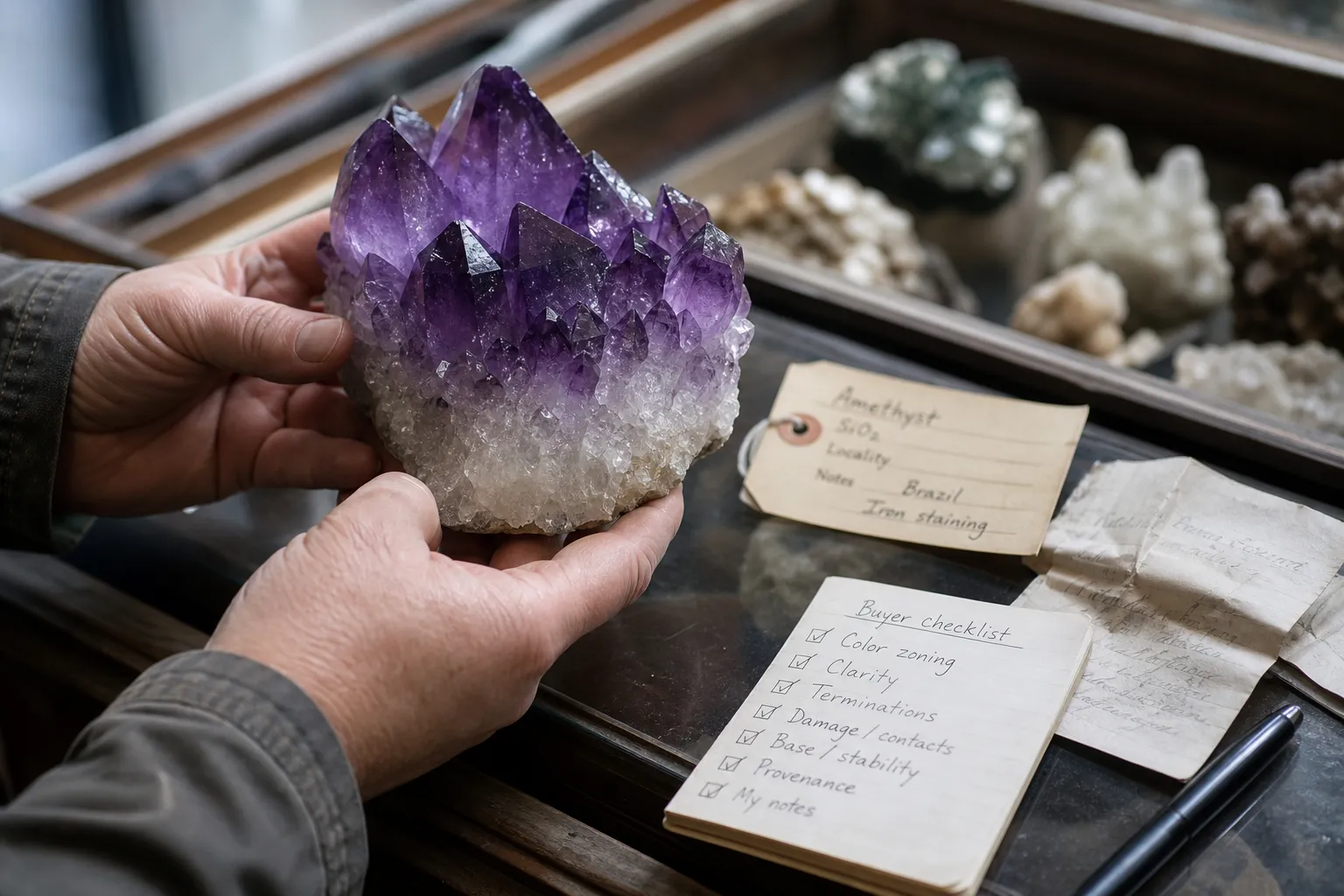
Color zoning can make an amethyst look alive: violet at the tips, paler quartz near the base, maybe a smoky edge where the crystal meets its matrix. That surface beauty is worth enjoying, but it cannot answer the buying questions by itself. When Buying amethyst in 2026, ask for specimen-specific answers about identity, treatment, origin, documentation, sourcing, and the meaning behind sales terms.
A good dealer conversation moves from “this is beautiful” to “what can be shown about this exact piece?” Ask what the stone is being sold as, whether any treatment is known or disclosed, what supports an origin or mine-direct claim, who issued any report, and what words such as natural, untreated, premium, ethical, certified, or rare mean in this listing. If the answer stays vague, slow down.
broader context
Begin with the main amethyst page
This narrower page lands better after the broader amethyst context page.
The Core Questions to Ask Before Buying Amethyst
A calm checklist works better than suspicion. You are not trying to catch every dealer out; you are trying to separate clear information from attractive language.
Start with identity
- “Is this being sold as amethyst, another quartz variety, or a treated material represented as amethyst?”
- “Is that identification based on your own description, a supplier statement, or a gemological report?”
- “Does any report describe this exact specimen, or only a parcel, product line, or general material type?”
Gemological and mineralogical references describe amethyst as a purple variety of quartz. That baseline gives buyers useful vocabulary: quartz variety, color, durability, treatment disclosure, locality, and documentation. It does not verify one crystal on a table or in an online listing.
Move next to treatment disclosure
- “Has this amethyst been heated, dyed, irradiated, coated, stabilized, or otherwise treated?”
- “If you do not know, will the listing or receipt say ‘treatment unknown’ rather than ‘untreated’?”
- “Is natural being used to mean naturally occurring quartz, untreated color, uncut crystal habit, or simply non-synthetic?”
This is where many buyer misunderstandings begin. A crystal can be natural quartz while its treatment history remains uncertain. A polished point can be genuine amethyst but no longer show its original crystal habit. A seller’s confidence is not the same as disclosure.
Then ask about origin
- “What country, region, mine, or locality is being claimed?”
- “What document or chain of custody connects this exact piece to that origin?”
- “Is the origin based on supplier information, collection records, labels, invoices, or a lab report?”
- “If the origin is uncertain, can the listing say that plainly?”
Mineralogical locality references can show that amethyst occurs in many places. They cannot confirm that one dealer’s specimen came from a claimed mine. That is the practical boundary: general locality information is not specimen-specific provenance.
What a Solid Dealer Answer Sounds Like
A strong answer is specific, limited, and willing to name what is not known. It does not need to sound dramatic.
For identity, a useful answer might say the piece is sold as amethyst, a purple quartz variety, and that the dealer’s identification comes from supplier documentation or an item-level report. If no independent report exists, the dealer should not dress the claim up as more certain than it is.
For treatment, better wording names either the known status or the uncertainty. “No treatment is known to us, but we do not have a lab report confirming untreated status” is more useful than “absolutely natural” with no scope. U.S. jewelry guidance from the Federal Trade Commission supports the general principle that material information and treatment-related representations should not mislead consumers; this page is not legal advice. For a buyer, the useful move is simple: ask for clear wording before purchase.
For origin certification, listen for the link between the claim and the exact specimen. A dealer may say a piece came from Brazil, Uruguay, Zambia, India, or another amethyst-producing region, but the sharper follow-up is not “is that a famous source?” It is “what connects this crystal to that place?” A collection label, supplier invoice, parcel record, or lab report may each help, but none should be treated as stronger than its actual scope.
For ethical sourcing questions, ask the dealer to define the process rather than the virtue
- “What does ethical mean in your sourcing process?”
- “Do you know the mine, exporter, lapidary, or supplier involved?”
- “Is there any written sourcing policy or documentation for this piece?”
- “Can you separate your general sourcing values from evidence for this exact item?”
Ethical sourcing is a serious phrase, but the available sources for this page do not include independent dealer audits or mine-to-market verification examples. This checklist can help you ask better questions; it cannot certify a seller’s supply chain. A dealer may still be thoughtful and transparent, but values, process, and proof are not the same thing.
Sales Terms That Need a Follow-Up Question
Some words are not automatically false; they are incomplete until defined. Treat them as prompts.
“Certified”
Certified by whom, for what, and tied to which item? A card in a display box is not the same as a gemological report from a recognizable lab, and even a report has limits. It may identify material without proving mine origin, ethical sourcing, age, ownership history, or spiritual significance.
“Untreated”
How is that known? If the answer is supplier assurance, ask whether the seller will put that scope in writing. If the dealer cannot support untreated amethyst claims, a more careful description may be “treatment not known” or “no treatment disclosed by supplier,” depending on what they actually know.
“Mine-direct”
Direct from which mine, through whom, and with what records? The phrase can sound intimate and clean, but without chain of custody it remains sales language. A single phrase cannot replace documents connecting the specimen to its path.
“Premium”
Premium in what sense? Color saturation, clarity, crystal form, size, locality, matrix, cutting, polish, rarity, or display quality? Gemological education sources often discuss amethyst through factors such as color and quality, but premium is not a fixed protection for buyers. It is a dealer’s value word unless the criteria are stated.
“Rare”
Rare compared with what? A particular crystal habit, locality, size, color zoning pattern, inclusion, or formation style may be less common in a dealer’s inventory, but rarity without context becomes haze. Ask for the comparison set.
“Ethical”
Which practices are being described? Fair payment, safer working conditions, reduced environmental harm, community relationships, transparent suppliers, or a preference for small vendors? These are not interchangeable. If the dealer cannot explain the term, do not let it carry the purchase decision.
Match the Paper to the Stone
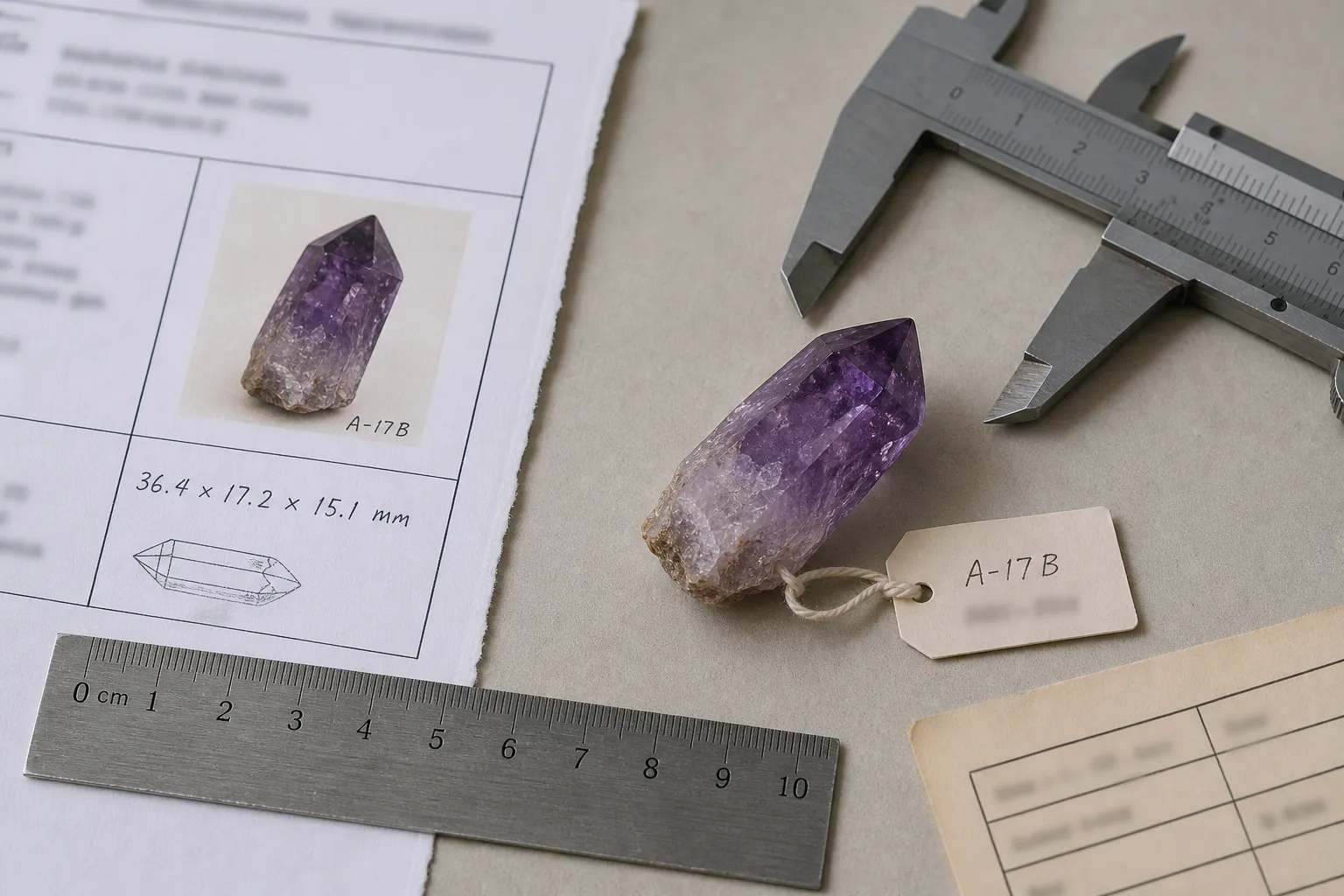
Documentation helps only when it fits the claim being made. Before trusting a certificate, report, label, or invoice, ask four quiet questions.
First, who issued it?
A gemological laboratory, mineral dealer, wholesaler, marketplace seller, and branded insert are not the same kind of source. Their documents serve different purposes.
Second, what does it identify?
A report may identify a material as amethyst or quartz; it may not address treatment, locality, sourcing ethics, or chain of custody. Read the scope before giving the document more weight than it deserves.
Third, does it match the exact item?
Look for report numbers, photographs, measurements, weight, shape, or other descriptors that connect the document to the specimen in front of you. For clusters and rough crystals, matching can be less tidy than for cut gems, so clear description matters.
Fourth, what does it not say?
Silence is not proof. If a document does not mention untreated status, origin certification, or ethical sourcing, it should not be used as if it does.
This check is especially useful online. Ask the dealer to photograph the specimen beside any report, label, or invoice that supports the claim. If ordinary details cannot be clarified, that tells you something about dealer transparency.
When to Pause Before Purchasing
Pause when sales language grows more certain as documentation grows thinner. That pattern matters more than any single word.
Practical warning signs include:
- The dealer uses certified amethyst language but cannot name the issuer or scope.
- The listing says origin-certified, but the document does not connect to the exact stone.
- The seller calls the piece untreated but will not explain how that status is known.
- Mine-direct claims appear without a mine name, supplier path, or record.
- Ethical sourcing is used as atmosphere rather than a defined practice.
- Basic questions are framed as buyer ignorance or negativity.
There are fair exceptions. Small sellers may not have laboratory reports for every modest specimen. Old collection pieces may carry handwritten locality labels but no modern chain of custody. A decorative amethyst cluster for a shelf may not need the same burden of proof as a high-value gem or a specimen sold with unusual origin claims. The point is proportion: the stronger the claim, the stronger the documentation should be.
For spiritually curious buyers, this boundary still helps. You may choose a crystal because its color, form, and presence suit a room, altar, meditation corner, or personal ritual. That symbolic choice does not verify origin, treatment status, or ethical sourcing. Keep the meanings you bring to the piece separate from the facts a dealer should be able to explain.
A Short Buying Script You Can Use
If you want one clean sequence, ask:
“Can you tell me what this is being sold as, and what that identification is based on?”
“Is any treatment known, disclosed, or unknown?”
“What origin or locality are you claiming, and what connects this exact specimen to that place?”
“If you use words like natural, untreated, premium, rare, ethical, certified, or mine-direct, what do those mean for this piece?”
“Do you have any report, invoice, label, or written statement that matches the item?”
“What does the documentation not cover?”
A dealer who answers carefully may still have limits. A dealer who cannot answer everything is not automatically dishonest. But a dealer who turns every question into a slogan is asking you to buy the language rather than the specimen.
The most useful amethyst dealer questions do not make the purchase cold; they make it clearer. Let the violet surface draw your attention, then let the paperwork, disclosures, and stated limits decide how much trust the claim deserves. A crystal can be beautiful in a room and still need careful wording at the counter; that is where collector judgment begins.