Earth-tone crystal styling
The “Earth Tone” Shift: Why Smoky Amethyst is Trending in 2026
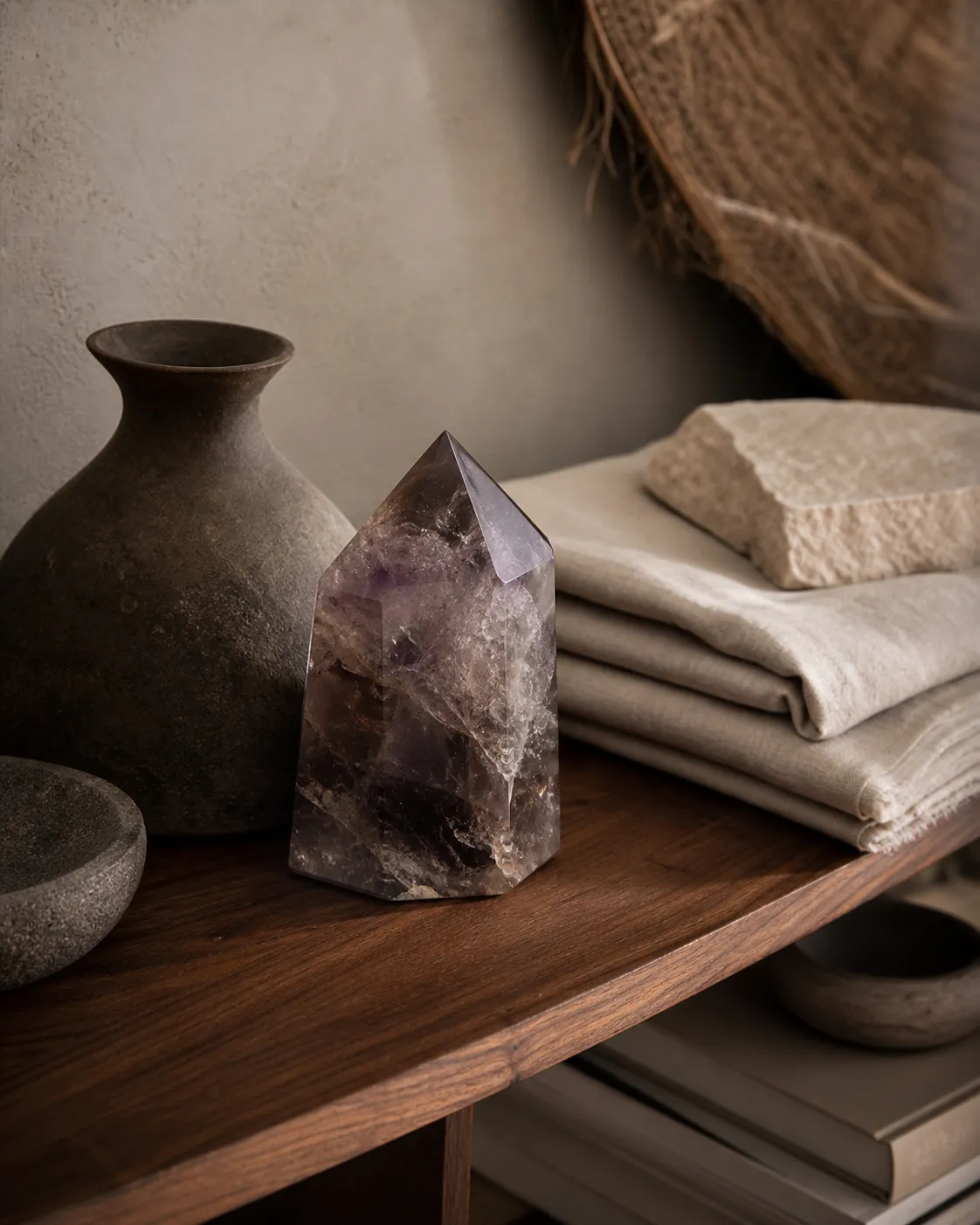
A smoky violet point beside clay pottery, linen, walnut, or unfinished stone does not behave like a bright purple accent. It settles into the room. That is the simplest reason Smoky Amethyst fits the 2026 earth-tone conversation: its purple is softened by brown, gray, or tea-colored depth, so it reads less like a jewel-tone statement and more like a natural object with shadow, texture, and atmosphere.
The word “trending” needs a careful frame. The available material does not prove a measured 2026 market surge, designer consensus, or verified demand for Smoky Amethyst. The stronger answer is narrower: Smoky Amethyst visually aligns with earth tone crystals, raw home decor, and grounded interior styling. It belongs naturally in rooms built around warm neutrals, tactile surfaces, and collected objects; it also gives spiritually curious readers symbolic language without turning that symbolism into a factual promise.
broader context
Amethyst context note
This narrower page lands better after the broader amethyst context page.
Why Smoky Amethyst Fits the Earth-Tone Shift
Smoky Amethyst works because it sits between two familiar visual worlds. From the amethyst side, it keeps a purple identity; from the smoky side, it carries a subdued mineral darkness that can lean brown, gray, bronze, or muted plum. That in-between color is why it often feels easier to place in earth tone interiors than a clear, saturated purple cluster.
Earth-tone rooms usually depend on clay, sand, bark, rust, cream, charcoal, aged metal, undyed fibers, and warm wood. A smoky purple crystal can echo those tones rather than interrupt them. It gives the room a point of color while still behaving like part of a natural materials decor palette.
That matters because many crystals read first as objects in a room, then as collector specimens. Clear quartz can look icy. Yellow crystals can feel sunny or commercial depending on the setting. Pale amethyst can look delicate or pastel. Smoky Amethyst, seen through a decor lens, has a quieter role: a darker purple surface with enough brownness to sit near ceramic, leather, travertine, rattan, linen, or rough wood.
Raw form strengthens that effect. A polished sphere may feel designed and intentionally placed. A raw point, cluster, or irregular formation can look closer to stone, landscape, and shelf archaeology. For readers drawn to raw crystal interiors, that unevenness is part of the appeal. The object does not need to look perfect to feel composed.
The 2026 Trend Claim Is Editorial, Not Statistical
The title’s 2026 language is best read as style interpretation, not proof that Smoky Amethyst has been officially measured as a market trend. The current evidence base does not support claims about sales growth, search growth, decorator adoption, or collector demand. It supports a smaller editorial point: Smoky Amethyst fits the look and language many readers associate with warmer, more grounded crystal decor.
That distinction matters. A crystal can feel visually timely without being statistically confirmed as a trend. A color can align with a broader mood without a public data set behind it. A phrase such as “earth tone crystals” can describe reader search language, shop vocabulary, or a styling instinct; it should not be treated as a confirmed design movement unless stronger sources are available.
So why does Smoky Amethyst feel timely for 2026? Because the “earth-tone shift” points toward lower contrast, warmer neutrals, mineral surfaces, tactile finishes, and objects that feel less glossy. Smoky Amethyst meets that mood by softening the familiar purple identity of amethyst into something more atmospheric. It is still recognizably amethyst in reader language, but it is not locked into the bright violet look that dominates many casual crystal displays.
This is where restraint helps collectors. If a seller uses trend language to make a specimen sound rare, urgent, or newly valuable, that is not the same as evidence. A collector can appreciate the color and still ask ordinary questions: What does the piece look like in natural light? Is the tone evenly smoky or strongly zoned? Is the surface suitable for display? Does the label explain the material clearly, or does it lean mostly on mood words?
The style appeal is worth discussing. The market certainty is not.
What Makes It Work in Raw Home Decor
Smoky Amethyst works best in raw home decor when it is allowed to act like a material, not just an ornament. Its appeal comes from color depth, surface variation, and the contrast between crystal geometry and organic surroundings.
A small smoky piece on a white lacquer table may look dramatic, but it may also feel isolated. The same piece beside stoneware, a linen runner, dried grasses, stacked books, or dark wood can feel more integrated. The brown amethyst decor effect is strongest when the room already has a grounded palette. The specimen then adds violet shadow rather than a separate decorative theme.
Scale changes the answer. A large raw specimen can become a focal object, especially if the crystal habit is jagged, layered, or architectural. A smaller point may work better as a shelf accent, desk piece, bedside object, or quiet corner marker. Without verified styling tests or firsthand documentation in the supplied material, it would be too much to claim that one placement “works best.” The safer observation is that Smoky Amethyst generally suits settings where texture and muted color are already doing the design work.
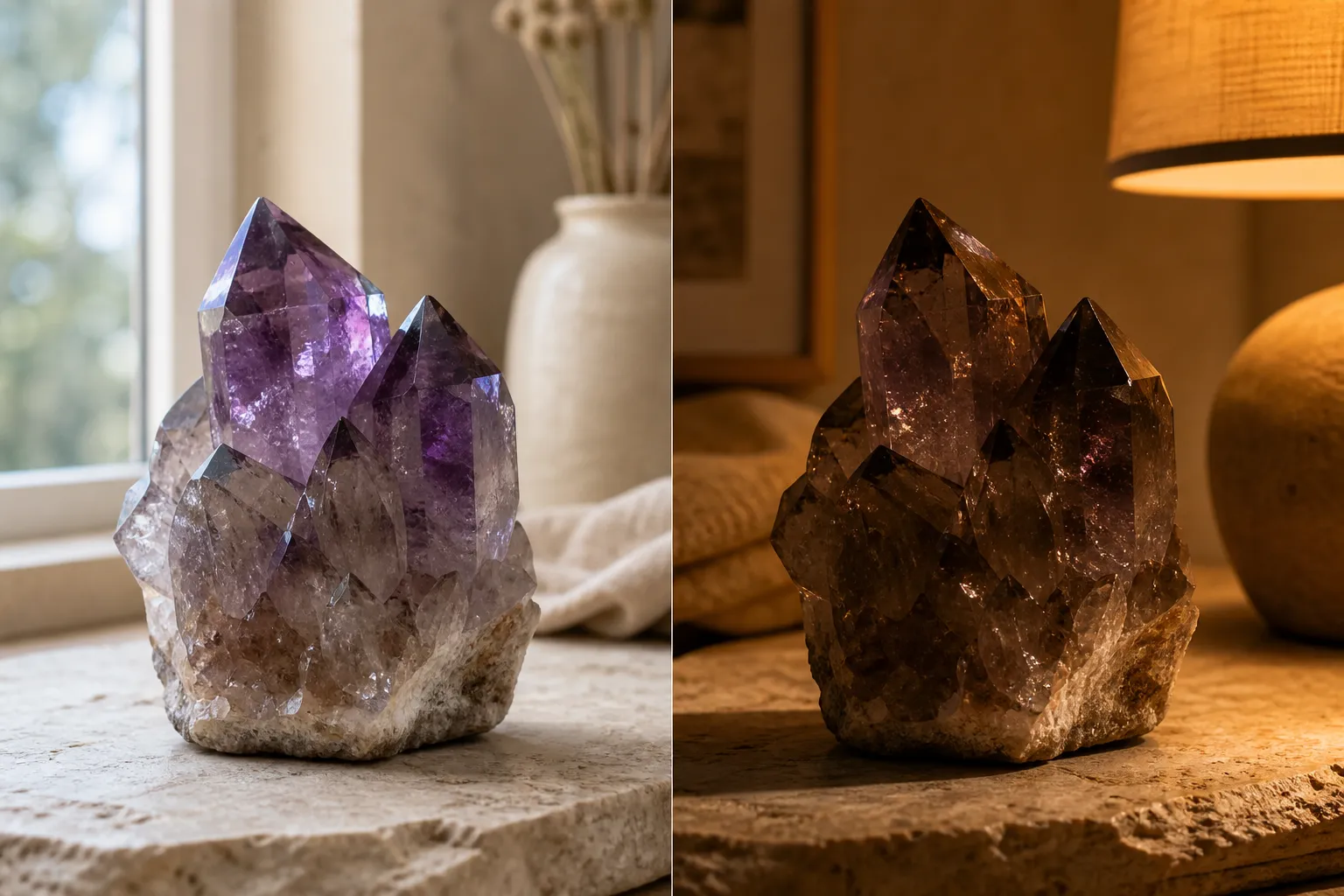
Lighting also changes the reading. In bright daylight, smoky purple crystals may reveal more violet, gray, or translucency. In low evening light, the same piece can appear heavier, browner, and more shadowed. That shift is part of the charm, but it also means online photos can mislead. A buyer who wants a specifically brown-purple effect should not rely on a single saturated product image or dramatic studio shot.
The most convincing placements respect the specimen’s visual weight. Smoky Amethyst can look elegant near unfinished stone, plaster, terracotta, aged brass, dark oak, wool, and unbleached fabric. It may look less harmonious in rooms built around icy whites, glossy acrylic, chrome, or candy-colored accents. That is not a rule; it is a color relationship.
Visible lane
Color, form, lighting, surface, and placement are the observable parts of the styling choice.
Collector lane
Labeling, condition, and discernment remain separate from mood-based seller language.
Symbolic lane
Grounding can be personal ritual language without becoming a measurable outcome claim.
The “Grounding Stone” Language Needs a Boundary
Smoky Amethyst is easy to place in the symbolic vocabulary of grounding stones because its color feels lower, darker, and more earth-connected than bright purple amethyst. In a mindfulness or spiritual-symbolic context, readers may use it to represent steadiness, quiet, inwardness, or a calmer room mood. Those are meanings people may choose to bring to the object.
They are not mineralogical proof or measurable outcomes.
A smoky, earthy color can support a symbolic association without proving that the stone changes a person’s body, mood, sleep, stress, space, or energy in a measurable way. For this page, “grounded” is best used as a styling and symbolism word: grounded color, grounded interior styling, grounded atmosphere, grounded ritual language. It should not be turned into a result claim.
That does not make the symbolic layer empty. Many people arrange crystals because objects help them mark attention. A dark amethyst point on a shelf can serve as a visual reminder to slow down, clear a surface, begin a quiet practice, or give a corner of the room a more deliberate mood. The object can have personal meaning without needing exaggerated claims.
The cleanest approach is to keep three lanes separate. The visible lane is color, form, and placement. The collector lane is labeling, condition, and discernment. The symbolic lane is what the owner chooses the piece to represent. When those lanes stay separate, Smoky Amethyst can be appreciated without seller haze or mystical certainty.
Common Confusions Around Smoky Amethyst Styling
One common confusion is treating “smoky” as a guarantee of rarity or value. The material supplied for this article does not verify rarity categories, provenance, pricing patterns, or official naming standards for Smoky Amethyst. In a styling article, “smoky” should be read first as a visual descriptor unless a seller provides reliable material detail. It tells you how the crystal appears; it does not, by itself, prove quality.
Another confusion is assuming all smoky purple crystals will create the same decor effect. They will not. A pale lavender piece with gray veils may feel misty and soft. A dark brown-violet specimen may feel weightier and more architectural. A strongly zoned piece may show both bright purple and smoky areas, making it more visually active. For a quiet earth-tone room, the best fit is usually the piece whose color temperature and surface character match the surrounding materials.
A third confusion is letting trend language replace personal judgment. If “2026” makes the stone feel urgent, pause. The room will matter more than the year. A smoky specimen that suits your shelf, light, and color palette is more useful than a crystal bought only because it appears in trend phrasing.
There is also a care-adjacent styling issue: placement should consider ordinary household realities. Without making unsupported durability or safety claims, it is still reasonable to think about stability, sunlight exposure, humidity around display areas, and the chance of knocks on a crowded shelf. Raw specimens decor can look effortless, but a jagged or heavy object still needs a stable place to sit.
The final confusion is spiritual overreach. Smoky Amethyst can be meaningful as a symbol, but symbolic meaning is not the same as evidence of an external effect. A room can feel quieter because its colors, lighting, and surfaces are quieter. The crystal may contribute visually and personally; that is enough for this page’s claim.
How to Judge the Look Without Buying the Hype
For this specific question, the most useful verification point is visual, not promotional. Look at the stone in relation to the room you actually have.
Ask whether the purple is bright, muted, brownish, grayish, or nearly black in the lighting where it will live. Ask whether the surface feels raw, polished, sculptural, delicate, or heavy. Ask whether the piece harmonizes with the materials around it or demands a different interior than the one you own. Those questions do more work than a trend label.
If you are comparing pieces online, be cautious with color. Product images can exaggerate saturation or hide brownness. A crystal photographed against black may look more dramatic; against cream, it may show its true warmth or reveal that it is cooler than expected. When the desired effect is smoky amethyst styling rather than simple purple sparkle, color context matters.
If the listing leans heavily on wellness promises, investment urgency, or vague rarity language, treat that as marketing language rather than proof. A useful description for this page’s purpose should help you understand appearance: smoky purple, brown-violet, gray-lavender, translucent, opaque, raw, polished, clustered, pointed, or irregular. Even then, those words describe what can be seen; they do not replace careful inspection.
A simple styling test is enough: imagine the specimen beside clay, wood, linen, stone, and shadow. If it feels like it belongs there, it fits the earth-tone shift. If it looks too bright, too glossy, or too disconnected from the palette, another amethyst may be better for that room.
So, Is Smoky Amethyst Really Trending in 2026?
Smoky Amethyst is “trending” in the most cautious editorial sense: it fits the visual mood of earth tone crystals, raw home decor, and grounded interior styling that readers are likely to recognize in 2026. Its smoky purple-brown character makes it easier to place with warm neutrals and natural materials than brighter purple amethyst, and its raw forms can suit interiors that favor texture over polish.
But this page cannot honestly claim verified trend adoption, official design consensus, market growth, or measurable spiritual effect. The strongest answer is narrower and more useful: Smoky Amethyst is compelling because it lets amethyst move from jewel-like purple into a quieter mineral palette. It can be a specimen first and a symbol second, a room object with color depth before it becomes a claim.
For collectors and home-aesthetic readers, that is the practical boundary. Choose Smoky Amethyst if its visible tone, form, and placement make sense in your room; treat “grounding” as symbolic language if it speaks to you; and keep trend claims separate from what the crystal itself can show on the shelf.