Non-destructive gemstone analysis
Raman Spectroscopy: The Non-Destructive Way to Read Gemstone Terroir
Color zoning in an amethyst can raise a more careful question than “is it purple enough?” A collector may want to know whether the stone carries mineral clues from the setting where it formed.
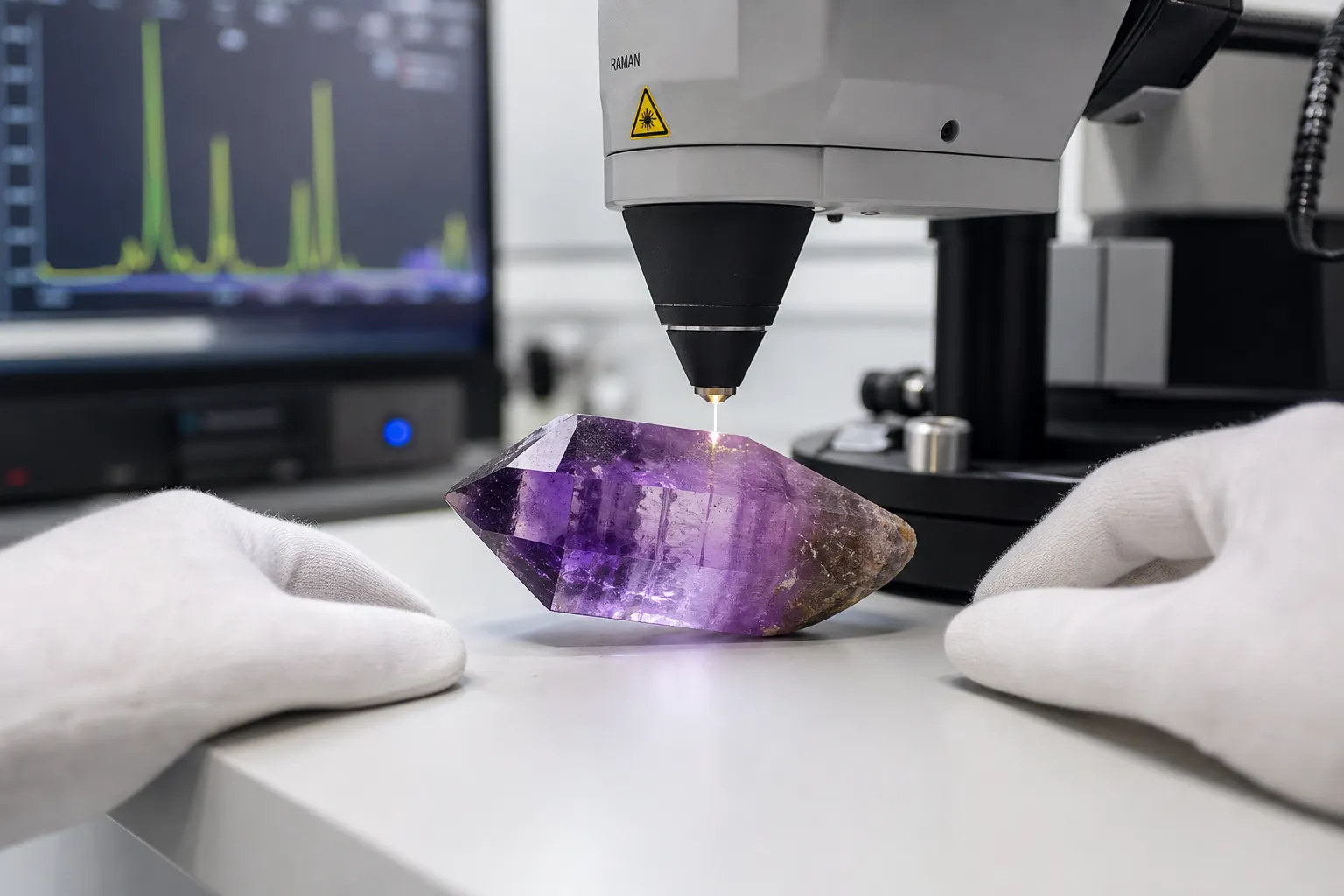
In Raman Spectroscopy Gemology, the direct answer is this: Raman spectroscopy can help read molecular vibrational fingerprints without cutting, powdering, or visibly altering the specimen. Those fingerprints may help identify quartz, inclusions, coatings, or associated mineral phases. For amethyst, that can support a more grounded description of the stone; it does not, by itself, prove terroir, origin, value, treatment history, ethical sourcing, or authenticity.
broader context
Broader amethyst guide
This narrower page lands better after the broader amethyst context page.
What Raman Actually Reads
Raman spectroscopy collects a spectrum from a material and compares that pattern with known Raman spectra reference minerals. In collector language, it listens for a mineral pattern rather than relying only on color, polish, or seller wording. The appeal is practical: the method can often be used on a finished gemstone, crystal point, or cluster without visibly damaging it.
For amethyst, the starting point is modest but important. Amethyst is purple quartz, and Raman may help support identification of quartz as the host material or help separate a small inclusion from the surrounding crystal. Wisps, needles, rusty films, dark specks, cloudy veils, and zoning are not always explained by body color alone.
“Terroir” needs careful handling here. In wine, the word suggests a place-shaped signature. In gemstones, it works better as a metaphor for mineral, growth, and inclusion clues that may reflect a formation environment. Raman can help name some of those clues. It cannot turn one spectrum into a birth certificate for the stone.
The useful workflow
- Collect the spectrum from the material being examined.
- Compare it with reference data.
- Interpret the match in gemological context.
The last step carries the judgment. A spectral match may identify a material, but its meaning depends on where the material sits in the stone, how it relates to visible features, and whether other observations point in the same direction.
The Terroir Clues Raman Can Contribute
Raman is strongest when the question is material: what is this inclusion, coating, particle, or mineral phase? Reference resources such as RRUFF matter because they organize mineral spectra that can be compared with unknowns. In gemology, that comparison may support mineral inclusion identification without removing a piece of the gemstone.
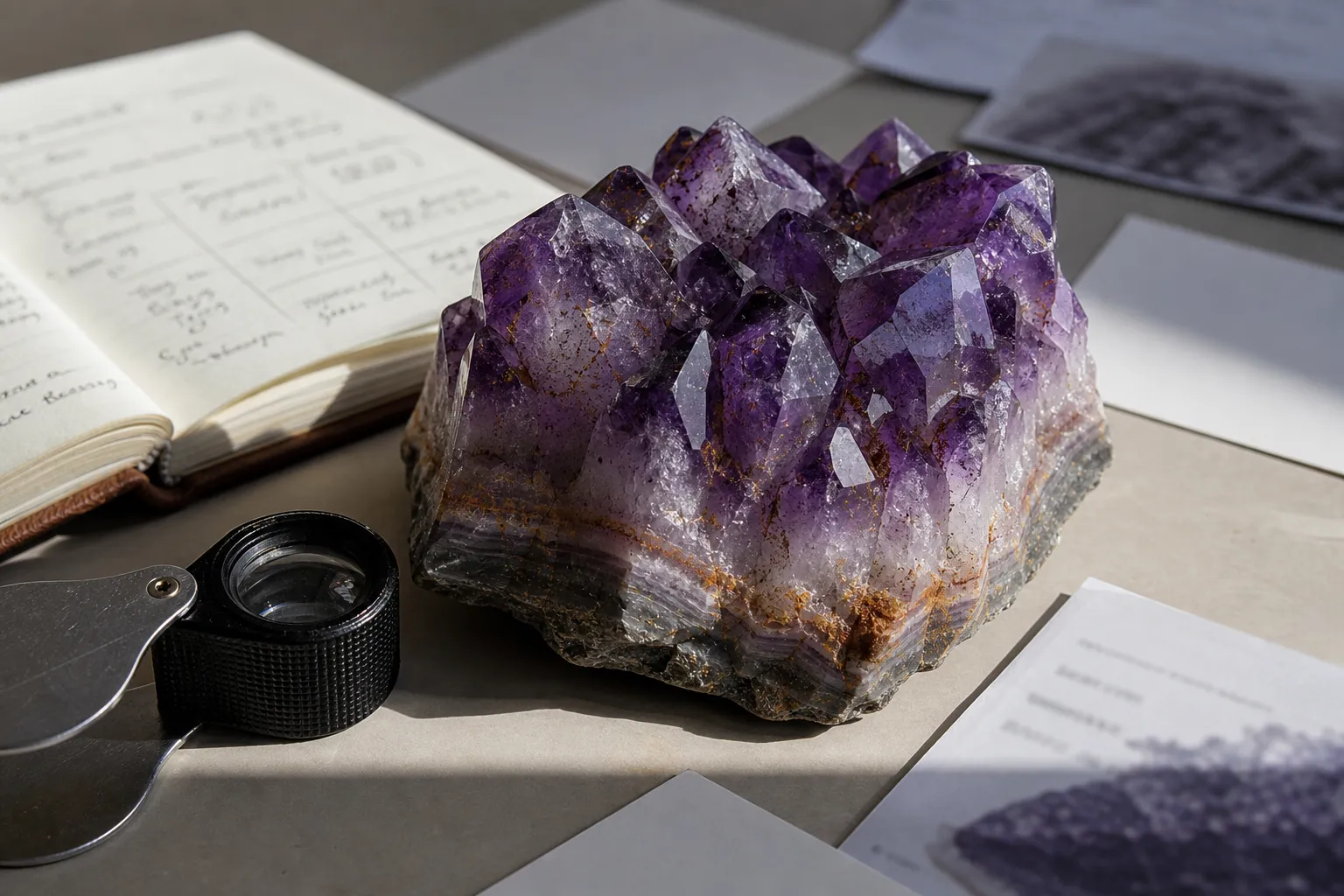
In amethyst, one useful case is quartz inclusion Raman work. A reading may help distinguish the quartz host from a small phase trapped within it or attached to it. Another case is iron-related material. Warm brown, yellowish, rusty, or orange features near fractures, cavities, or matrix can draw attention, and Raman may help investigate whether a feature is related to iron oxides or goethite-related material. Those are possible material clues, not guaranteed locality markers.
The value is not only academic. A named inclusion can make a specimen description more precise and less dependent on vague market language. For a spiritually curious owner, the same detail can keep symbolic use grounded: the amethyst may still be chosen for color, presence, and personal meaning, while the mineral statement remains a material statement. A specimen first; a symbol second.
Raman also helps when visual inspection stalls. A polished stone may hide its internal story behind a clean surface. A cluster may hold several phases close together. A tiny inclusion may be too ambiguous to name by eye. Raman adds a layer of evidence when the question is “what is this small material?” rather than “where exactly was this mined?”
Raman Versus FTIR
Raman and FTIR often appear near each other because both are spectroscopic methods used in material identification. They are not interchangeable. Raman is commonly used for molecular vibrational fingerprints collected through light scattering, while FTIR reads absorption patterns. In practice, the better tool depends on the material, the feature being examined, and the question being asked.
Raman
Especially relevant when the goal is to identify a small mineral phase or inclusion by comparing its spectrum with reference data.
FTIR
May be useful in broader non-destructive gemstone analysis, including some material features, structural questions, or treatment-related investigations, but it should not be stretched into an all-purpose answer.
The collector-facing distinction is clean enough: Raman may help name a tiny mineral clue; FTIR may answer a neighboring molecular or structural question. Neither method replaces microscopy, visual evidence, locality knowledge, or broader gemological interpretation.
That matters with amethyst because color can be persuasive. Deep purple, pale lavender, chevrons, smoky zones, and orange-brown companions all shape the stone’s atmosphere. Raman can strengthen the material vocabulary around those features. It does not make visual atmosphere into proof of origin.
Where Raman’s Limits Begin
The main Raman spectroscopy limits shape the answer, not just the fine print. A Raman match can support identification of a mineral or inclusion-related phase, but it does not independently establish geographic origin. The same or similar mineral phases can appear in more than one geological setting, and one inclusion does not map automatically to a mine, country, or source.
That is why “gemstone terroir clues” is better than “gemstone terroir proof.” Raman can reveal clues that may belong in an origin discussion. It cannot certify locality for an amethyst from the current evidence base, and it cannot establish market value, commercial quality, ethical sourcing, treatment status, or authenticity on its own.
The source base also stays narrow. RRUFF and the Gems & Gemology archive are useful broad entry points for mineral spectra and gemological context, but the available material here does not include a specific amethyst origin study, a lab case report, a peak-by-peak amethyst spectrum record, or firsthand Raman testing evidence. Detailed claims about goethite, provenance, treatment detection, or gemstone terroir need stronger primary or near-primary support before they become firm conclusions.
“Non-destructive” also needs plain wording. It means the test can often be performed without visible damage to the stone. It does not mean every reading is complete, universally applicable, or free from interpretation. A clean spectrum, a relevant reference match, and trained context all matter.
Common Confusions to Separate
A database match is not a finished report
It may help identify a mineral phase, but it does not include all the surrounding observations that a careful assessment would normally consider. The spectrum is a clue; the interpretation is the work.
An inclusion name is not a locality answer
If a feature is identified as an iron oxide inclusion or possible goethite-related material, that may enrich the specimen description. It does not, by itself, show where the amethyst came from.
Spiritual symbolism is a different lane
A person may value amethyst for meditation, room atmosphere, or personal ritual language. Raman does not validate or dismiss that meaning; it answers a material question about molecular or mineral signatures.
One test is not an all-purpose answer
One non-destructive test should not be expected to answer authenticity, treatment, value, and source in a single pass. Raman can be part of collector literacy, especially when a visible feature needs identification. For buying decisions, sourcing claims, or high-value descriptions, it belongs inside a broader gemological assessment.
A Practical Reading of the Answer
If you are considering amethyst Raman analysis, begin with the question. “What is this inclusion?” is a Raman-shaped question. “Does this one spectrum prove the stone’s country of origin?” is not. “Can this help compare the specimen with known mineral fingerprints?” is reasonable. “Can it certify terroir, price, or ethical sourcing?” asks more than the method can support alone.
For a collector, the best use of Raman is disciplined curiosity. It can move a specimen description away from vague seller language and toward named material evidence: quartz host, possible inclusion phase, or associated mineral. That makes the stone more legible without making it more certain than the data allows.
For a home display or mindfulness setting, the same restraint is useful. You can appreciate the purple zoning, crystal habit, mineral inclusions, and the atmosphere the piece brings to a shelf. Raman may clarify part of the stone’s physical story; personal meaning remains a chosen layer, not a laboratory result.
Short FAQ
Can Raman spectroscopy prove where my amethyst was mined?
No, not by itself. Raman can identify some molecular or mineral clues, including inclusions or associated phases, but locality requires broader gemological and geological evidence.
Is Raman better than visual inspection?
It answers a different question. Visual inspection notices color, habit, zoning, inclusions, and wear; Raman can help identify certain materials behind those observations. The strongest reading uses both.
Does a goethite match prove amethyst terroir?
No. A goethite-related reading may be useful for mineral inclusion identification, but it remains one clue. Without a specific case study and supporting origin evidence, it should not be used as a provenance conclusion.
Raman spectroscopy gives amethyst a quieter kind of legibility: not a grand verdict, but a way to name some of the mineral clues held inside or beside the purple quartz. Use it for material questions, keep origin and value claims wider than one spectrum, and let symbolic meaning stay beside the specimen without pretending to be its scientific result.