Raw Crystal Decor
The "Wild" Aesthetic: Why Interior Designers Are Choosing Raw Veins
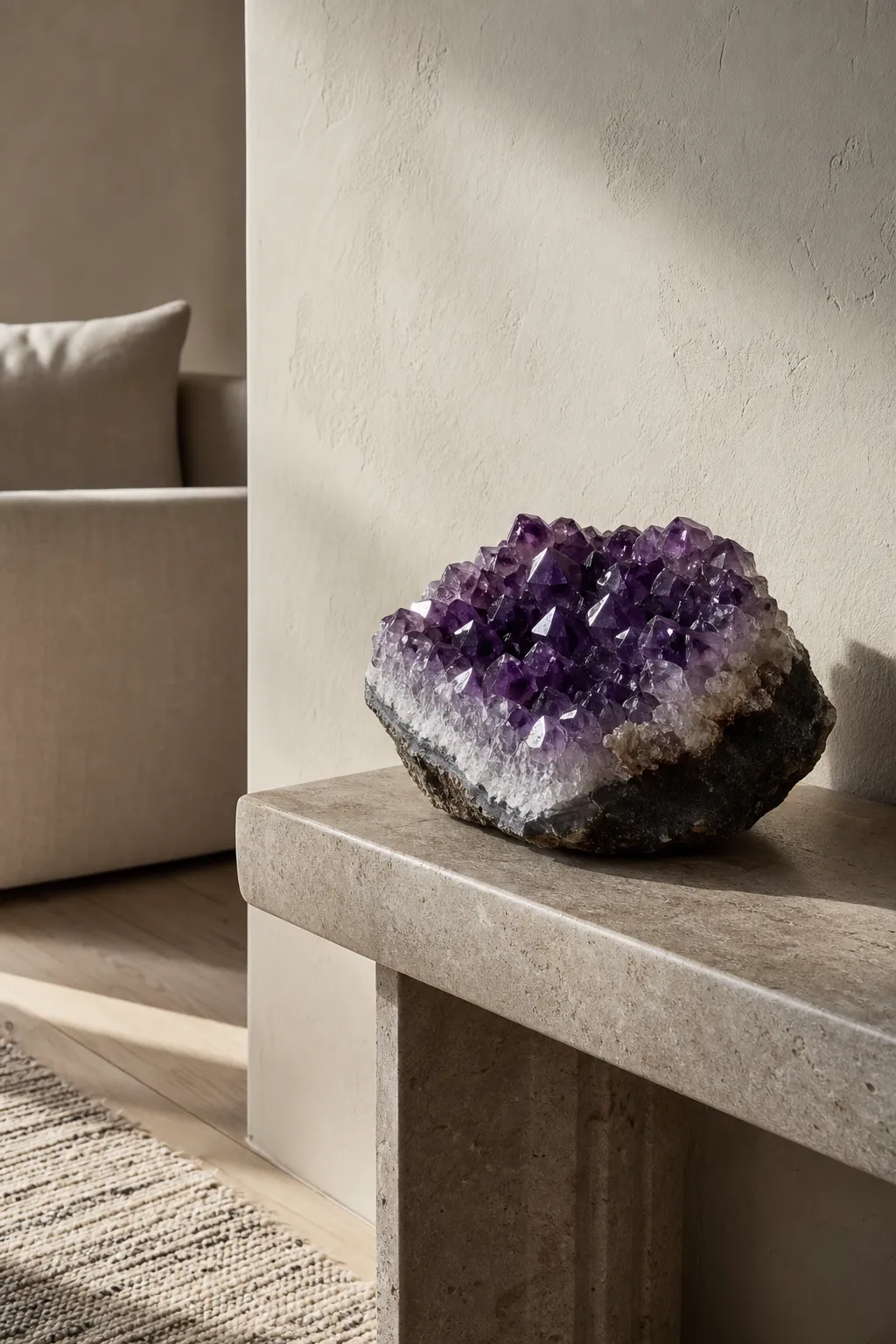
Raw amethyst catches the eye in a room because it brings mineral irregularity into a controlled setting. A polished table, smooth wall, or clean-lined sofa may feel composed; a raw crystal edge adds color zoning, jagged geometry, shadow, and tactile contrast. That is the useful appeal behind Raw Crystal Decor: not a guaranteed design movement, not a wellness claim, but a visual turn toward rougher, more material-aware statement pieces.
The word “wild” matters. It points to veins, fractures, points, matrix, uneven backs, and the sense that the object was formed before it was styled. In raw amethyst decor, the strongest effect comes when the specimen is treated as a sculptural mineral object first, then as a symbolic or atmospheric accent if the owner chooses that meaning.
broader context
Amethyst context note
This narrower page lands better after the broader amethyst context page.
Why Raw Veins Feel Current in Interiors
The appeal of raw crystal statement pieces sits inside a broader appetite for natural textures in interiors: stone, wood grain, linen, clay tones, rough plaster, rattan, and layered tactile finishes. Commercial design language around Home design trends 2026 often uses words such as earthy, tactile, sculptural, organic, and material honesty. Those sources do not prove that designers everywhere are adopting raw amethyst, but they do explain why the look feels legible right now.
Raw amethyst fits that language because it behaves visually like a small geological event. Its purple quartz crystals create depth, brightness, and shadow across one surface. A geode or cluster can read as a dense form from across the room, then become intricate up close. Veins and raw mineral edges interrupt the predictability of modern interiors, especially near flat planes such as plaster walls, concrete, cabinetry, stone counters, or low upholstered furniture.
That does not make raw amethyst a design requirement. It answers a narrower visual problem: a room feels too smooth, too new, too symmetrical, or too dependent on soft goods. A raw mineral edge can break that softness without becoming another framed print, vase, or trend object.
The Effect Comes from Contrast, Not Mystique
The strongest case for raw amethyst decor is visual. It can add contrast in five grounded ways:
- Irregular outline: raw edges resist the perfect circle, rectangle, and cylinder that dominate many rooms.
- Sculptural mass: large amethyst geodes, caves, and clusters can act like small architectural forms.
- Color depth: purple zoning gives the object more variation than a flat painted accent.
- Light interaction: crystal faces catch light differently across the day, especially under angled daylight or warm lamps.
- Tactile surface: points, cavities, matrix, and rough backs make the piece feel less manufactured.
Soft brutalism decor is a useful comparison, but only a comparison. Brutalist and soft-brutalist language often values mass, raw beauty, concrete, structural honesty, and imperfect surfaces. Raw amethyst can echo that mood at domestic scale, especially beside concrete, steel, blackened wood, heavy stone, or thick neutral textiles. Still, amethyst is not a core brutalist material, and raw crystal decor does not automatically make a room brutalist.
A better phrase may be “controlled wildness.” The crystal introduces natural asymmetry; the surrounding materials keep the room calm.
What Raw Amethyst Adds Beyond Generic Crystal Decor
Not every crystal accent creates the same room effect. Clear quartz, agate slices, polished spheres, citrine-toned pieces, lamps, and coasters each carry a different visual language. Raw amethyst is distinctive because it combines rough mineral structure with a recognizable purple range.
GIA describes amethyst as the purple variety of quartz, and that identity matters for decor because color is part of the object’s design role. A pale lavender cluster reads differently from a deep violet geode. A specimen with visible matrix can feel earthier; an open crystal face can feel brighter and more decorative. The collector’s eye notices those differences before any symbolic interpretation begins.
Raw amethyst also has a useful tension. It is familiar enough to be read as crystal decor, yet irregular enough to avoid looking purely manufactured. That balance explains why the same piece can feel grounded in a room with linen, clay, and wood, or more dramatic against black stone, steel, and sharp modern lines.
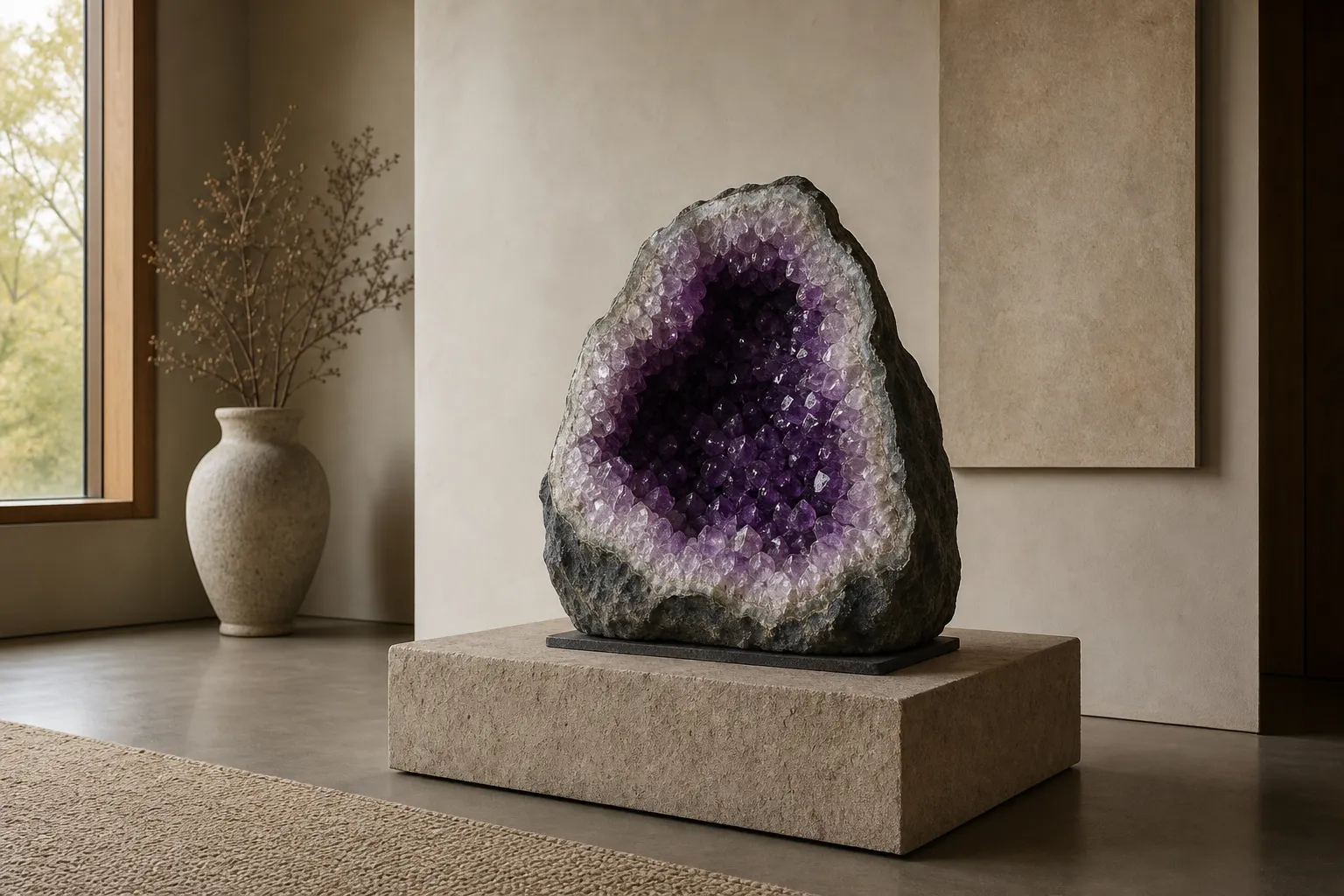
Scale changes the message. A small cluster on a shelf is a texture note. A large geode beside a fireplace, console, or entry wall becomes closer to sculptural crystal decor. Functional pieces such as coasters and lamps move toward decorative utility; caves and oversized clusters move toward focal-point placement. The more mass a specimen has, the more visual breathing room it needs.
Where Trend Language Gets Ahead of the Evidence
The phrase “interior designers are choosing raw veins” is best read as an aesthetic observation, not a verified industry statistic. The available visible sources support amethyst identity and care boundaries, not broad adoption data, 2026 market certainty, professional field testing, or long-term interior-design outcomes. Commercial design and decor sources suggest an appetite for natural materials, tactile surfaces, warmer minimalism, and statement minerals; that is softer evidence.
The same caution applies to luxury and sustainability language. Raw mineral decor may look luxurious because it is heavy, reflective, natural in form, and visually uncommon in many rooms. But “natural” does not automatically mean responsibly sourced or environmentally low-impact. Without sourcing, mining, labor, shipping, and provenance details, sustainability claims should stay modest.
Spiritual language needs a clear separation from material evidence. Amethyst has a long symbolic life in personal, spiritual, and decorative contexts, and many people place it in rooms for meaning. That can be a valid personal practice. It should not be presented as proof that raw amethyst changes health, sleep, stress, productivity, relationships, indoor air, or other outcomes. In an interior, the supportable claim is aesthetic: the specimen changes what the room looks like and how the composition feels visually.
Placement Decides Whether the “Wild” Look Works
Raw mineral edges need control around them. A dramatic amethyst piece can look intentional when nearby materials are quiet: matte walls, warm wood, linen upholstery, simple ceramics, greenery, clay tones, or a restrained neutral palette. It can look cluttered when surrounded by too many reflective objects, small accessories, or unrelated colors.
Placement choices that keep the effect grounded
- Give large raw crystal statement pieces a stable surface with enough visual space around them.
- Use light to reveal texture, but avoid assuming direct sun is harmless in every display condition.
- Pair raw mineral edges with calmer shapes so the specimen remains the focal point.
- Avoid crowding shelves with many small crystals if the goal is sculptural clarity.
- Treat sharp points, weight, and rough backs as practical design factors, not just visual features.
This matters around children and pets. A heavy geode, tall cluster, or sharp-edged specimen should not sit where it can be pulled down, knocked over, chewed, or used as a climbing object. Crystal placement around pets is ordinary household prudence: weight, stability, fragments, dust, and access all matter.
Furniture protection matters too. Raw bases and rough matrix can scratch delicate surfaces. Use a stable pad, tray, plinth, or felt barrier under heavier pieces, especially on wood, stone, lacquer, or glass. The most successful raw amethyst displays often look effortless because the support has been carefully considered.
Care Limits for Raw Crystal Decor
Amethyst is durable enough for jewelry and decorative objects, but raw home specimens have different concerns than a ring or pendant. GIA’s amethyst care guidance supports gentle cleaning boundaries and notes that sudden temperature changes can be risky for some gems. For decor, the practical translation is simple: avoid harsh experiments, excessive heat, steam, and unverified cleaning methods from social posts or seller videos.
Dust is the ordinary problem. Raw crystal points and cavities collect it more readily than polished surfaces. A soft brush, gentle cloth, and careful handling are better starting points than aggressive scrubbing. Large pieces may have fragile edges, attached matrix, or narrow crystal pockets that are easy to damage if treated like a washable household object.
Sunlight exposure is another common concern. The sensible position is caution rather than alarm. If a specimen matters to you, avoid long, intense exposure in a hot window and watch for display conditions that combine direct sun, heat, instability, and frequent handling. A room can still use light beautifully without putting a raw piece in the harshest possible spot.
The care point is not to make amethyst feel precious beyond use. It is to remember that a raw specimen is both decor and mineral material. It deserves the respect you would give a heavy stone object with sharp details and visible natural surfaces.
The Clearest Reason Designers Like the Look
Raw amethyst works because it makes a room feel less edited without making it chaotic. It brings raw mineral edges into spaces dominated by flat finishes, repeated shapes, and predictable materials. In the right setting, a geode or cluster becomes a natural counterweight: purple quartz, rough matrix, irregular texture, and sculptural mass held inside a deliberate room.
That is the useful answer behind the “wild” aesthetic. Raw crystal decor is not automatically a proven trend, a wellness tool, a sustainable choice, or a mark of luxury. It is a visual decision. If the piece is stable, cared for, and placed with restraint, raw amethyst can offer what polished decor often cannot: a specimen first, a symbol second, and a room accent with visible mineral life.