Non-contact mineral care ritual
Shattering Stagnation: How to Safely Cleanse Minerals with Sound
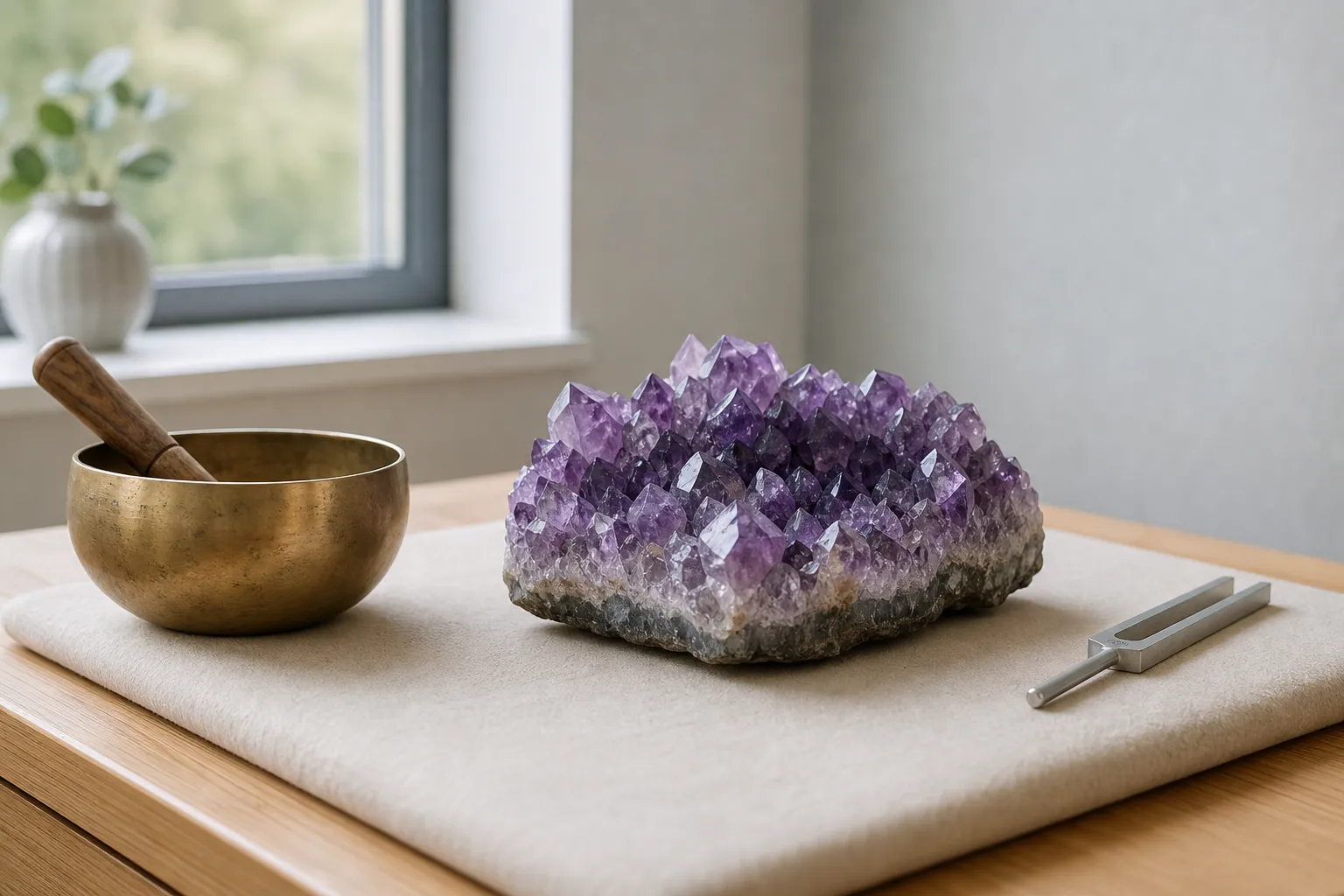
An amethyst cluster with uneven color zoning, small points, and a dust-catching base does not always welcome water, salt, sunlight, smoke, or repeated handling. For that kind of specimen, Sound resonance crystal cleansing can be used as a gentle, non-contact ritual: place the mineral on a stable surface, keep the sound source nearby rather than touching it, use moderate volume, and treat the tone as a symbolic reset rather than a physical cleaning method.
The direct answer is narrow: sound can support a mindful crystal-cleansing practice, especially when low handling matters. It should not be described as removing hazards, changing mineral structure, repairing inclusions, making toxic material safer, or producing a measurable mineralogical change. Its practical value is restraint. Its spiritual meaning is personal.
broader context
Broader amethyst guide
This narrower page lands better after the broader amethyst context page.
What Sound Cleansing Can Safely Mean
Sound cleansing for minerals is best understood as a ritual cue. The tone of a singing bowl, the clear ring of a tuning fork, or a short vocal sound can mark a pause: the crystal is set apart from ordinary handling, the room becomes quieter, and the owner renews an intention around the specimen.
That is different from mineralogical cleaning. A dusty amethyst geode is still dusty after a sound ritual. A fragile point is still fragile. A specimen with unknown coatings, loose matrix, or delicate inclusions still needs careful material judgment. Sound may help the person using the crystal feel more organized around care and symbolism, but it does not replace appropriate cleaning, storage, labeling, or caution.
This distinction matters because crystal cleansing vocabulary often uses words such as “purification,” “charge,” “frequency,” “vibration,” or “stagnant energy.” Here, those words belong to spiritual symbolism and personal practice, not to measured physical claims. A collector can honor ritual language without treating it as proof that the stone has changed.
For amethyst in particular, the modest framing is the most useful one: the specimen remains purple quartz, with its own crystal habit, color zoning, chips, fractures, base material, and display needs. Sound changes the atmosphere of the practice; it should not be said to change the stone.
A Low-Handling Ritual for Amethyst and Other Minerals
A careful sound-based cleansing ritual begins before the sound starts. Choose a steady table, shelf, tray, or cloth-covered surface where the crystal will not roll, scrape, or be knocked by the instrument. Keep bowls, mallets, tuning forks, bells, and chimes separate from the specimen itself. For a delicate cluster, distance is the calmer choice.
Set the mineral down once. Avoid turning a sound ritual into repeated repositioning, tapping, lifting, or passing the crystal through a crowded setup. Low-handling crystal cleansing is most useful when the specimen is small, sharp, friable, heavy, awkward, or visually delicate. The less the stone has to move, the fewer chances there are for ordinary handling accidents.
A restrained process can be simple
- Place the crystal on a stable surface where it can remain undisturbed.
- Keep the singing bowl, tuning fork, bell, or chime beside the specimen, not on it.
- Use a moderate volume that feels calm in the room.
- Let the sound mark a short pause, breath, or intention.
- Stop before the ritual becomes forceful, loud, or physically elaborate.
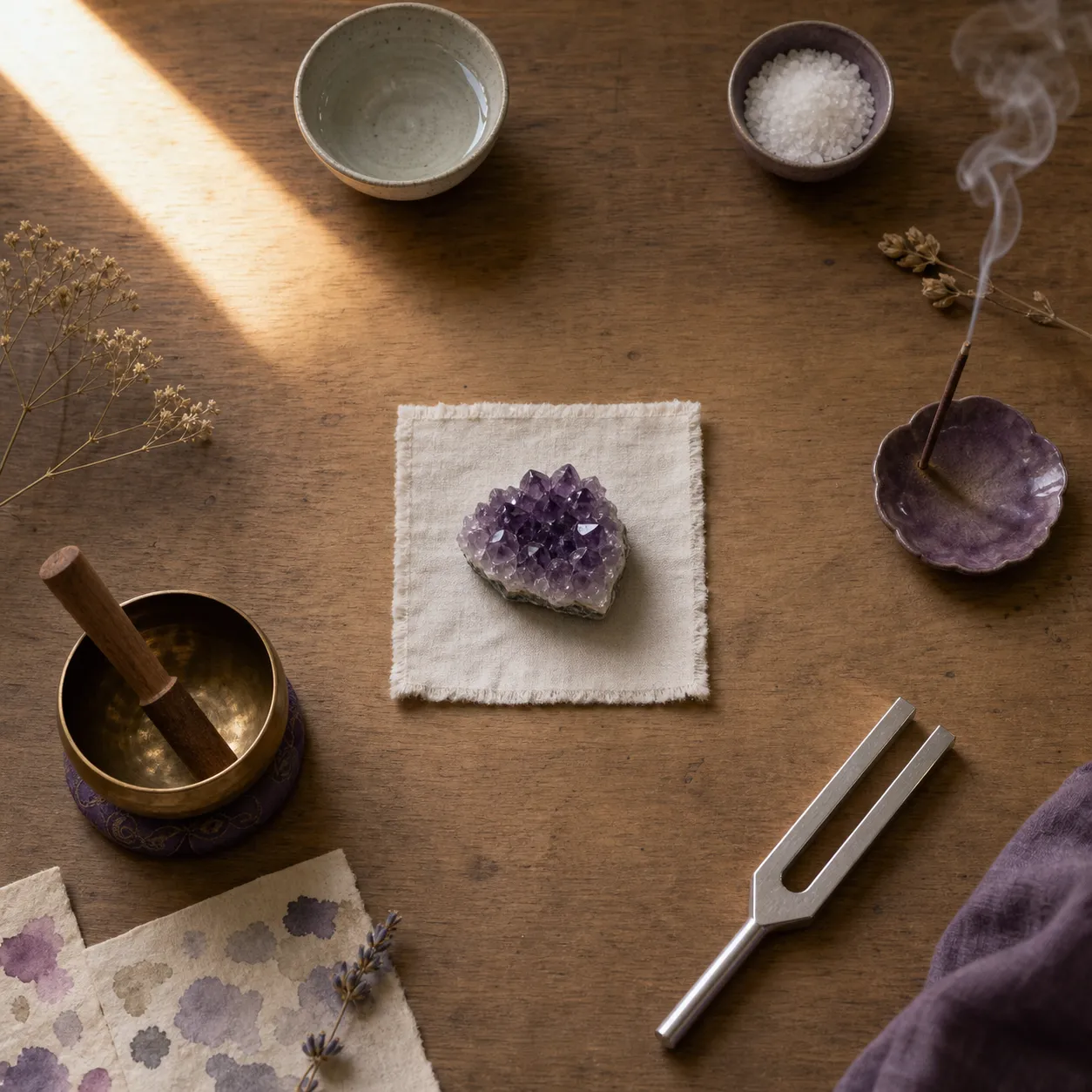
This is water-free crystal cleansing, salt-free crystal cleansing, smoke-free crystal cleansing, and smoke-free or sunlight-free practice in the narrow ritual sense. It avoids several common methods that some owners prefer not to use around certain minerals, displays, rooms, pets, fabrics, or sensitivities. That does not make sound a universal safety method; it simply makes it a non-contact option when the goal is symbolic reset rather than material treatment.
Singing bowls for crystal cleansing are often imagined as surrounding the stone with tone. A cautious version keeps the bowl on its own surface and the mineral outside the bowl. Tuning forks for crystal cleansing can be used in the same restrained way: activate the fork away from the specimen and let the sound be present in the space. There is no need to chase intensity.
When Sound Is the Better Ritual Choice
Sound is often most appealing when the owner wants a gentle mineral cleansing ritual without moisture, residue, heat, smoke, or abrasion. That can be especially relevant for displayed crystals where the main concern is not deep cleaning, but avoiding unnecessary stress while maintaining a sense of care.
For a collector, the strongest advantage is not mystical certainty; it is restraint. A sound-based cleansing ritual can be performed without rubbing points, soaking matrix, sprinkling salt, placing a specimen in direct sun, or carrying a fragile cluster from room to room. If a mineral is already stable on a shelf, a non-contact ritual lets it stay there.
This approach may fit
- Amethyst clusters with sharp points or crumbly matrix.
- Display pieces arranged in a cabinet, altar, desk, or bedroom.
- Mixed mineral groups where one cleansing method should not be applied to everything.
- Specimens that are meaningful symbolically but not suited to casual washing or rough handling.
- Rooms where smoke, water bowls, salt, or bright sunlight are not practical.
The limit
The important word is “may.” Without strong source support for mineral-specific handling rules in this research set, it would be irresponsible to claim that sound is the safest method for every stone. Some specimens need ordinary dusting. Some need no intervention. Some should be assessed by a knowledgeable mineral handler or conservator before anyone attempts cleaning, display changes, or treatment.
Sound is a light-touch ritual, not a material diagnosis.
What Changes the Answer
The safer use of sound depends on the specimen, the setting, and the behavior of the person performing the ritual. The method becomes less sensible when the sound tool creates contact, vibration, clutter, or handling pressure around the mineral.
A large singing bowl placed on the same unstable table as a delicate crystal group is not automatically gentle just because the method is called sound cleansing. A tuning fork struck too close to a brittle edge, a mallet swung over a display shelf, or a bowl used as a container for loose stones can introduce ordinary physical risk. The issue is not only sound; it is movement, impact, and setup.
Specimen condition matters too. Loose points, visible cracks, powdery surfaces, old repairs, fragile matrix, and unknown coatings all call for more caution. Sound should not become an excuse to ignore those features. If the crystal already seems unstable, the better ritual may be stillness: leave it in place, keep tools away, and use the sound at a distance in the room.
The room matters as well. Pets, children, narrow shelves, crowded altars, dangling cords, glass tables, and slippery cloths can make a simple ritual less controlled. A non-contact purification practice is only low-handling if the arrangement actually prevents bumps and falls.
Volume deserves the same restraint. Louder sound should not be treated as stronger cleansing. Longer sessions should not be treated as deeper purification. Those are ritual preferences, not verified measures of mineral change. In a practical home setting, the better test is whether the process stays calm, brief, and physically uneventful.
Common Confusion Around Resonance and Cleansing
“Resonance” is an attractive word because it suggests connection: tone, vibration, room atmosphere, and personal intention seem to meet in one image. In crystal cleansing cultural vocabulary, that language can be meaningful. It gives a person a way to mark transition, release old associations, or refresh how a specimen is used in a room.
The mistake is turning that vocabulary into a material claim. Sound cleansing should not be presented as removing inclusions from crystals, repairing internal fractures, sterilizing a surface, neutralizing contaminants, changing hazardous handling requirements, or altering mineral structure. Those claims go beyond the support available here and confuse symbolic practice with physical treatment.
Another confusion is comparing sound to water, salt, smoke, or sunlight as if one method has been established as superior in every sense. A more accurate comparison is narrower: sound can be less messy, less abrasive, and less handling-heavy as a ritual. It does not do the same job as physical cleaning, conservation care, or hazard assessment.
There is also a product-language trap. Bowls, forks, bells, and chimes are often marketed with strong metaphysical phrases. A reader does not need to accept every claim attached to a tool in order to use sound thoughtfully. The tool can remain simple: a way to create a tone, focus attention, and avoid touching the specimen.
For amethyst, that distinction keeps collector literacy intact. The stone’s visible features still matter: color zoning, crystal habit, breakage, base material, and display condition. The ritual can sit beside those observations, not overrule them.
A Practical Boundary Checklist
Before using sound cleansing for minerals, ask a few plain questions. They keep the ritual from drifting into unsupported claims or careless handling.
- Is the crystal stable where it is, or would moving it create more risk than the ritual is worth?
- Can the sound tool be used nearby without touching, shaking, or crowding the specimen?
- Is the volume moderate enough that the practice feels calm rather than forceful?
- Am I using “cleanse” as ritual language, not as a claim of physical decontamination?
- Does this mineral need actual cleaning, safer storage, or knowledgeable handling instead of a symbolic reset?
- Am I avoiding promises about health outcomes, hazards, authenticity, rarity, or guaranteed spiritual effects?
If the answer to any of these questions is uncertain, simplify. Keep the crystal still. Move the sound source farther away. Shorten the practice. Use the ritual as a pause rather than a performance.
This is where sound has its quiet strength: it can reduce fuss. A crystal cleansing without abrasion can be as minimal as a specimen left in place while a soft tone marks the beginning or ending of a mindful moment. For a delicate amethyst cluster, that may be more respectful than an elaborate method that requires water, salt, smoke, direct sun, or repeated handling.
The Evidence Limit Readers Should Notice
The current research set for this page does not provide public, verifiable sources for strong scientific, cultural, conservation, or firsthand claims about sound resonance crystal cleansing. That absence shapes the answer. This article can describe a cautious ritual practice, but it should not pretend that sound has been demonstrated here to physically purify minerals.
That limit does not make the practice empty. Many symbolic practices are chosen for atmosphere, intention, memory, or personal rhythm rather than external proof. The key is naming the category honestly. Sound cleansing belongs here as a personal, non-contact ritual; it is not a substitute for mineral care knowledge, hazard awareness, or appropriate cleaning methods.
If future research adds strong mineral-handling references, reliable cultural context, or clear acoustics sources, the factual discussion could become more detailed. Until then, the most responsible answer is restrained: use sound gently, keep it off the specimen, avoid exaggerated claims, and let the mineral remain what it visibly is.
An amethyst cluster on a shelf can be both a specimen and a symbol. Sound may frame the symbolic moment; the stone’s material condition still asks for ordinary care, steady placement, and collector judgment.