Surface clue, not proof
The Water Drop Illusion: Why Surface Tension Can’t Prove Origin
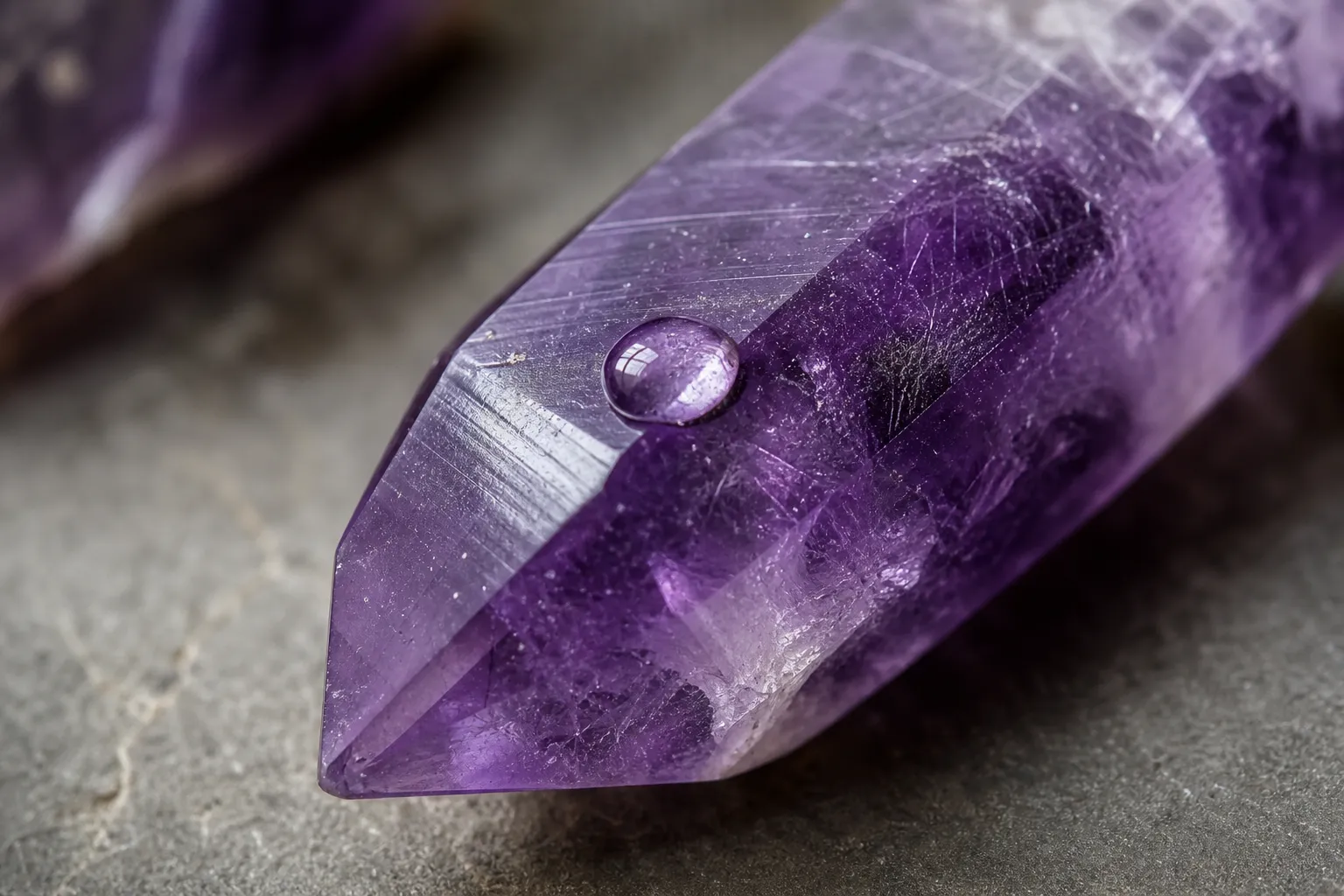
A bead of water on a polished amethyst point can look oddly convincing. It may sit high, slide slowly, or spread into a thin film; in a short video or shop-counter demonstration, that tiny movement can feel like evidence. The direct answer is simpler: the Water drop test cannot prove the origin, authenticity, treatment status, value, or glass-vs-crystal identity of a stone.
At most, the test shows how water behaves on that surface in that moment. Surface tension, wetting, hydrophobicity, polish, coatings, dust, handling oils, residue, texture, and drop placement can all affect the result. None of those conditions can name where a specimen formed or confirm whether it is glass, quartz, amethyst, or another material.
For a collector, the useful lesson is not that the water drop means nothing. It means something narrow: the surface responded in a certain way. It does not carry the burden of proof.
broader context
Broader amethyst guide
This narrower page lands better after the broader amethyst context page.
What the Water Drop Test Actually Observes
The informal water drop test usually asks you to place a small drop of water on a crystal, stone, or glass object and watch whether it beads, spreads, clings, or rolls away. Some demonstrations then turn that behavior into a verdict: beading means “real,” spreading means “glass,” “treated,” or “fake.” The visual part may be real; the conclusion is where the test breaks down.
Water is interacting with the outermost surface. It is not reading the specimen’s formation history, mine source, treatment status, or internal structure. A polished amethyst bead, a carved quartz point, a glass ornament, and a coated decorative object can all present smooth surfaces to the eye.
That matters because authenticity questions are rarely surface-only questions. With amethyst, a more careful judgment may look at color zoning, crystal habit, inclusions, growth features, cutting style, seller disclosure, and provenance language. A water drop may prompt a closer look, but it cannot replace that broader context.
The same limit applies to a glass crystal comparison. If two objects show different water behavior, the difference only says their visible surfaces behaved differently under one informal condition. It does not settle the material identity by itself.
Why Surface Behavior Can Mislead
Surface tension is often used to explain the water drop test, but the phrase can sound more decisive than the observation deserves. In plain terms, water can bead or spread depending on the relationship between the liquid and the surface it touches.
That relationship is not controlled by origin alone. A surface may be freshly cleaned, slightly oily from fingers, dusty from display, polished to a high shine, microscopically rough, waxed, coated, or affected by packaging residue. Any of those ordinary conditions can change what a small drop appears to do.
A rounded bead does not automatically mean “natural.” A spreading drop does not automatically mean “imitation.” Hydrophobicity, when used here, only describes a surface that appears to resist wetting under the conditions being watched. It does not identify a geographic source, prove that a purple quartz specimen is untreated, establish rarity, or confirm value.
This is why misleading tests travel so easily: they turn a visible effect into a material verdict. The effect may be observable. The verdict is not supported by the water line alone.
Origin Is Not Written on the Water Line
“Origin” can mean several different things. One person may be asking whether a crystal is natural rather than synthetic or imitation. Another may mean the country, mine, or deposit. Someone else may be asking whether a purple object is glass instead of quartz. The water drop origin claim often blurs all of these questions into one shortcut.
A surface tension test cannot responsibly carry that range of meaning. Natural formation, geographic source, material identity, treatment status, and market value are separate claims. They require different kinds of support.
For amethyst, the distinction is especially useful. A specimen may be beautiful in a room setting or meaningful in a personal practice, but symbolic use does not prove geological origin. Likewise, seller language does not become stronger because a drop of water beads on the surface. Collector literacy begins with separating what can be seen from what has only been asserted.
A water drop may tell you to look closer. It should not tell you to stop looking.
Conditions That Can Change the Result
Because the water drop test is informal, small changes can alter the appearance of the drop. That instability is one reason it should not be treated as an authentication method.
- Surface cleanliness: Finger oils, dust, soap residue, and display grime can affect whether water sits or spreads.
- Polishing and finish: A glossy surface may behave differently from a rough, fractured, matte, or weathered surface.
- Coatings or treatments: A surface layer can change water behavior without revealing the material underneath.
- Texture and shape: A curved bead, flat slab, carved point, or uneven cluster face gives the drop a different physical setting.
- Drop size and placement: A tiny drop on a sloped edge is not the same observation as a larger drop on a flat face.
- Recent handling: A piece wiped with cloth, held in warm hands, or stored in packaging may behave differently after cleaning and drying.
These are not exotic laboratory variables. They are ordinary conditions around real objects: a pendant from a hand, a glass piece from a display tray, an amethyst point from a shop counter. The more ordinary the variables are, the weaker the test becomes as proof.
The Glass vs Crystal Shortcut Is Too Simple
The glass vs crystal version of the water drop test is tempting because it promises a quick answer. A buyer sees two purple objects, places a drop on each, and hopes the result will separate glass from mineral.
But glass and mineral specimens can both be polished. Both can be handled. Both can carry residue. Both can be shaped into beads, towers, points, and decorative forms. If water behaves differently on two samples, the reason may be finish, cleaning, coating, texture, or shape rather than the material category itself.
Visual observations can still help a collector ask better questions. Color distribution, bubbles, mold marks, growth habit, fracture patterns, inclusions, heft, cutting quality, and seller documentation may all matter in context. But this page is not a full identification workflow, and a single home observation should not be turned into a final rule.
The narrow conclusion is enough: the water drop test limits are too large for glass vs crystal identity to be settled by beading or spreading alone.
Why the Demonstration Feels Convincing
Misleading material tests often work because they are simple, visual, and easy to repeat on camera. A drop of water creates a clean moment: before, after, explanation. It can feel more concrete than a seller’s description and less subjective than judging color or shape.
But a convincing demonstration is not the same as a diagnostic test. The viewer sees one object, one surface, one drop, one lighting condition, and one explanation. The missing question is control: what else could cause the same result?
Could cleaning change the behavior? Could a coating change it? Could another genuine specimen behave differently? Could a glass object behave similarly? Without those answers, the test remains a weak surface clue at best.
This is not a reason to distrust every informal tip. It is a reason to keep the claim proportional. For amethyst, a quick demonstration can blur the line between visible beauty, stated origin, and the quieter evidence needed for authenticity.
A Better Way to Use the Observation
If you have already tried the test, treat the result as a surface note, not a verdict. You might record what you saw: the drop beaded, spread, clung, slid, or broke apart. Then keep the conclusion modest.
- “This surface behaved this way with water.”
- “That does not prove origin.”
- “I need other support before accepting an authenticity claim.”
- “If the seller gives strong source or treatment language, I should ask what supports it.”
That last point matters more than the drop itself. If a listing claims a specific source, natural status, treatment history, or material identity, the support should come from appropriate evidence, not from a bead of water. For higher-stakes purchases, informal tests are especially easy to overvalue.
For a low-cost decorative piece, the decision may rest on color, finish, form, and how it fits the room. For collector-grade amethyst, the burden is higher. In both cases, the water drop should stay in its place.
What This Page Can and Cannot Claim
The materials available for this article did not include authoritative public references, confirmed testing, standards documents, museum guidance, university guidance, or firsthand experiments. That limits the certainty of this page, and it should.
What can be said cautiously is this: the water drop test is an informal surface observation, and the available material does not support using it to prove origin, authenticity, treatment status, value, or glass-versus-crystal identity. The reason is practical as much as technical: surface behavior can be affected by many ordinary conditions, so it is too indirect to carry larger claims.
That boundary is not a weakness in the answer. It is the answer. When a test claims more than its observation can show, the responsible move is to reduce the claim.
Short Answers to Common Leftover Questions
Can a water drop ever be useful?
It can be useful as a prompt to inspect the surface more carefully. It is not useful as proof of origin, authenticity, treatment status, value, or material identity on its own.
Does hydrophobicity prove a crystal is natural?
No. A hydrophobicity observation describes how water appears to behave on a surface. It does not establish natural formation, geographic source, treatment status, or value.
Should I use the test before buying amethyst?
You can notice water behavior if it happens, but do not let it carry the buying decision. Stronger judgment comes from the whole specimen context: visible features, seller transparency, documentation when relevant, and a clear separation between beauty, symbolism, and material evidence.
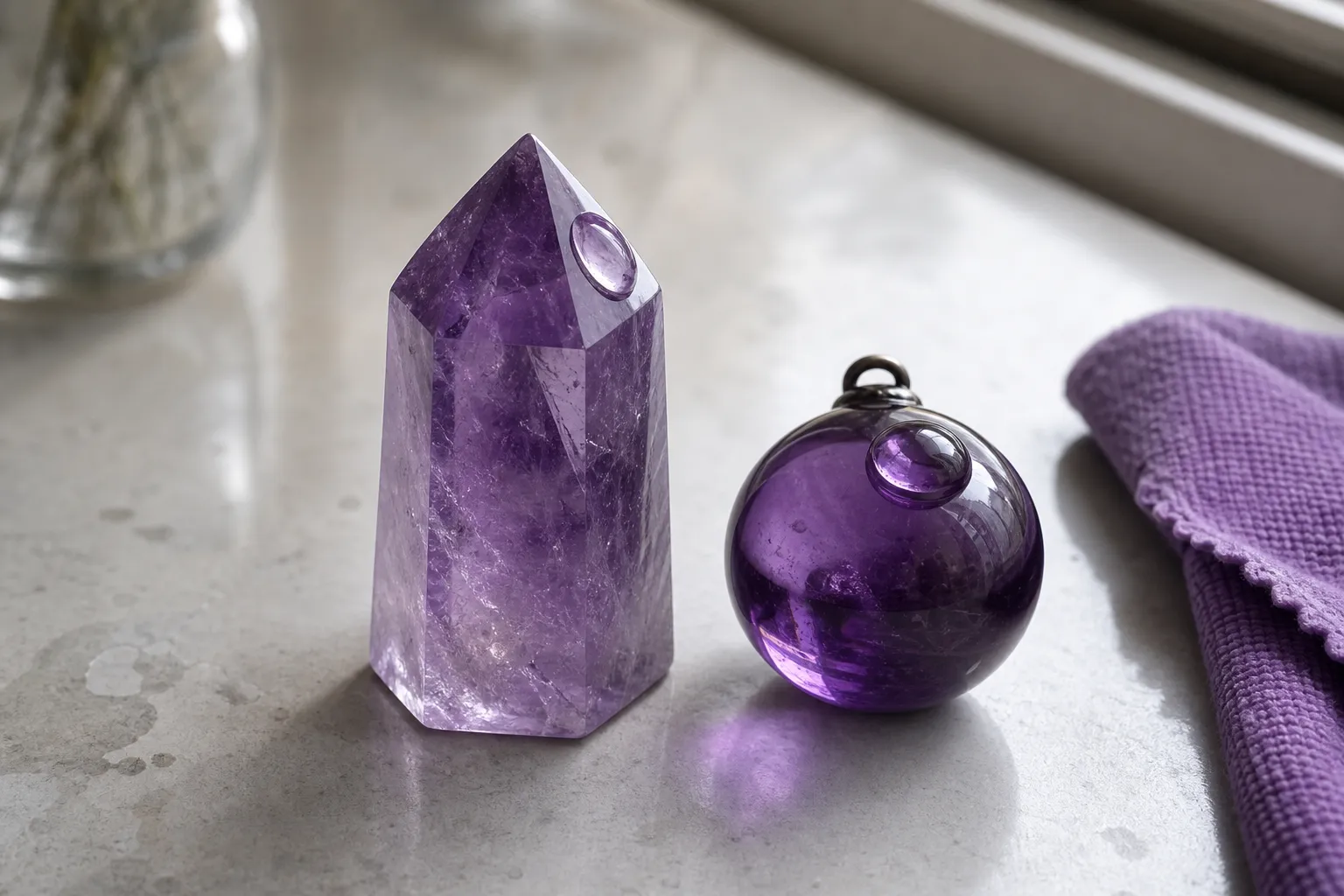
A water drop on purple quartz may be visually satisfying, especially on a polished point catching light on a shelf. Let it remain that small: a surface moment, not a certificate of origin. The specimen can still be chosen for color, form, care needs, and personal meaning; the water line simply cannot prove where it came from or what it truly is.