Amethyst care note
Temperature Dangers: Why Summer Heat Can Crack Your Amethyst Settings
A fine line across an amethyst cabochon, or a sudden-looking fracture inside a faceted ring, often gets blamed on the last hot day the piece survived. The careful answer is narrower: ordinary summer warmth does not mean an amethyst setting will crack, but abrupt temperature changes can raise the risk, especially when the stone is mounted, included, previously damaged, repaired, or held tightly in metal.
That is the practical center of thermal shock amethyst care. GIA’s public care guidance names abrupt temperature change as a fracture concern for amethyst, while the available sources do not give a reliable “hot car” temperature threshold. So the answer should be conditional, not dramatic.
broader context
Amethyst context note
This narrower page lands better after the broader amethyst context page.
What thermal shock means for mounted amethyst
Thermal shock is damage associated with rapid heating or cooling. A material expands or contracts unevenly; if stress concentrates around a weak point, a crack can open or an old fracture can spread.
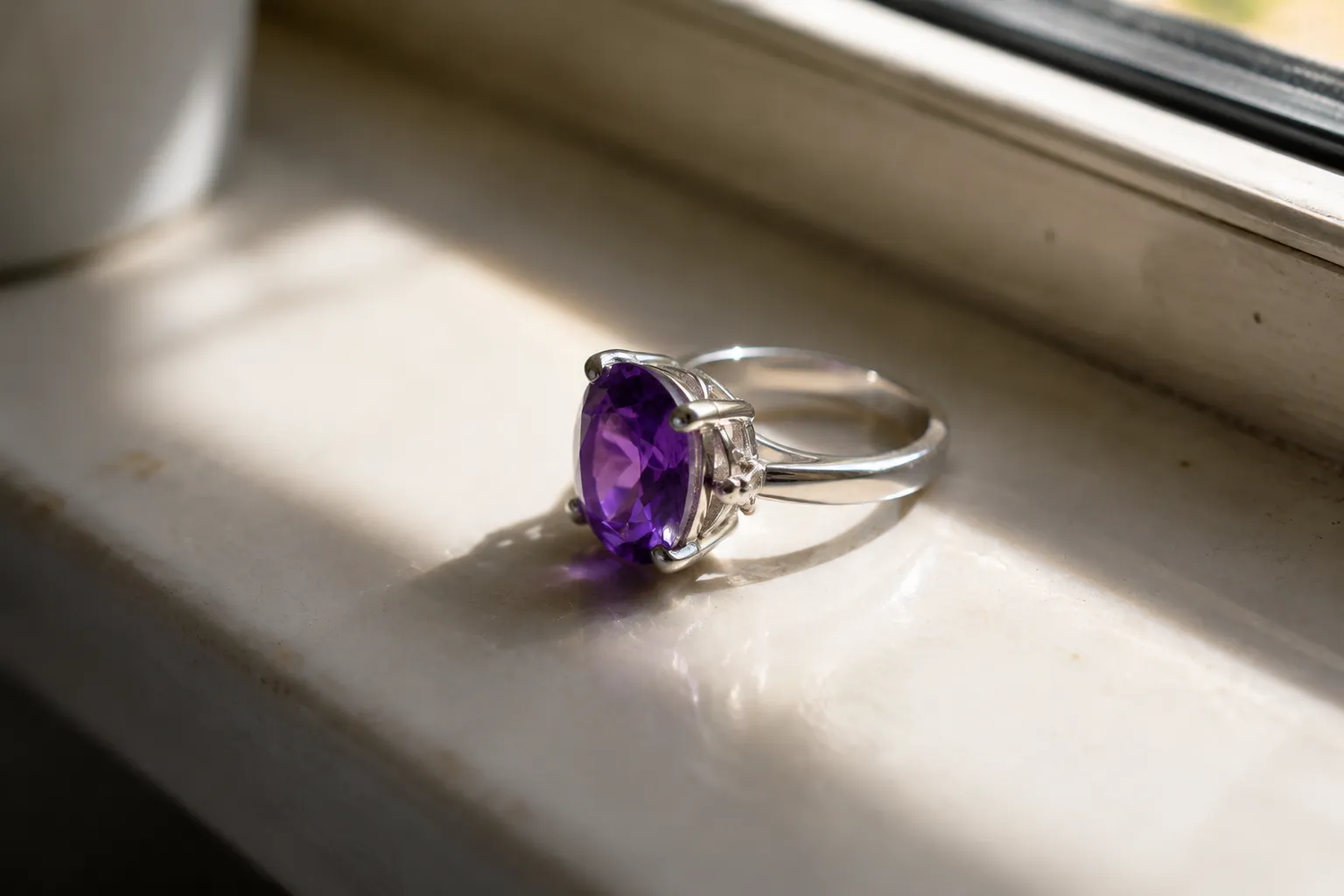
For amethyst jewelry, the risk is not only about the purple quartz. It is the stone plus its setting: prongs, bezels, adhesives, solder repairs, prior chips, and hidden pressure around the girdle. A loose crystal point on a shelf and a ring held tightly in metal do not carry stress in quite the same way.
Amethyst is quartz, a silicon dioxide mineral. Quartz is commonly listed around 7 on the Mohs hardness scale, which helps explain why amethyst can work well in many jewelry pieces. But Mohs hardness describes scratch resistance, not immunity from breaking. A stone can resist abrasion and still fracture when stress finds an existing path.
So “can heat crack amethyst?” deserves a cautious yes under certain conditions. “Will summer heat always crack amethyst?” deserves no.
Why summer settings can be more vulnerable than loose stones
Mounted amethyst has contact points. A prong can press on a facet edge; a bezel can grip the stone firmly; an older repair may leave tension that is not visible from above. When the piece warms or cools quickly, those points can matter more than the air temperature by itself.
Metal and quartz also respond differently to temperature change. That does not mean every amethyst ring left in a warm car is doomed. It does mean a tightly set, included, or previously stressed stone has less room to tolerate a sudden shift.
Everyday risk situations involve transitions, not steady warmth
- an amethyst ring left in a parked vehicle, then brought quickly into a cold room;
- jewelry warmed in direct sun, then rinsed under cold water;
- a pendant moved from strong sun into heavy air conditioning;
- an older or repaired setting exposed to repeated hot-cold cycling;
- a stone with visible inclusions, edge chips, or internal lines held tightly in metal.
These are risk situations, not guaranteed outcomes. The current evidence does not support a precise summer-temperature rule for mounted amethyst.
Inclusions and old fractures can become the path
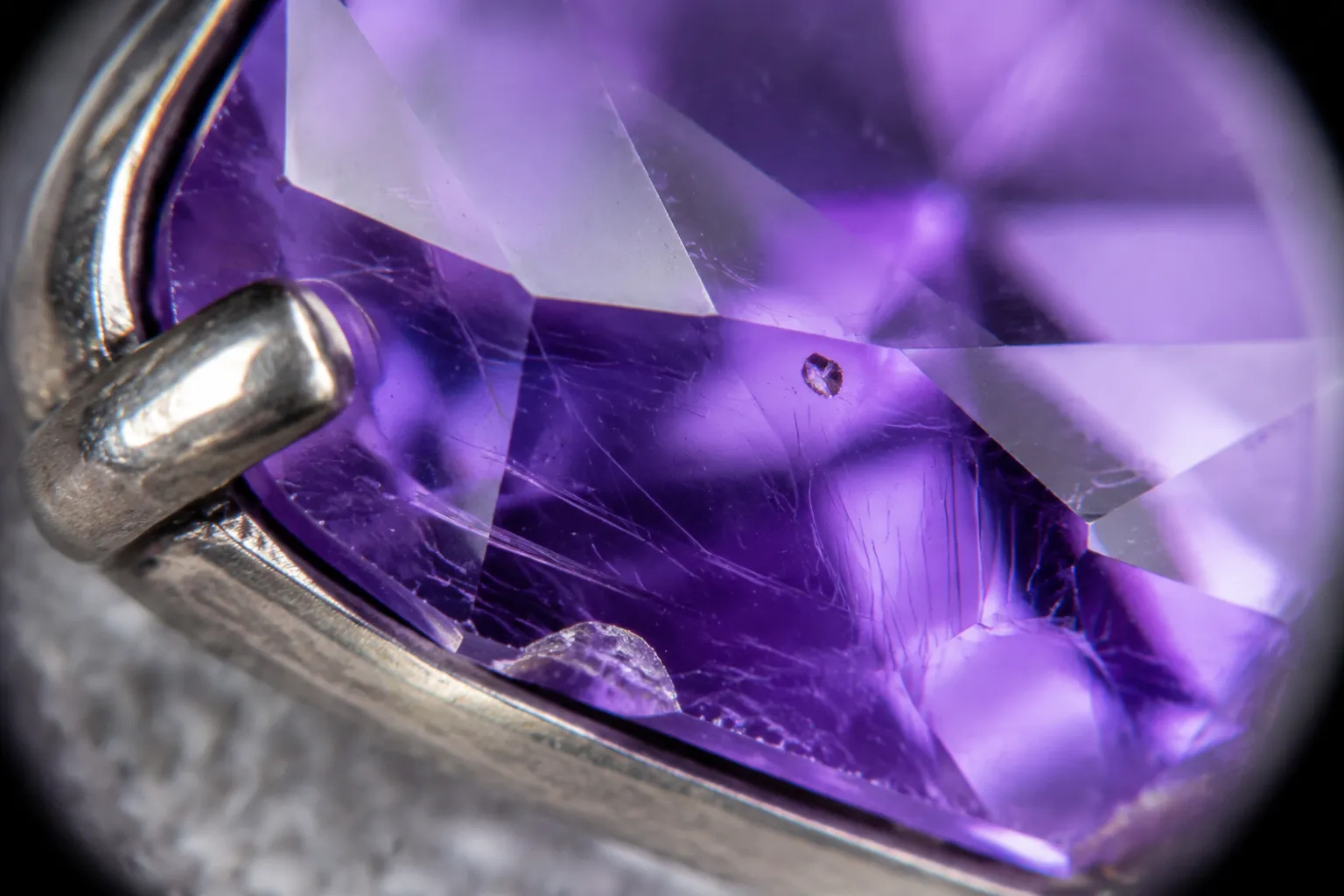
Many amethysts show inclusions, color zoning, growth features, or internal lines. Some are only visual character; others may mark a weaker area. A crack that seems to appear suddenly inside the gem may have followed a small fracture or stress path that was already present but difficult to see.
One wording point matters here. Some searchers describe “cleavage plane fractures,” but amethyst is quartz, and quartz is generally described as having no cleavage and a conchoidal fracture. In ordinary care language, that means an amethyst crack should not be explained as the stone splitting neatly along true cleavage planes.
A better explanation is that cracks may propagate through inclusions, growth zones, polished edges, facet junctions, old chips, or pressure points from the setting. Risk is not judged by color alone. Clarity features, prior damage, stone thickness, and the mounting all matter.
Heat cracking, sunlight color change, and heat treatment are separate issues
Summer warnings often mix three different concerns: thermal shock cracking, light-related color change, and high-temperature heat treatment. They are not the same problem.
Thermal shock cracking
Thermal shock cracking is about rapid temperature change and internal stress. This is the concern behind amethyst sudden temperature changes, rapid cooling cracks, and amethyst jewelry heat damage.
Prolonged strong light
Prolonged strong light is mainly a color concern. GIA notes that prolonged exposure to strong light may affect amethyst color. For daily care, that supports a simple habit: do not store amethyst jewelry or display specimens for long periods on a sunny windowsill, dashboard, or other bright hot surface.
High-temperature heat treatment
High-temperature heat treatment belongs to a different gemological context. Scientific studies of amethyst heat-treatment behavior involve controlled, much higher temperatures than ordinary summer wear. They should not be used to claim that a parked car can reproduce laboratory treatment or reliably change amethyst into another commercial-looking material.
If your amethyst spent an afternoon in summer sun, do not rush to cool it. Let the piece return gradually to room temperature, then inspect the stone and setting under steady light.
Calm prevention steps for summer wear
Amethyst does not need to be treated like fragile glass. Mounted pieces simply benefit from avoiding sharp temperature swings and unnecessary heat storage.
For most owners, these habits are enough
- Do not leave amethyst jewelry in a parked car, especially on a dashboard, console, or window-facing surface.
- Let a hot or cold piece sit at room temperature before cleaning it.
- Avoid sudden hot-to-cold or cold-to-hot rinsing.
- Keep amethyst jewelry away from heating vents, freezing storage areas, and long direct sun exposure.
- Be more cautious with tight bezels, lifted prongs, repaired stones, visible inclusions, or stones that already show internal lines.
- If the stone rattles, a prong looks lifted, or a crack appears new, stop wearing the piece until a jeweler or gemologist can inspect it.
That inspection is not about proving the weather caused the crack. Heat, impact, old fractures, pressure, and cleaning stress can look similar to a non-specialist. The useful question is whether the setting is secure and whether continued wear could worsen the damage.
For home display, the same principle applies. A specimen used for atmosphere, meditation space, or decoration is still a mineral object. Keep it away from prolonged intense sun, avoid abrupt temperature swings, and do not move a very warm stone into cold water.
What not to assume when a crack appears
A new-looking line after summer heat may involve thermal shock, but it is not the only plausible cause. A small knock against a countertop, pressure from a tight setting, an old internal fracture, or a cleaning shock can all contribute. Without inspection, the cause is usually an inference.
It is also worth separating physical care from spiritual symbolism. A damaged amethyst may feel personally meaningful, especially if the piece has a place in a room, ritual, or memory. That meaning belongs to the owner’s relationship with the object. It should not replace material clues such as inclusions, conchoidal fracture, setting pressure, or abrupt temperature change.
The reliable boundary is simple: amethyst is generally durable enough for normal jewelry wear, but rapid temperature changes are a recognized care concern, and mounted stones can carry extra stress points.
Quick answers for common heat worries
Can a hot car crack amethyst?
It can increase concern, especially if the jewelry is then cooled quickly or if the stone is included, already cracked, repaired, or tightly set. The available sources do not establish an exact hot-car temperature threshold for amethyst cracking.
Can direct sunlight damage amethyst?
Direct sunlight is more often discussed as a color concern than an immediate cracking cause. Prolonged strong light may affect amethyst color, and sun-warmed jewelry should not be rapidly cooled or rinsed in cold water.
Does hardness 7 mean amethyst cannot break?
No. Mohs hardness describes scratch resistance. Amethyst can still fracture along existing cracks, inclusions, growth features, edge damage, or stress paths created by a setting.
An amethyst ring on a summer dresser, a pendant left in a car, and a display crystal near a bright window ask for the same measured care: avoid sharp temperature transitions, watch the mounting, and treat symbolic concern as separate from physical cause. The purple quartz remains both a specimen and a personal object; its safest handling begins with the material facts.