Summer jewelry care
Summer Survival Guide: Reviving Gemstones After Chlorine and Sunscreen Exposure
A gemstone ring that looks dull after a pool day is not automatically ruined. For most sturdy, well-set pieces, the first move in Cleaning jewelry after pool exposure is modest: rinse in clean lukewarm water, pat dry with a soft lint-free cloth, and inspect the stone, metal, prongs, clasp, and any glue points before trying anything stronger.
The important limit is material. Sunscreen often leaves a surface film on harder, more tolerant stones, but chlorine residue on jewelry deserves more caution when the piece includes pearls, opals, turquoise, coral, treated stones, glued elements, vintage construction, or high financial or sentimental value. If a gem stays cloudy, looks discolored, feels sticky after gentle rinsing, or seems loose in its setting, stop and ask a jeweler or gemologist to assess it.
broader context
Broader amethyst guide
This narrower page lands better after the broader amethyst context page.
The first 10 minutes after a pool day
Start with what you can see: a sunscreen-smudged diamond, a sticky amethyst pendant, a silver ring that looks flatter than it did in the morning, or a pearl piece that picked up lotion before lunch. The best first response is not a dramatic shine-restoring routine. It is a low-intervention reset.
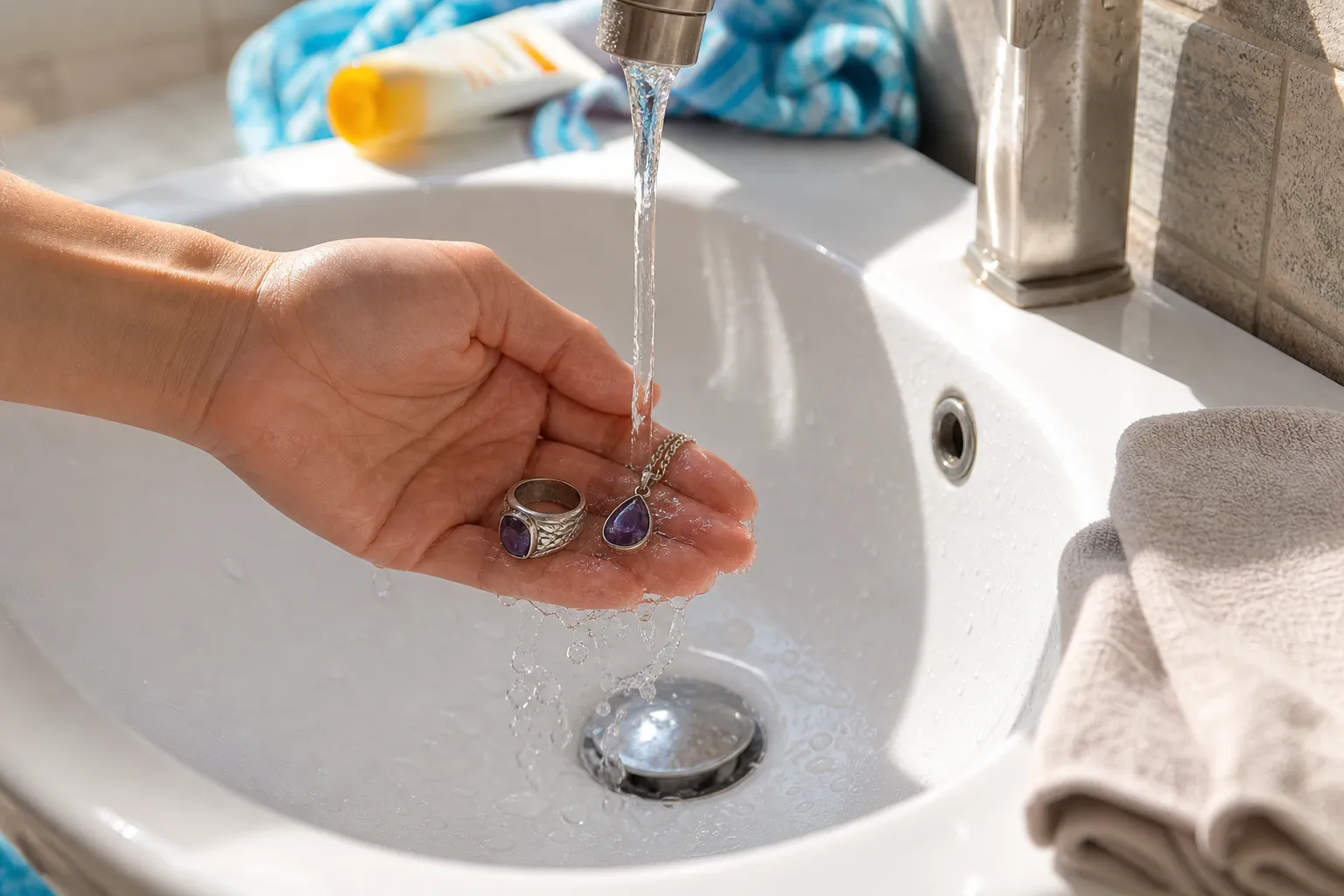
Remove the piece and rinse it under clean lukewarm water if the materials are reasonably water-tolerant. Keep the stream gentle; do not blast pavé settings, bead strands, old foiled stones, or anything already loose. Then pat dry the jewelry with a soft lint-free cloth instead of rubbing hard across the surface.
Before cleaning further, inspect loose settings. Look at prongs, bezels, jump rings, clasps, glue points, and any place where a stone meets metal. If a gem moves, clicks, rotates, or catches fibers from the cloth, the cleaning session is over. A loose stone is a setting problem, not a polishing problem.
For many everyday pieces with harder stones and secure modern settings, a soft cloth may be enough. If sunscreen buildup on gemstones remains, a small amount of mild, fragrance-free soap in lukewarm water may be reasonable only for materials you already know tolerate gentle washing. Avoid aggressive scrubbing. A soft-bristled brush can help around metalwork, but it can also stress delicate settings or mark vulnerable surfaces if used carelessly.
Amethyst sits in a middle place for this site’s readers: quartz is generally more tolerant than pearls or turquoise, but jewelry is never just a crystal. The setting, treatments, adhesives, age, and surface condition decide the care route as much as the purple stone itself.
Surface film is not the same as damage
Summer jewelry panic usually begins with a visual change: cloudy sparkle, a greasy halo near the setting, a dull metal edge, or a chalky look on a porous gem. Those signs do not all mean the same thing.
Sunscreen commonly behaves like a film. It can collect around prongs, under ring galleries, along pendant bails, and across faceted surfaces. On harder, nonporous stones in secure settings, that film may reduce brightness without proving lasting material damage. A careful rinse, soft cloth, and conservative cleaning may improve the appearance.
Chlorine exposure is harder to reduce to one rule because gemstone species, alloys, adhesives, coatings, treatments, exposure time, and previous condition all matter. Do not assume one swim has destroyed the piece. Do not assume every piece can be cleaned back to normal at home either. Both reactions go beyond what a careful jewelry-care boundary can support.
Metal response also varies. Sterling silver may look dull after summer wear, but plated pieces, rhodium finishes, gold alloys, and mixed-metal jewelry each bring their own limits. If the surface looks altered rather than merely dirty, especially after drying, avoid abrasive polishing compounds unless the maker or a jeweler has confirmed they suit that specific piece.
For amethyst jewelry, look for residue first: lotion caught under a claw, sunscreen haze across a cabochon, or grime at the back of a pendant. Then look for condition changes: chips, looseness, open prongs, cloudy glue, or a changed surface. That distinction protects the specimen and prevents overcleaning.
Pieces that need a gentler stop sign
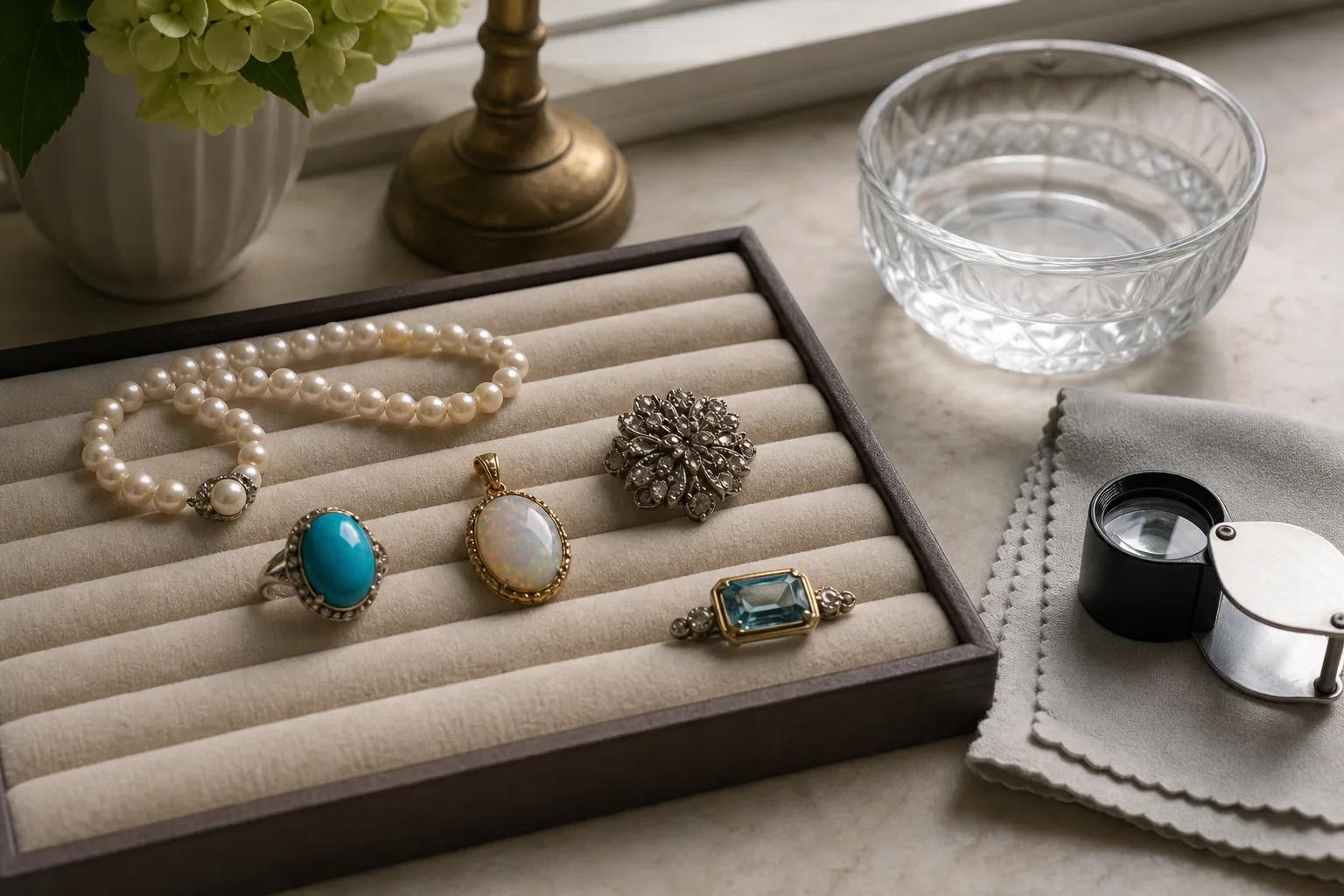
GIA jewelry-care guidance supports extra caution for delicate, porous, vintage, and treated jewelry. It also notes that cosmetics and lotions can be a concern for pearls and other delicate or porous gems such as turquoise, and that ammonia and ultrasonic cleaners are not universal answers. That should shape the recovery decision.
Pearls and sunscreen are a poor casual pairing. Pearls are organic gems, and surface quality is central to their appearance. If a pearl strand or pearl ring has been worn with sunscreen and pool water, wipe gently with a damp soft cloth if appropriate, dry carefully, and avoid soaking unless the construction has been confirmed suitable. Strands, knots, and older settings add uncertainty.
Turquoise jewelry care also deserves restraint. Turquoise is often treated as porous or sensitive in jewelry-care contexts, and treatments may not be obvious to the wearer. If turquoise looks cloudy, darker, chalky, or uneven after pool exposure, do not scrub it with soap or place it in a cleaner. A jeweler or gemologist is the better next step.
Opals after pool exposure should be handled with similar caution. Opals vary, settings vary, and old or treated pieces may not tolerate the same routine as a sturdy modern ring. Coral, shell, amber, and other organic or porous materials belong in the same conservative group. Cloudy porous stones are a warning sign, not a cue to intensify home cleaning.
Treated stones after chlorine exposure are another stop sign because the treatment may be more vulnerable than the gem species name suggests. Dye, coating, filling, oiling, diffusion, assembled construction, or glue can change cleaning tolerance. If you do not know whether a stone is treated, keep stronger cleaners off the table.
Vintage jewelry deserves its own caution because age can hide weak solder, worn prongs, water-sensitive construction, old adhesives, foil backing, or fragile finishes. If the piece has family history, rarity, or meaningful value, restraint is part of care.
What not to use as a rescue shortcut
The common summer-cleaning mistake is reaching for a stronger method before identifying the material. Chlorine residue on jewelry and sunscreen buildup are not invitations to use bleach, ammonia, abrasive polish, boiling water, alcohol soaks, toothpaste, or a generic deep-clean routine.
Ammonia jewelry cleaner risks are easy to understate. Ammonia may appear in some diamond-cleaning conversations, but that does not make it appropriate for pearls, turquoise, opals, treated stones, antique construction, glued settings, or mixed-material jewelry. A cleaner that suits one ring can be wrong for another ring in the same jewelry box.
Ultrasonic cleaner risks follow the same logic. Ultrasonic machines can shake residue out of durable settings, but they can also expose loose stones, stressed inclusions, fragile settings, treated materials, or already-weakened construction. After pool and sunscreen exposure, an ultrasonic cleaner should not be the default recovery step for gemstone jewelry.
Be careful with commercial reassurance words as well. “pH-neutral,” “fragrance-free,” “ammonia-free,” and “chlorine-free” may sound gentler, and they can be useful clues when choosing products, but they do not prove a cleaner is suitable for every gemstone, treatment, adhesive, or antique setting. Product language is not the same as a material-specific care decision.
The same caution applies to phrases such as “desalination process” or “chemical decontamination.” For this page’s purpose, the supported home step is a gentle fresh-water rinse for appropriate pieces, followed by drying and inspection. Do not turn a pool-day cleanup into a chemistry experiment. If the concern feels that serious, the piece belongs with a professional, not in a sink-side trial.
A simple triage route for summer jewelry
Use the route that matches the most delicate part of the piece, not the strongest stone in it.
Light sunscreen film on a sturdy, secure gemstone ring
Reasonable first move: Lukewarm water jewelry rinse, soft cloth, careful drying.
When to stop: If film remains deep in the setting or the stone moves.
Sticky residue around prongs or under a pendant bail
Reasonable first move: Gentle rinse, and possibly mild soap only if the materials tolerate it.
When to stop: If glue, foil backing, pearls, turquoise, opal, coral, or vintage construction is present.
Cloudy porous stones
Reasonable first move: Do not scrub or soak.
When to stop: Ask a jeweler or gemologist.
Dull metal with no loose stones
Reasonable first move: Dry fully and inspect the finish before polishing.
When to stop: If the metal is plated, antique, engraved, or chemically altered in appearance.
Loose stone, bent prong, open clasp, or rattling sound
Reasonable first move: Stop cleaning.
When to stop: Professional inspection is the next step.
High-value or sentimental jewelry
Reasonable first move: Minimal handling.
When to stop: Professional care is usually more prudent than home experimentation.
This route is deliberately modest. The goal is to remove ordinary residue when that is all you are dealing with, while avoiding the larger mistake of treating every gem as if it were a durable modern diamond ring.
Prevention is short but useful: remove jewelry before swimming when possible, apply sunscreen before putting jewelry on, and store pieces somewhere secure rather than loose in a towel or pool bag. Loss risk is not chemical damage, but it is one of the most ordinary ways summer jewelry disappears.
Common confusion after chlorine and sunscreen exposure
A dull ring is not always damaged.
Sunscreen, lotion, sweat, and ordinary skin oils can mute brilliance, especially around settings. If the stone is hard, stable, untreated as far as you know, and securely set, gentle cleaning may be enough.
One chlorine exposure does not prove irreversible harm.
Some seller and social media warnings use urgent language around pool chemicals, but a universal one-exposure rule is too broad. Repeated exposure, delicate materials, treatments, adhesives, and old settings still deserve caution.
A “waterproof” label does not settle gemstone care.
Even if a metal or fashion piece is marketed for water wear, the gemstone, coating, glue, plating, or finish may have a different tolerance. Judge the whole object.
Diamonds and pearls do not belong in the same cleaning category.
Neither do amethyst, turquoise, opal, coral, sterling silver, and a glued vintage brooch. Material literacy is the practical heart of recovery.
Home cleaning cannot verify authenticity, treatment, provenance, or value.
If pool exposure has made you notice a cloudy stone, uneven color, loose setting, or suspicious surface, that observation may justify professional review, but it does not prove what the stone is or what it is worth.
When professional inspection is the careful choice
Take the piece to a jeweler or gemologist if you see discoloration that remains after gentle drying, cloudy porous gems, looseness, damaged prongs, softened glue, changed coatings, cracked surfaces, or residue trapped where you cannot reach it without force. Also escalate antique, inherited, rare, or high-value jewelry before trying cleaners marketed as universal.
This is not because every pool day is a disaster. It is because the visible symptom may be only the surface of a more specific material question. A jeweler can assess settings and construction; a gemological professional can help identify stone-related concerns. Neither should be replaced by stronger soap, a home ultrasonic cycle, or an aggressive polishing session.
For amethyst owners, the calm answer is often this: rinse if the setting and construction allow it, dry thoroughly, inspect closely, and keep meaning separate from care. A purple quartz pendant may hold personal significance on a summer evening, but its recovery after chlorine and sunscreen still depends on surface residue, setting condition, treatment uncertainty, and the quiet discipline of stopping before cleaning becomes damage.