Post-wear care
The Post-Wear Ritual: Safely Removing Body Oils Before Long-Term Storage
A worn amethyst ring or pendant can look clean while still holding a thin trace of skin oil, lotion, fingerprints, or moisture behind the setting. For cleaning amethyst jewelry before long-term storage, keep the ritual modest: inspect the piece, wipe it with a clean microfiber or lint-free cloth, use warm soapy water with mild dish soap only when residue remains, rinse only when the construction allows it, dry fully, then store the piece separately in a soft pouch or lined box.
Avoid steam, hot water, harsh household cleaners, alkaline oil removers, abrasive cloths, stiff brushes, and forceful scrubbing. If the setting is loose, glued, cracked, antique, inherited, treated, fracture-filled, dyed, or unusually valuable to you, stop at a gentle wipe and ask a jeweler before deeper cleaning.
broader context
Broader amethyst guide
This narrower page lands better after the broader amethyst context page.
The Short Ritual After Wearing Amethyst
Start under normal room light. Look for lotion film near prongs, a dull patch on the stone, trapped moisture behind a pendant, or residue along the inside of a ring shank. This is not gem testing; it is a practical check before the piece rests for weeks or months.
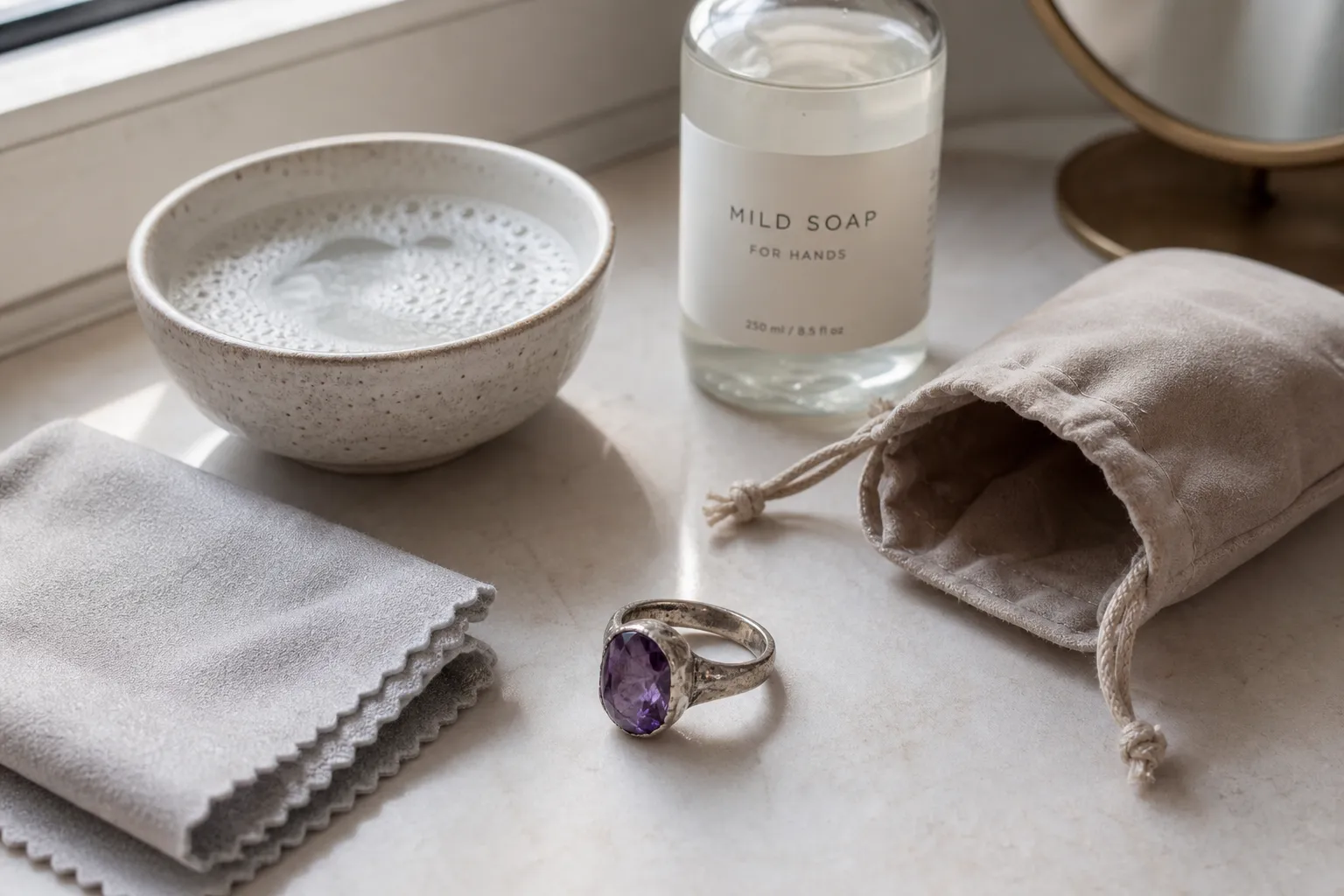
For light body oils or fingerprints, a dry microfiber cloth or lint-free towel is usually enough. Fold the cloth over your fingertip and wipe the amethyst, metal, and back of the setting with light pressure. Treat microfiber as a soft drying and wiping tool, not as a guaranteed oil-removal technology; the available sources do not support detailed performance claims about microfiber moisture absorption.
If lotion residue remains, prepare a small bowl of warm soapy water with mild dish soap. GIA identifies warm soapy water as suitable for amethyst, which makes it the clearest amethyst-specific home-cleaning boundary in the available material. Dampen a soft cloth or very soft toothbrush, work gently around the setting, and avoid pushing water into closed backs, glued areas, or fragile mounts.
Rinse with clean lukewarm water only if the jewelry construction can tolerate it. Then dry with a lint-free towel and follow with a dry cloth. Check the underside of stones, chain links, prongs, bezels, hinges, and clasps. Long-term jewelry storage should begin when the whole piece feels dry, not simply when the purple quartz looks bright.
A restrained sequence
- Inspect for residue, looseness, cracks, or trapped moisture.
- Wipe with a clean microfiber or lint-free cloth.
- Use warm soapy water only if a dry wipe is not enough.
- Clean gently with a soft cloth or very soft toothbrush.
- Rinse carefully only when the setting allows it.
- Dry fully, let hidden moisture clear, then store separately.
That is the ritual; it is intentionally restrained.
What Body Oils and Lotion Actually Change
Body oils are not mineral grit or heavy dirt. They usually appear as a soft film: a smudge where a pendant touched skin, a faint dullness on a faceted stone, or a slightly sticky area near a ring’s under-gallery. The phrase “sebum degradation” appears in search language, but the available care sources do not support a precise chemistry lesson for sebum on amethyst. A more useful, supported statement is simpler: skin oil and lotion residue can make jewelry look dull or become harder to remove if the piece is stored without attention.
Lotion makes the task trickier because it collects in small jewelry details. A smooth amethyst cabochon is easier to wipe than a faceted stone in prongs. An open-back pendant dries more easily than a closed or glued design. The stone matters, but the setting often decides how cautious the cleaning should be.
GIA describes amethyst as quartz with Mohs hardness 7 and good toughness, but hardness is not permission for rough handling. Dust, grit, polishing compound, or a dirty towel can still drag abrasive particles across stone or metal. If you use a toothbrush, choose a very soft one reserved for delicate jewelry work.
For collectors, the practical judgment is not “clean harder.” A daily-wear pendant, an inherited ring, and a newly purchased necklace do not deserve the same confidence. Unknown treatment, old repairs, visible cracks, glued elements, or sentimental value all point toward lighter cleaning and piece-specific advice.
What Not to Use Before Storage
Steam cleaning is the clearest no for this task. GIA advises against steam cleaning amethyst because heat exposure should be avoided. Steam may look like a quick way to loosen oils, but speed is not the goal before storage; gentle residue removal is.
Hot water and sudden temperature changes also do not belong in the routine. GIA notes that amethyst can be affected by thermal shock, and prolonged strong light may fade color. Ordinary room handling is not a crisis, but a storage habit should avoid heat, strong light, and dramatic temperature shifts. A cool, shaded drawer or lined box fits the evidence better than a bathroom shelf, sunny tray, or window ledge.
Avoid harsh household chemicals, including alkaline solutions. GIA specifically identifies hydrofluoric acid, ammonium fluoride, and alkaline solutions as damaging to amethyst. For removing body oils, that rules out strong oil-cutting agents, lye-based methods, ammonia-heavy cleaning, aggressive degreasers, toothpaste, powdered cleansers, and polishing compounds.
Ultrasonic cleaning needs a narrower answer. GIA says ultrasonic cleaning is usually safe for untreated amethyst, but that exception does not cover fracture-filled, dyed, or treated stones. It also does not answer questions about glue, loosened prongs, old repairs, delicate settings, or uncertain metal condition. For a storage-focused post-wear ritual, skip ultrasonic cleaning unless a jeweler has confirmed the specific piece is a good candidate.
Drying Before Long-Term Storage
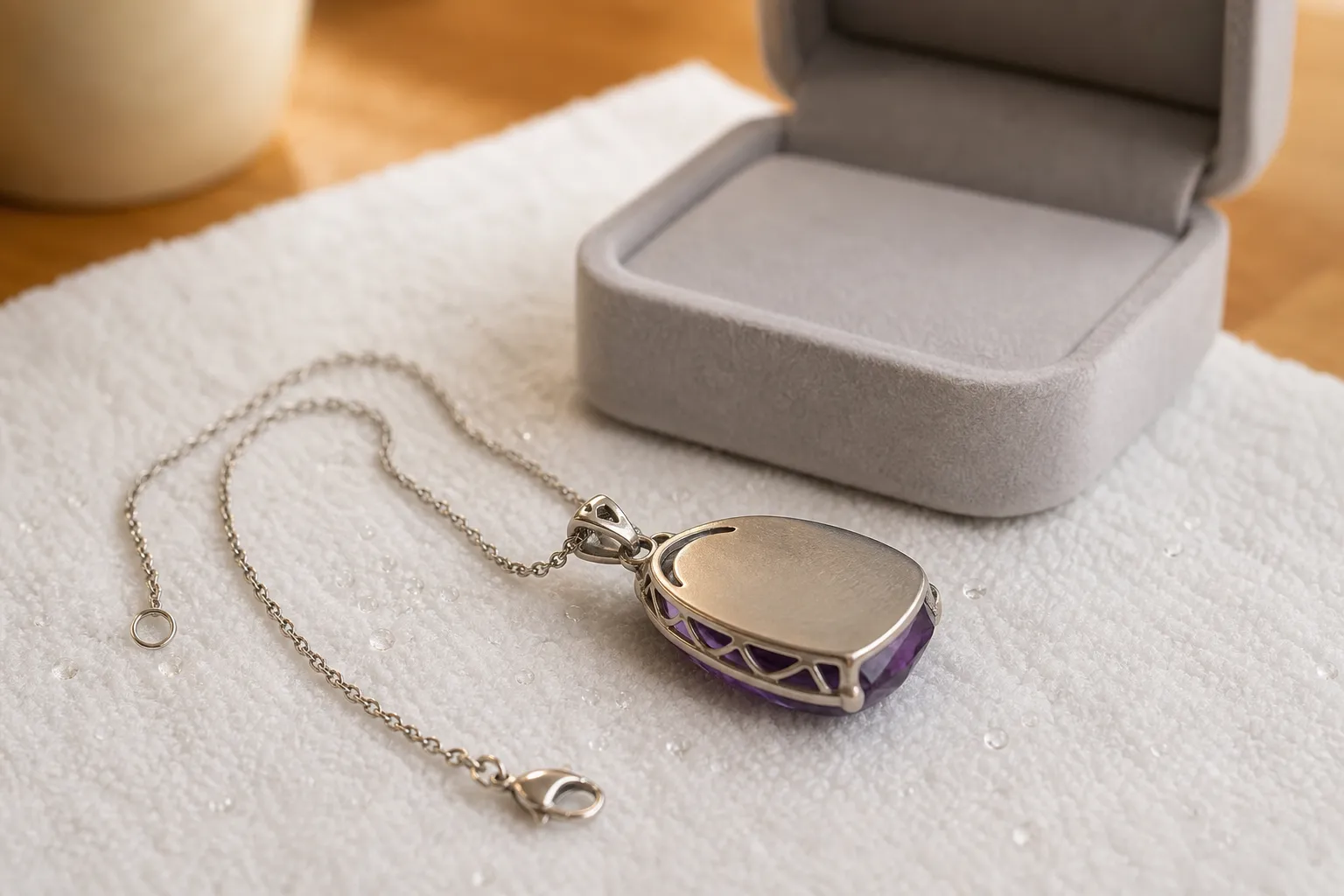
Drying is the step most easily missed. A stone can look clean while moisture remains under a bezel edge, inside a chain link, behind a pendant, or around a clasp. After wiping, let the piece sit briefly on a clean lint-free towel. Do not use a hair dryer, radiator, sunny windowsill, or hot surface to hurry the process.
Prevention makes this ritual lighter. Remove amethyst jewelry before showering, swimming, cleaning, exercising, sleeping, or applying lotion. General jewelry-care guidance from professional associations supports removing jewelry before activities that expose it to chemicals, impact, moisture, or unnecessary wear. The less residue you add, the less cleaning the stone and setting need later.
Once dry, store the amethyst separately. Use a soft pouch, soft-lined box, or individual compartment to reduce abrasion, tangled chains, bent prongs, and metal-on-stone contact. This is not treating amethyst like fragile glass; it is avoiding preventable storage wear.
If the piece includes pearls, opals, glued accents, plated metal, or other materials, the most delicate component may set the storage rule. Amethyst is the center of this page, but jewelry is often a mixed-material object.
When a Jeweler Is the Better Next Step
At-home care has a narrow lane: light body oils, lotion film, everyday residue, and moisture after wear. A jeweler is the better next step when the piece is valuable, inherited, cracked, loose, heavily soiled, antique, glued, visibly repaired, or uncertain in treatment.
A prong that catches on cloth, a stone that shifts when touched, a cloudy film that does not lift with mild soap, or dark buildup under a setting should not be solved with stronger chemicals. Cleaning may reveal a problem, but it should not create one. If a ring or pendant carries family memory, the cost of a wrong experiment is higher than the inconvenience of asking for an inspection.
Professional jewelry-care guidance supports piece-specific judgment because gemstone identity is only one variable. Metal type, setting style, adhesives, prior repairs, and treatments all affect what is reasonable. For amethyst, the basic home lane remains warm soapy water, gentle wiping, careful drying, and separate storage.
Common Confusion Around Post-Wear Amethyst Cleaning
Is one wipe enough after wearing amethyst jewelry?
Often, yes. If the surface has only fingerprints or light skin oil, a clean microfiber or lint-free cloth is the least invasive first step. Use warm soapy water only when visible film or lotion residue remains.
Should I deep-clean amethyst before storing it for months?
Not by default. Long-term storage calls for clean, dry, separate placement, not aggressive cleaning. If mild soap and warm water do not improve dullness, the issue may be setting buildup, damage, coating, or treatment uncertainty.
Can I use steam or ultrasonic cleaning just once?
Skip steam for amethyst. Ultrasonic cleaning is conditional: it may be acceptable for untreated amethyst, but it is not a default post-wear step. If treatment, filling, dye, glue, age, or setting condition is unknown, do not use it at home.
The Evidence Boundary for This Ritual
The strongest source here is GIA’s amethyst-specific care guidance: warm soapy water, avoidance of steam, caution around heat and strong light, chemical cautions, and treatment-related limits for ultrasonic cleaning. Jewelers of America and AGS add broader support for removing jewelry before risky activities, seeking jeweler advice, and storing pieces separately.
The evidence is thinner for exact soak times, detailed sebum chemistry, microfiber mechanics, and measurable long-term storage outcomes. That is why this page treats the ritual as conservative residue management rather than a preservation formula. Remove what the day left behind, avoid heat and harsh chemistry, let the piece dry, and give the purple quartz its own soft place to rest.