Quartz color zoning
Ametrine vs. Amethyst: Understanding Color Zoning Origins
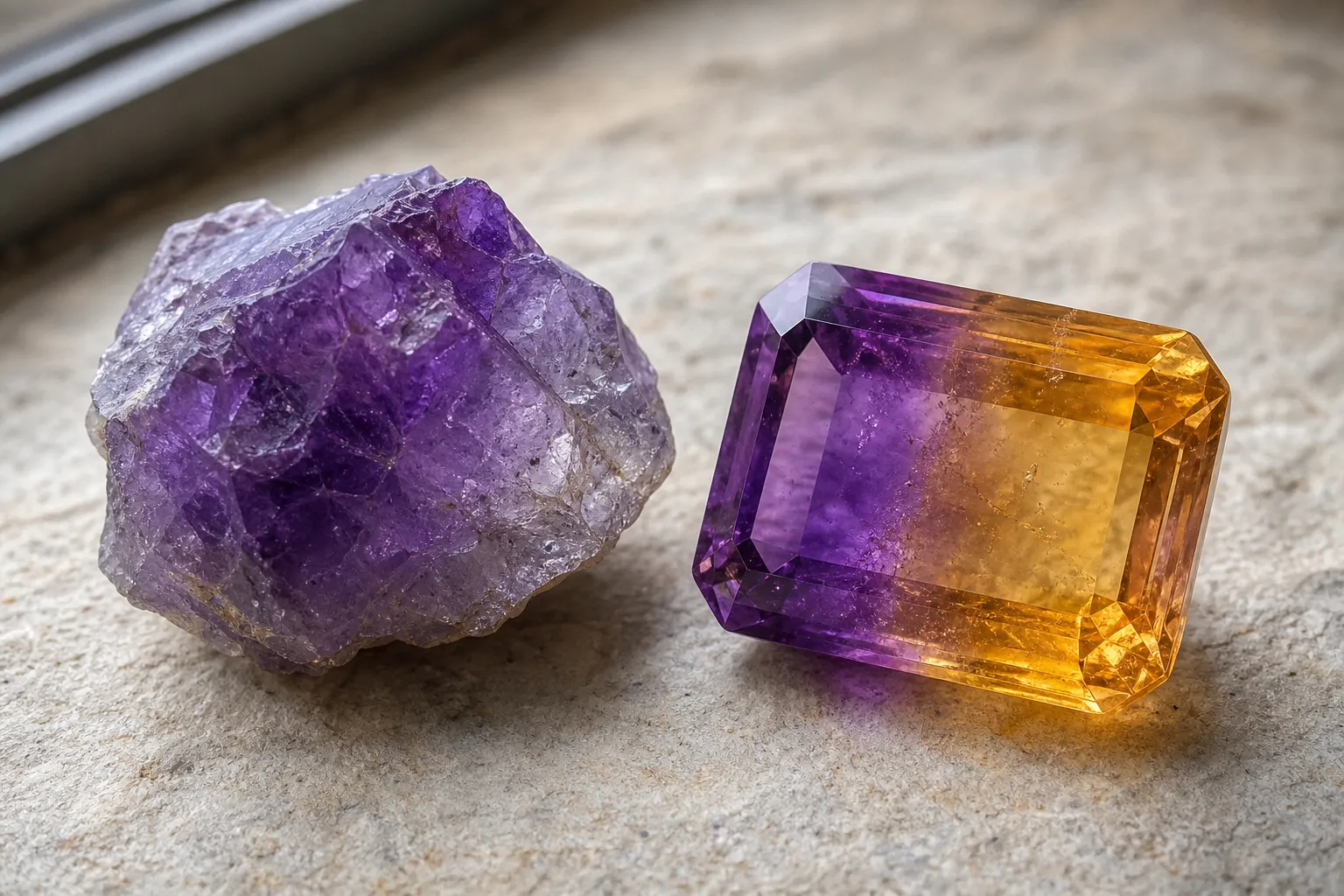
Bolivian Ametrine is often compared with amethyst because both are quartz and both can include purple color. The practical difference is simple: amethyst is usually read as purple quartz, while ametrine is read as bicolor quartz, with purple and yellow-to-orange zones appearing in the same crystal or cut stone.
That visible split is the center of the ametrine vs amethyst question. It is also where the limit begins. Color zoning can explain why a stone looks like ametrine rather than ordinary amethyst, but color alone cannot confirm origin, natural formation, treatment status, or value.
broader context
Broader amethyst guide
This narrower page lands better after the broader amethyst context page.
The direct comparison
Amethyst is identified in everyday gem language by its purple body color. It can still be uneven. One piece may show pale and dark purple areas, bands, patches, or internal zoning. Uneven purple does not automatically make it ametrine.
Ametrine is different because the comparison involves two color families. The feature readers usually notice is purple meeting yellow, golden, or orange-yellow color in one piece of quartz. The point is not simply “more than one shade.” It is a meaningful purple-and-yellow bicolor pattern.
Amethyst reading
Does the stone mainly look like purple quartz?
Ametrine reading
Or does it show both purple and yellow-to-orange zones in the same material?
If the answer is only visual, the conclusion should stay visual too. A label such as Bolivian Ametrine carries more than a color description. It also suggests identity and origin, and those claims need support beyond appearance.
How color zoning changes what you see
Quartz color zoning means color is not distributed evenly through the whole crystal. One area may look darker, lighter, warmer, cooler, or differently colored from another.
In amethyst, zoning usually stays within the purple range. A crystal may have deeper purple tips, paler sections, or soft internal transitions. Those features can be attractive and distinctive, but they still fit an amethyst reading when the stone is essentially purple quartz.
In ametrine, the zoning changes the category of the comparison because two color families are involved. The purple side connects it visually with amethyst. The yellow-to-orange side creates the bicolor effect associated with ametrine.
Cutting can make this contrast look sharper. A faceted gem may be oriented to show a clean split between colors. A crystal specimen may look more irregular, with zones that do not fall into a neat graphic boundary. Photos can also shift the impression: lighting may warm a pale yellow area, deepen purple, or hide part of the transition.
So the visible pattern is a good starting point, not the whole answer.
What “Bolivian” can and cannot prove
“Bolivian” is not a visual feature. It is an origin claim.
A stone can be described visually as bicolor quartz if purple and yellow-to-orange zones are visible. It can be discussed as ametrine if that color relationship is the basis for the identification. But saying it is Bolivian Ametrine adds a locality claim. That depends on provenance, documentation, and appropriate gemological context, not on color alone.
Color alone cannot verify:
- where the crystal was mined;
- whether the present color is natural or modified;
- whether the label is being used precisely;
- whether the value implied by the name is justified;
- whether the source’s origin story is complete.
This does not mean every origin description is wrong. It means the visual evidence and the documentary evidence should be kept separate. The eye can notice bicolor zoning. It cannot certify Bolivia.
Why the two are easy to confuse
The confusion is understandable. Ametrine contains an amethyst-like purple portion, so readers often focus on that first. If the yellow area is pale, small, hidden by a jewelry setting, or exaggerated by lighting, the distinction may not be obvious.
There is also a wording problem. Casual listings may use color terms such as purple, lavender, golden, honey, champagne, or bi-color without saying what has actually been verified. Those words can describe appearance, but they do not establish locality, treatment history, or full gem identity.
Uneven amethyst adds another trap. A purple stone with lighter areas is not necessarily bicolor quartz in the ametrine sense. The more relevant question is whether the stone shows a true purple-and-yellow relationship rather than ordinary light-to-dark purple variation.
Polished and faceted stones can make this harder. Cutting may emphasize color zones or hide them from certain angles. A mounted stone may show only its best-looking side. For that reason, distinctive visual features in a photo should be treated as clues, not final proof.
A careful way to describe what you see
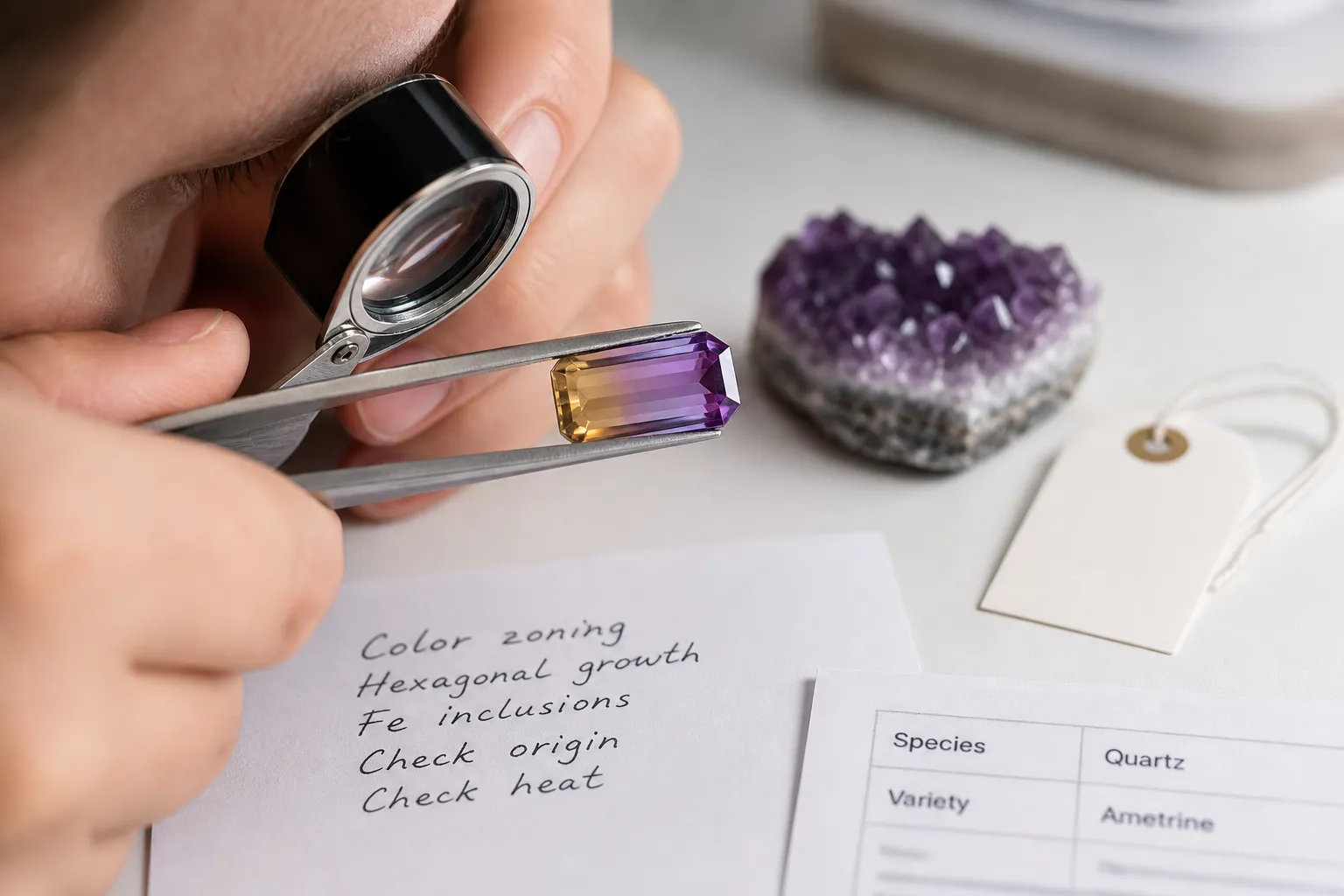
For a non-laboratory comparison, start by describing the visible features before accepting the strongest label.
Start with the color range
If the stone is mainly purple with lighter and darker areas, the amethyst comparison is stronger. If it clearly shows purple plus yellow-to-orange zones in one piece, the ametrine comparison becomes more relevant.
Check the zoning pattern
Does the color change appear to be part of the stone from more than one angle, or does it depend on lighting, background, reflection, or photography? A single image is often too thin a basis for confident wording.
Separate description from identification
“Purple and golden zones are visible” is a visual statement. “Bolivian Ametrine” is a stronger identity and origin phrase. The second claim needs more support than the first.
Notice the source of the claim
A decorative listing, short caption, or broad marketing phrase is not the same as transparent provenance or gemological assessment. The stronger the claim, the stronger the support should be.
What color zoning origins can be said cautiously
“Color zoning origins” points to why different color areas exist within quartz. A deeper mineralogical explanation may involve crystal growth conditions, trace elements, color centers, heating, irradiation, and later alteration questions. Without authoritative source coverage for a specific specimen, those mechanisms should not be stated as settled facts for that stone.
For this comparison, the safer answer is narrower: ametrine is understood through bicolor zoning, while amethyst is understood primarily through purple quartz color. The origin of the color zones in any individual stone should not be assumed from the name or appearance alone.
A sharp purple-yellow division may look persuasive, but visual neatness is not formation evidence. A soft or irregular transition may look more natural to the eye, but that impression is not proof either.
The balanced takeaway is this: color zoning explains why ametrine looks different from amethyst, but it does not by itself prove where the stone came from, how it formed, or whether its appearance changed later.
Practical takeaway
If you are deciding whether a stone is better described as amethyst or ametrine, keep the question small.
Amethyst comparison begins with purple quartz appearance. Ametrine comparison begins when purple and yellow-to-orange zones appear together in the same quartz material. Bolivian Ametrine adds an origin layer that should not be accepted from color alone.
Amethyst
Mainly purple quartz, even when the purple is uneven.
Ametrine
Bicolor quartz showing purple plus yellow-to-orange zoning.
Bolivian Ametrine
An ametrine identity with an origin claim that needs support beyond appearance.
That distinction keeps the visual comparison useful without asking color to prove more than it can.
Brief FAQ
Is every purple-and-yellow quartz automatically Bolivian Ametrine?
No. A purple-and-yellow appearance may explain why a stone is compared with ametrine, but “Bolivian” is an origin claim. It needs evidence beyond the visible color pattern.
Can amethyst have zoning without being ametrine?
Yes. Amethyst can show uneven purple color, lighter and darker areas, or internal zoning. The ametrine comparison becomes relevant when the stone shows a true bicolor relationship between purple and yellow-to-orange zones.
Is color enough to identify ametrine with certainty?
No. Color is a useful first clue, not complete proof. It can support a visual comparison, but it cannot confirm origin, natural formation, treatment status, or value by itself.