Jewelry box moisture control
Silica Gel vs. Calcium Chloride: Choosing the Safest Desiccant for Your Jewelry Box
An amethyst pendant on a velvet-lined tray has different needs from a shipping carton or a damp closet. For a jewelry box desiccant, silica gel packets are usually the safer default than calcium chloride because they control moisture without normally turning into liquid brine. Calcium chloride can work well in wetter settings, but its deliquescence means it can pull in enough water to become liquid or gel-like residue; in a small box holding metals, stones, clasps, glue, fabric lining, and polished finishes, that contact risk matters more than raw capacity.
The short answer is not that silica gel is perfect. It is that a jewelry box is a sensitive enclosure, and the lower-leakage profile of silica gel fits that job better.
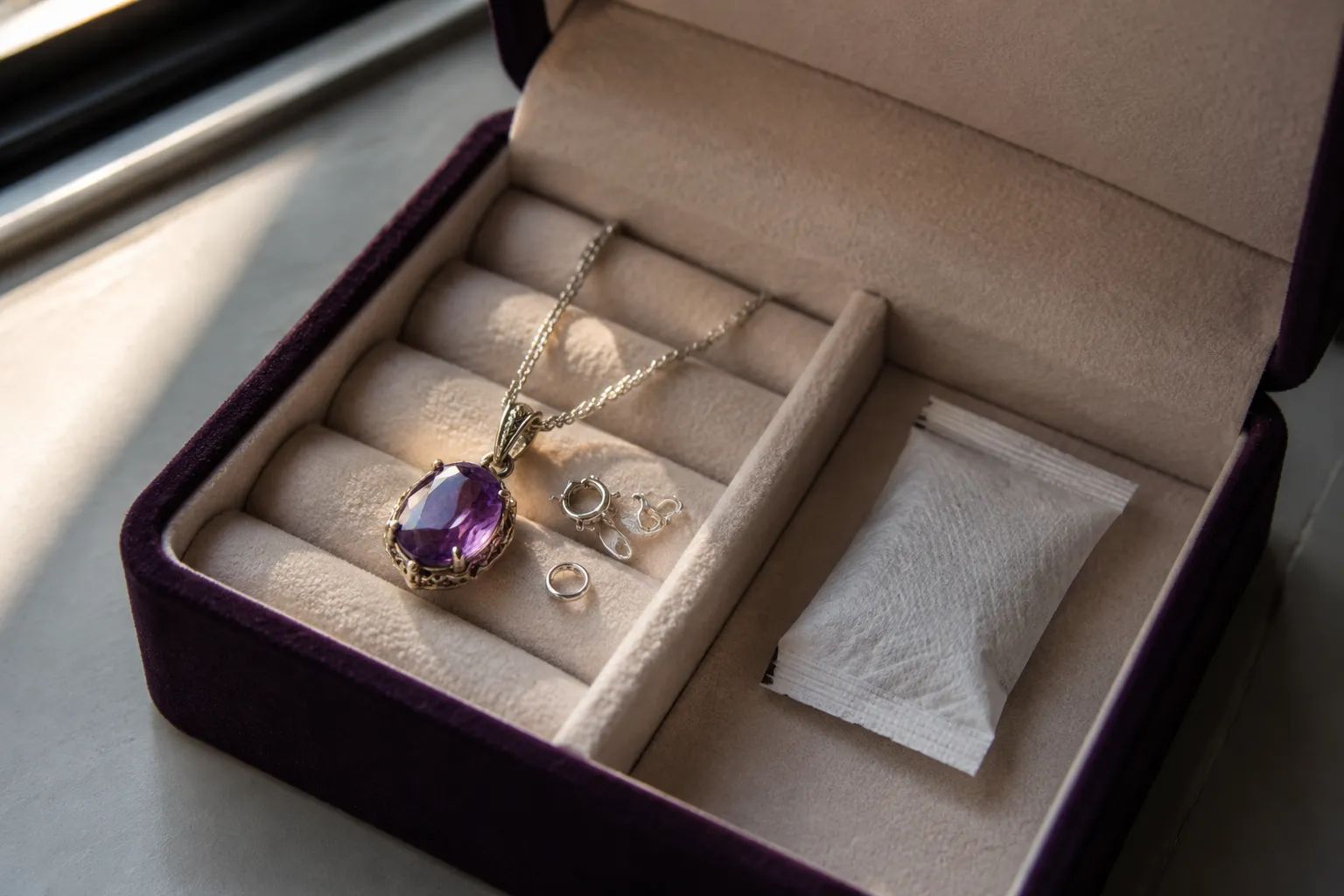
broader context
Begin with the main amethyst page
This narrower page lands better after the broader amethyst context page.
Why Silica Gel Is the Lower-Risk Default
Silica gel is commonly described as a desiccant that adsorbs moisture from the air. In plain household terms, that means it helps reduce dampness inside a small enclosed space while keeping the moisture within the packet material rather than turning into loose liquid. That distinction matters when the enclosure is a jewelry box instead of a warehouse container.
Jewelry boxes often hold mixed materials. One compartment might contain sterling silver, plated chains, brass findings, pearls or porous stones, glued settings, ribbon, leatherette lining, and paper tags. The desiccant is not only being asked to remove moisture; it is being asked to do it quietly, without creating a second problem. Silica gel fits that role better because it is familiar, compact, and less associated with leakage or residue in normal packet use.
This is also why “stronger moisture absorber” is not the same as “safer desiccant for jewelry.” A calcium chloride pouch may be marketed for high-humidity use, but a jewelry box is not usually a place where maximum absorption is the only goal.
The better question is simpler: if the packet shifts, tears, saturates, or rests against a delicate surface, which material creates the smaller problem?
On that narrow question, silica gel has the advantage.
Where Calcium Chloride Becomes Riskier
Calcium chloride is hygroscopic and deliquescent. The useful part is that it attracts moisture strongly, especially in damp conditions. The jewelry-box problem is the same mechanism in reverse: calcium chloride deliquescence can lead to liquid or brine formation as it takes up water.
That liquid-desiccant concern is not cosmetic nitpicking. Calcium chloride leakage can leave residue, and the available handling materials support caution around contact and material compatibility. In a closet tub or hanging moisture absorber, that liquid is often expected to collect in a lower chamber. In a jewelry box, there may be no safe place for it to go.
If a calcium chloride packet fails, overfills, leaks, or is pressed between objects, the result may be harder to tolerate than a spent silica gel packet. Residue could contact metal surfaces, stone settings, fabric, wood, adhesives, or protective coatings. The sources available for this page do not prove exact damage outcomes for every jewelry material, but they do justify a conservative choice: avoid putting a liquid-forming desiccant close to delicate jewelry unless the product is specifically designed to isolate the collected liquid and keep it physically separated from the contents.
This is the main reason the comparison changes when the use case changes. In cargo shipping, warehouse storage, or other large damp environments, calcium chloride may be attractive because it is aggressive. In a compact jewelry box, that same aggressiveness is less appealing because there is very little distance between the desiccant and the things you are trying to protect.
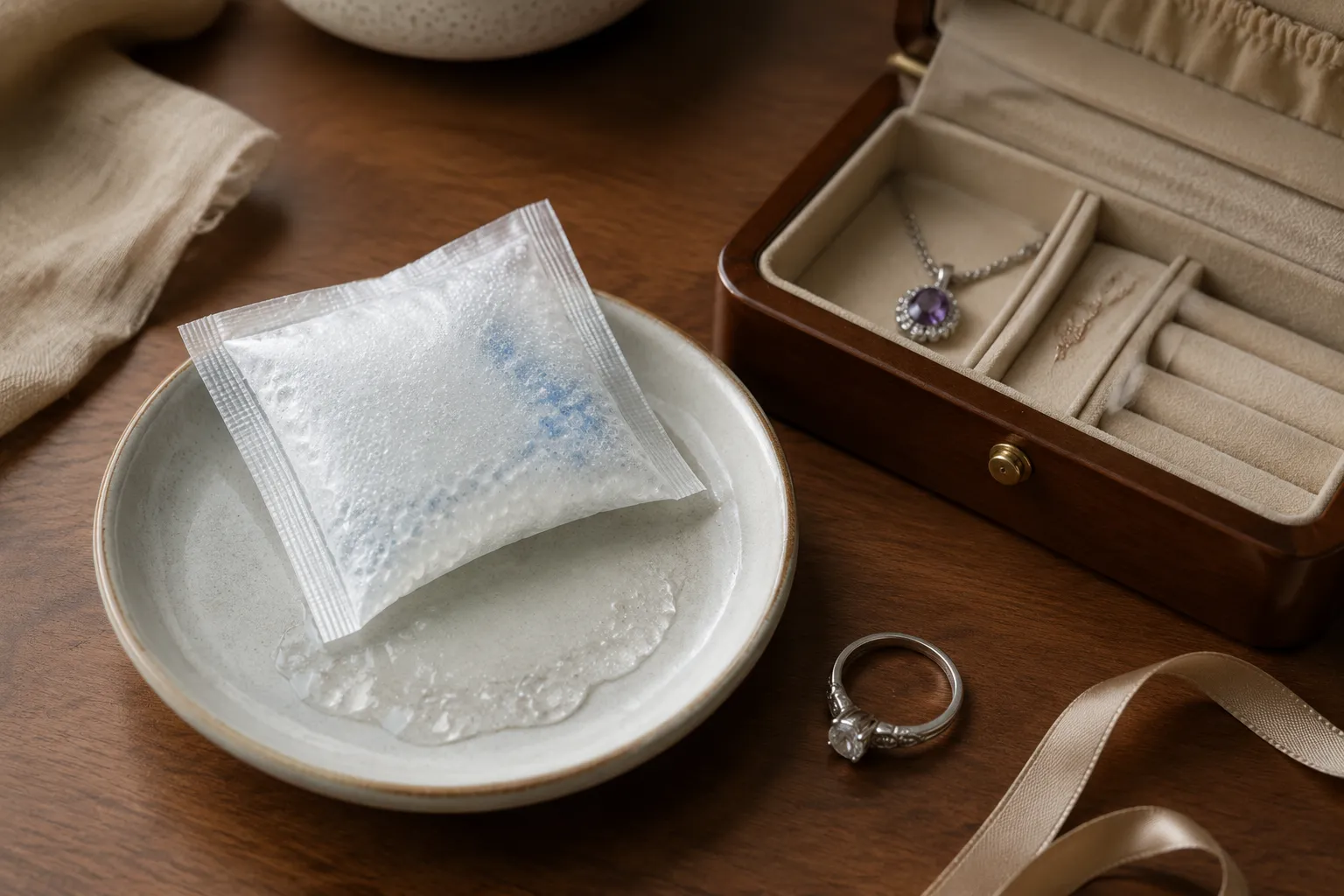
The Condition That Can Change the Answer
There are cases where silica gel may not be enough on its own. If the storage area is persistently damp, the room has poor ventilation, the jewelry box sits against an exterior wall, or the contents show repeated moisture problems, a small packet may become saturated quickly. In that situation, simply choosing a stronger chemical is not always the cleanest fix.
Improve the storage conditions first
- Move the jewelry box away from damp surfaces.
- Avoid bathrooms and laundry areas.
- Let pieces dry before closing the lid.
- Use a larger or refreshed silica gel packet if the packet type allows reuse.
- Follow the packet’s own drying instructions, because reusable silica gel instructions vary by packet design, indicator type, and packaging material.
- Do not heat packets casually if the label does not support it.
Calcium chloride is easier to consider outside the jewelry box than inside it. A room, closet, or storage cabinet may use a calcium chloride moisture collector if it is stable, upright, and isolated from direct contact with jewelry. That is a different use from placing the pouch among rings and chains. The point is not that calcium chloride has no role in moisture control; it is that it is a poor match for close-contact storage of sensitive objects.
If you are dealing with repeated condensation, damp drawer linings, or visibly wet storage furniture, the desiccant choice is only part of the problem. A jewelry box desiccant can buffer moisture; it cannot fix a chronically wet room.
What Capacity Claims Do and Do Not Tell You
Many comparison pages and product listings describe calcium chloride as absorbing far more moisture than silica gel. Some seller materials use multiples such as “7 times” or “10 times,” while other pages discuss silica gel capacity as a percentage of its own weight. Those claims may be meaningful inside a seller’s stated test conditions, but they should not be treated as universal jewelry-care proof.
Capacity depends on relative humidity, temperature, packet size, airflow, enclosure volume, and how the desiccant is packaged. A pouch designed for shipping cartons does not automatically become the best choice for a velvet-lined jewelry box. A large moisture absorber may outperform a small silica gel packet in a damp closet, yet still be the wrong object to put beside a strand of pearls, a plated chain, or an amethyst bracelet with metal findings.
What the numbers can suggest
Calcium chloride is commonly positioned for heavier moisture loads, especially where aggressive moisture collection is the goal.
What the numbers cannot prove
Capacity claims do not prove that a pouch is the right close-contact object for a velvet-lined box holding porous, plated, glued, or polished jewelry.
The clearest lesson from the available material is simpler than the numbers: calcium chloride is commonly positioned for heavier moisture loads, while silica gel is commonly positioned for controlled, reusable packet use. For a jewelry box, the second profile matters more.
Market language can also mislead here. Words such as “safe,” “non-toxic,” “non-corrosive,” and “leak-proof” appear often in commercial descriptions, but they are product claims, not a blanket care rule for every jewelry box. A pouch may be designed to resist leaking; that does not mean calcium chloride residue would be harmless if the containment failed or the packet was misused.
Practical Choice for a Jewelry Box
Choose silica gel packets when the jewelry box is otherwise dry, the goal is routine moisture control, and the packet can sit in a corner or compartment without being crushed. This is the sensible default for everyday storage of mixed jewelry, including amethyst pieces that are valued both as mineral objects and as personal keepsakes. The care decision should come from the physical materials first; any symbolic meaning comes after the object is protected.
Use a packet size appropriate to the box, and keep it from rubbing directly against delicate surfaces when possible. Replace or refresh it according to the packet’s instructions. If the jewelry box has a fabric lining, avoid tearing open packets or using loose beads unless they are safely contained. A desiccant scattered through a box is harder to inspect and easier to trap in clasps, hinges, or settings.
Be much more cautious with calcium chloride inside the box. If you use it at all, it should be in a sealed, purpose-made container that cannot tip, leak, or touch jewelry. Even then, it is usually better placed nearby rather than among the pieces. The more valuable, porous, plated, glued, or sentimental the jewelry is, the less attractive a liquid-forming desiccant becomes.
A small humidity indicator card can help if you are trying to understand whether the box is actually damp, but the available material does not establish one ideal humidity threshold for every jewelry collection. Silver tarnish, gemstone care, plated finishes, adhesives, and storage fabrics do not all respond to moisture in exactly the same way. That is another reason to avoid overconfident claims.
Common Confusion: More Absorbent vs. More Appropriate
Moisture capacity is not the whole answer.
Calcium chloride may be more aggressive in damp settings, but a jewelry box is a close-contact, sensitive enclosure. A desiccant that can become wet, sticky, or residue-forming carries a different kind of risk than a packet that gradually becomes spent.
Desiccant packets do not all work the same way.
Silica gel adsorbs moisture; calcium chloride absorbs moisture and can form liquid as part of that process. The difference sounds technical, but it is exactly the point when the packet is sitting near polished metal, crystal beads, or soft lining.
Industrial language can distort the jewelry-box decision.
Packaging and shipping examples are useful for understanding why calcium chloride is sold so widely, but they should not set the rule for jewelry-box moisture control. A desiccant chosen for a container crossing humid routes is solving a different problem from a packet tucked beside a pendant tray.
Evidence Limits
Public information on this exact jewelry-box comparison is limited. The available sources support the mechanism-level distinction: silica gel is widely described as a reusable adsorbent desiccant, while calcium chloride is widely described as hygroscopic or deliquescent and capable of forming liquid or brine. Handling materials also support caution around calcium chloride contact and compatibility.
What the source pool does not prove is equally important. It does not establish measured leakage rates inside jewelry boxes, exact packet lifespans, gemstone-by-gemstone outcomes, or guaranteed tarnish prevention. It also does not provide independent jewelry-box field tests comparing the two materials. For that reason, the recommendation stays narrow: for a small box containing delicate jewelry, silica gel is the lower-risk default because it avoids the central calcium chloride problem of liquid formation and residue contact.
For an amethyst piece in a home collection, that is the care boundary worth keeping. Treat the stone as a material object before treating it as a symbol; keep moisture control modest, contained, and separate from the surfaces you want to preserve.